
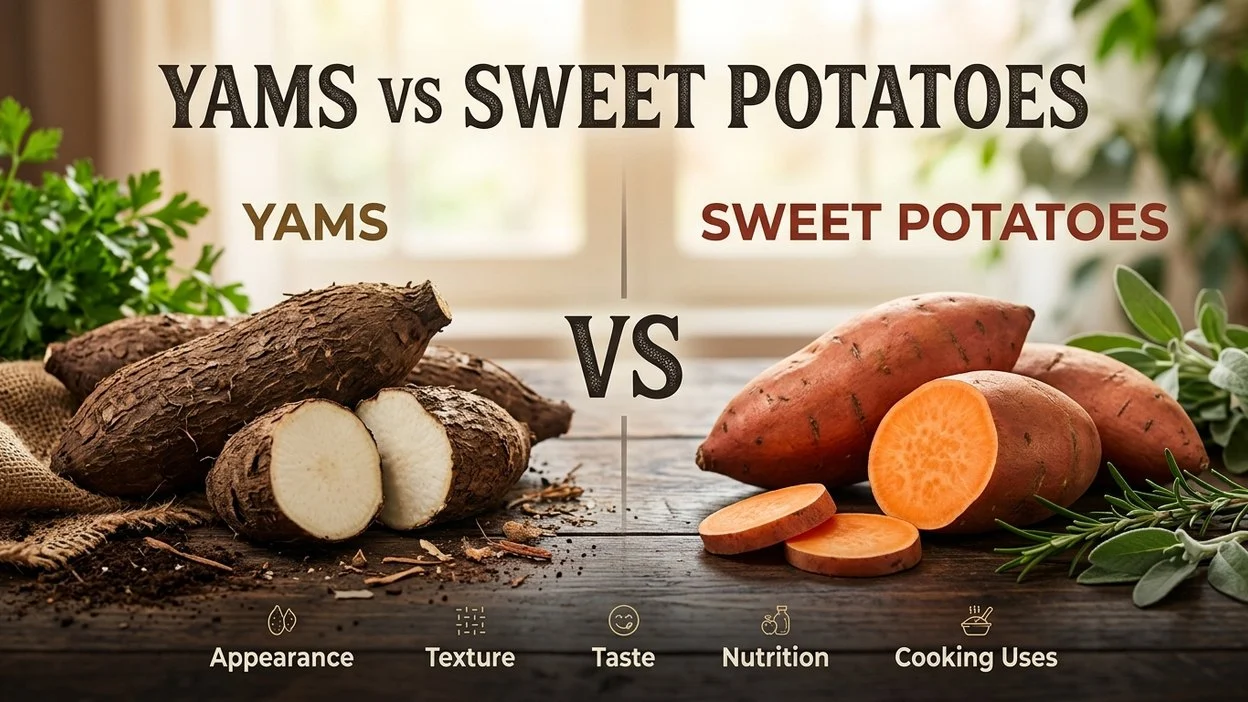
Yams and sweet potatoes are two different root vegetables that people often confuse because they can look similar in grocery stores and recipes. However, yams vs sweet potatoes differ in appearance, taste, texture, nutrition, and botanical classification. True yams belong to the Dioscorea genus, while sweet potatoes belong to the Ipomoea batatas species.
Sweet potatoes are usually sweet, moist, and soft when cooked, although some varieties have a drier texture. True yams are often starchier and less sweet, with flesh that can range from white and yellow to purple. Their skin and size also vary widely. In the United States, the word “yam” is frequently used for certain orange-fleshed sweet potatoes, which adds to the confusion.
Understanding these differences helps you choose the right ingredient for roasting, baking, boiling, mashing, or preparing traditional dishes. Although both vegetables provide carbohydrates, fiber, and useful nutrients, their exact nutritional content depends on the variety and how they are prepared.
Quick Answer: Yams vs Sweet Potatoes
Yams and sweet potatoes are different vegetables. True yams generally have rough, bark-like skin and starchy flesh, while sweet potatoes usually have smoother skin and may have orange, white, or purple flesh. Sweet potatoes are often sweeter and more moist. In American grocery stores, products labeled “yams” are frequently orange sweet potatoes.
Why Do People Confuse Yams and Sweet Potatoes?
People confuse yams and sweet potatoes mainly because of grocery store labeling, similar shapes, and their use in comparable recipes.
In the United States, orange-fleshed sweet potatoes have traditionally been marketed as “yams” to distinguish them from lighter-fleshed varieties. As a result, a canned or fresh product labeled “yam” in an American supermarket may actually be a sweet potato.
True yams are common in parts of Africa, the Caribbean, Asia, and other tropical regions. They are especially important in many traditional cuisines, where they may be boiled, pounded, roasted, fried, or made into flour.
The easiest way to understand the difference is to remember that a true yam is not the same plant as a sweet potato, even when the names are used interchangeably in stores.
First Word: Yams
A yam is a starchy underground tuber from the Dioscorea genus. Many yam varieties grow in tropical and subtropical regions and are important food crops in Africa, Asia, the Caribbean, and other parts of the world.
True yams often have thick, rough, brown skin that resembles tree bark. Their flesh can be white, cream-colored, yellow, or purple, depending on the variety.
What Do Yams Taste Like?
True yams usually have a mild, earthy flavor and a starchy texture. They are generally less sweet than orange-fleshed sweet potatoes.
When cooked, some varieties become soft and fluffy, while others remain firm enough to hold their shape. The texture depends on the species and cooking method.
How Are Yams Used?
Yams are commonly prepared by:
- Boiling and serving as a side dish
- Pounding into a smooth, stretchy food in some West African cuisines
- Roasting or baking
- Frying into yam chips or slices
- Mashing with seasonings
- Drying and processing into flour
Important: Some wild yam species contain naturally occurring compounds that can be harmful if eaten improperly. Use edible varieties prepared appropriately rather than assuming every plant called a yam is safe to eat.
Second Word: Sweet Potatoes
A sweet potato is a starchy root vegetable from the Ipomoea batatas species. It belongs to the morning glory plant family, making it botanically different from true yams.
Sweet potatoes are widely grown and eaten around the world. Their skin can be tan, red, orange, purple, or other colors, while their flesh may be white, yellow, orange, or purple.
What Do Sweet Potatoes Taste Like?
Sweet potatoes often have a naturally sweet flavor, especially orange-fleshed varieties. Their texture can be moist and creamy or relatively dry and firm, depending on the variety.
Orange sweet potatoes are especially popular for baked dishes, mashed vegetables, casseroles, soups, and fries.
How Are Sweet Potatoes Used?
Sweet potatoes are commonly prepared by:
- Baking whole in the oven
- Roasting into cubes or wedges
- Mashing with butter or spices
- Making sweet potato fries
- Adding to soups, stews, and curries
- Using in pies, cakes, and casseroles
- Boiling or steaming as a side dish
Their natural sweetness makes them suitable for both savory meals and desserts.
Yams vs Sweet Potatoes: Comparison Table
| Feature | True Yams | Sweet Potatoes |
| Botanical group | Dioscorea genus | Ipomoea batatas species |
| Typical skin | Rough, thick, bark-like | Often smoother and thinner |
| Flesh color | White, cream, yellow, purple, or other colors | White, yellow, orange, purple, and others |
| Taste | Generally mild and starchy | Often sweet, depending on variety |
| Texture | Usually starchy; varies by variety | Can be moist, creamy, dry, or firm |
| Shape | Often long or cylindrical; may be irregular | Often tapered, elongated, or rounded |
| Growing regions | Especially tropical regions | Widely grown in tropical and temperate regions |
| Common uses | Boiling, pounding, roasting, frying, flour | Baking, roasting, mashing, fries, soups, desserts |
| Nutrition | Mainly carbohydrates, with fiber and other nutrients | Mainly carbohydrates, with fiber and other nutrients |
| Notable nutrients | Potassium and vitamin C in varying amounts | Orange varieties are especially rich in beta-carotene |
| Grocery store labeling | May refer to true yams or mislabeled sweet potatoes in some markets | Usually identified as sweet potatoes, but labels vary |
When Should You Use Yams or Sweet Potatoes?
Both vegetables can be delicious, but the best choice depends on the dish you want to prepare.
Choose Yams When:
- You are preparing a traditional dish that specifically calls for true yams.
- You want a starchy vegetable with a mild flavor.
- You are making pounded yam or another traditional yam-based dish.
- You need a variety that holds its shape or has a particular texture after cooking.
- You are following a recipe from a region where true yams are commonly eaten.
Choose Sweet Potatoes When:
- You want a naturally sweet vegetable for roasting or baking.
- You are making sweet potato fries or mashed sweet potatoes.
- You want orange flesh rich in beta-carotene.
- You are preparing sweet potato pie or a casserole.
- You need a versatile root vegetable for soups, curries, or everyday meals.
Can You Substitute Yams for Sweet Potatoes?
Sometimes, but the result may differ. True yams are generally starchier and less sweet, so replacing sweet potatoes with yams can change a dish’s flavor and texture.
If an American recipe calls for “yams,” check whether it actually means orange sweet potatoes. That distinction matters more than the label alone.
12 Examples of Yams vs Sweet Potatoes in Everyday Cooking
1. Baked Vegetables
Sweet potatoes work well when baked whole because their flesh can become soft and sweet. True yams can also be baked, but the final texture may be starchier.
2. French-Fry-Style Slices
Sweet potatoes are popular for oven-baked or fried wedges and fries. Yam slices can also be fried, especially in cuisines where true yams are a common staple.
3. Mashed Side Dishes
Mashed sweet potatoes are often creamy and naturally sweet. Boiled true yams can be mashed or pounded, depending on the variety and the dish.
4. Traditional West African Meals
True yams are used in dishes such as pounded yam, often served with soups and stews. Sweet potatoes do not have exactly the same texture or traditional role.
5. American Holiday Casseroles
Many American recipes labeled “candied yams” actually use orange sweet potatoes. These dishes often include butter, sugar, spices, or marshmallows.
6. Soups
Both vegetables can add body to soups. Sweet potatoes contribute more sweetness in many recipes, while true yams provide a starchy base.
7. Vegetable Curries
Sweet potatoes work well in curries because they absorb seasonings and can soften during cooking. True yams can also be used when the recipe suits their texture.
8. Roasted Cubes
Sweet potatoes are a popular choice for roasting with olive oil, salt, pepper, and herbs. True yams can also be roasted into cubes or chunks.
9. Desserts
Sweet potatoes are commonly used in pies, puddings, and cakes because of their sweet flavor. True yams are less commonly used in typical Western desserts.
10. Boiled Root Vegetables
Both can be boiled and served with a meal. Cooking time depends on the size of the pieces and the variety.
11. Flour and Processed Foods
True yams can be dried and processed into flour in some food traditions. Sweet potatoes can also be processed into flour and other products.
12. Purple-Fleshed Dishes
Some true yam varieties have purple flesh, and some sweet potatoes are purple too. Purple color alone does not reliably identify which vegetable you have.
Common Mistakes About Yams and Sweet Potatoes
Mistake 1: Thinking They Are the Same Vegetable
They are botanically different plants. Similar cooking methods do not make them the same vegetable.
Mistake 2: Assuming Every Yam Has Orange Flesh
True yams can have white, cream, yellow, purple, or other flesh colors. Orange flesh is not a reliable way to identify a true yam.
Mistake 3: Believing Sweet Potatoes Are Always Orange
Sweet potatoes can have white, yellow, orange, purple, and other flesh colors, depending on the variety.
Mistake 4: Trusting the Grocery Store Label Without Checking
In some American stores, “yam” is used for orange sweet potatoes. If the distinction matters for a recipe, check the product description or ask the seller.
Mistake 5: Assuming One Is Always Healthier
Both vegetables can fit into a balanced diet. Their nutritional value depends on the variety, serving size, preparation method, and the rest of the meal.
Memory Trick: How to Remember the Difference
Use this simple memory trick:
Yam = traditionally starchy tuber.
Sweet potato = often sweet, with many flesh colors.
For a quick visual clue, true yams often have rough, bark-like skin, while many sweet potatoes have smoother skin. However, appearance can vary, so botanical identity and reliable labeling are more useful than color alone.
Remember that American grocery stores sometimes call sweet potatoes “yams.” A label is not always a reliable botanical identification.
American vs British English
The words “yam” and “sweet potato” can be used differently across countries and food markets.
American English
In the United States, “sweet potato” is the standard name for the vegetable. The word “yam” is also used commercially for certain orange-fleshed sweet potatoes, especially in supermarkets and holiday recipes.
British English
In British English, “sweet potato” is the usual name for Ipomoea batatas. “Yam” generally refers to a true yam or to a food identified as a yam in a particular cultural or regional context.
Usage can vary in both countries, especially in international grocery stores and recipes from African, Caribbean, and Asian cuisines.
Practical tip: When following a recipe, look at the ingredient description rather than assuming that “yam” always means the same vegetable.
Similar Words
Here are some related food terms that can help you understand the difference.
- Potato: A tuber from Solanum tuberosum, which belongs to a different plant family from both yams and sweet potatoes.
- Cassava: A starchy root used in many tropical cuisines. It is different from both yams and sweet potatoes.
- Taro: A tropical root crop with starchy corms, commonly used in savory dishes and some desserts.
- Purple sweet potato: A sweet potato variety with purple flesh; it is not automatically a true yam.
- Japanese sweet potato: A name commonly used for particular sweet potato varieties, often with reddish-purple skin and pale flesh.
- Ube: A purple yam from the Dioscorea genus, widely used in Filipino desserts.
- Yam bean (jicama): A crunchy edible root from a different plant group, despite having “yam” in its common name.
Final Verdict: Yams vs Sweet Potatoes
Yams and sweet potatoes are different root vegetables with different botanical origins, textures, and typical flavors. True yams are generally starchy and often have rough, bark-like skin, while sweet potatoes are frequently sweeter and may have moist or dry flesh in several colors.
For everyday baking, roasting, fries, and many American holiday recipes, sweet potatoes are often the intended ingredient. For traditional dishes that specifically require true yams, choose the appropriate yam variety. Always consider regional naming differences when shopping or following a recipe.
FAQs:
1. Are yams and sweet potatoes the same thing?
No. True yams belong to the Dioscorea genus, while sweet potatoes belong to Ipomoea batatas. They are different plants, although some stores use the word “yam” for orange sweet potatoes.
2. Which is sweeter, yams or sweet potatoes?
Sweet potatoes are generally sweeter, especially orange-fleshed varieties. True yams usually have a milder, starchier flavor, although taste varies by variety and preparation.
3. Which is healthier, yams or sweet potatoes?
Both can be nutritious choices. Orange sweet potatoes are particularly rich in beta-carotene, which the body can convert into vitamin A. True yams also provide carbohydrates, fiber, and other nutrients. The healthier choice depends on the variety, serving size, and preparation method.
4. Can I use yams instead of sweet potatoes in a recipe?
Sometimes. Both can be boiled, roasted, or mashed, but true yams are often starchier and less sweet. For the closest result, use the vegetable intended by the original recipe.
5. Why are sweet potatoes called yams in America?
The term “yam” became a commercial label for some orange-fleshed sweet potatoes to distinguish them from lighter-fleshed varieties. In many American grocery stores, these products are still sold under the name “yams.”
6. Do yams and sweet potatoes have different nutritional values?
Yes. Their nutrient profiles differ by species and variety. Orange sweet potatoes are notable for beta-carotene, while true yams provide starch and varying amounts of fiber, potassium, vitamin C, and other nutrients.
7. Is ube a yam or a sweet potato?
Ube is a purple yam, usually identified as Dioscorea alata. It is different from a purple sweet potato, even though both can have purple flesh.
8. How can I identify a true yam at the grocery store?
True yams often have thick, rough, bark-like skin and starchy flesh. However, appearance varies, and grocery store labels can be confusing. Look for a reliable botanical or product description, or ask the seller if you need a true yam for a particular recipe.
Remember This
- True yam: A starchy tuber from the Dioscorea genus.
- Sweet potato: A root vegetable from Ipomoea batatas, often sweet and available in several flesh colors.
- American grocery store “yam”: Often an orange-fleshed sweet potato rather than a true yam.
- Best cooking choice: Use sweet potatoes for recipes that rely on their sweetness and true yams for dishes that specifically require them.
Conclusion:
The main difference between yams and sweet potatoes is their botanical identity. True yams are generally starchy tubers with rough skin, while sweet potatoes often have a sweeter flavor and a wide range of flesh colors. Although they can sometimes be used in similar recipes, their textures and flavors are not always interchangeable.
When buying either vegetable, pay attention to the variety and how it will be used. If a recipe calls for true yams, make sure the ingredient is not simply an American supermarket sweet potato labeled as a yam. Choosing the correct vegetable will help you achieve the flavor and texture you expect.

Delaney Brooks is a contemporary author celebrated for heartfelt fiction, vivid storytelling, and relatable characters. Her engaging novels inspire readers through emotional depth, creativity, resilience, and memorable literary journeys.