
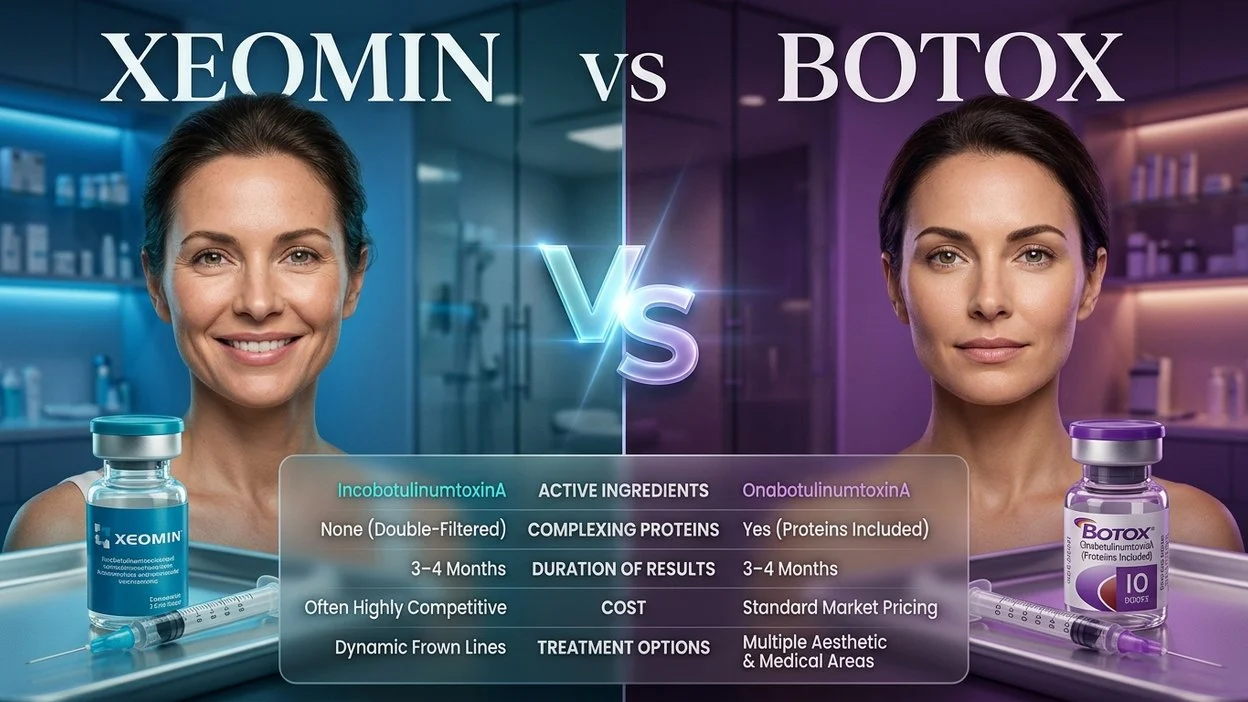
Xeomin vs Botox is a common comparison for people who want to reduce facial wrinkles without surgery. Both are injectable treatments made with botulinum toxin type A, a substance that temporarily relaxes specific muscles. They are commonly used to soften dynamic wrinkles, which are lines that appear when you smile, frown, or raise your eyebrows. Although both treatments work in a similar way, they differ in formulation, approved uses, dosing, and individual treatment results.
Xeomin is the brand name for incobotulinumtoxinA, while Botox Cosmetic is the brand name for onabotulinumtoxinA. One important difference is that Xeomin is manufactured without the accessory proteins found in some other botulinum toxin formulations. Botox Cosmetic has a different formulation and a longer-established history of cosmetic use. Neither product is automatically better for everyone. The right choice depends on the area being treated, your medical history, your previous response to injections, your goals, and the advice of a qualified healthcare professional.
Quick Answer
Xeomin vs Botox: Both are botulinum toxin type A injections that temporarily reduce muscle activity and soften certain facial wrinkles. Xeomin does not contain accessory proteins, while Botox has a different formulation. Both can be effective, and neither is universally better. A qualified injector can help determine which product best suits your needs.
Why Do People Confuse Xeomin and Botox?
People often confuse Xeomin and Botox because both are injectable neuromodulators used to treat facial wrinkles. They work by temporarily blocking signals from nerves to targeted muscles, reducing muscle contractions that create expression lines.
Both treatments may be used to improve the appearance of frown lines between the eyebrows, although approved cosmetic uses vary by product and country.
Their similarities include:
- Both contain botulinum toxin type A.
- Both are administered by injection.
- Both temporarily reduce activity in targeted muscles.
- Both can soften certain expression lines.
- Both require a trained healthcare professional for appropriate administration.
- Both have potential side effects and risks.
However, the products are not identical. Their formulations differ, their units are not interchangeable, and their approved uses may vary.
First Word: Xeomin
Xeomin is the brand name for incobotulinumtoxinA, an injectable botulinum toxin type A treatment manufactured by Merz.
One of its main distinguishing features is that it is made without the accessory proteins associated with the botulinum toxin complex. It still contains the active neurotoxin responsible for temporarily reducing muscle activity.
What Is Xeomin Used For?
Xeomin has approved medical uses that vary by country and formulation. In the United States, Xeomin is approved for certain conditions, including glabellar lines, which are the vertical frown lines between the eyebrows, in adults.
It also has medical uses involving certain muscle movement disorders and other conditions, depending on the specific indication.
Potential Benefits of Xeomin
- Temporarily softens certain expression lines.
- Has a formulation without accessory proteins.
- May be an alternative for people who prefer a different botulinum toxin product.
- Can provide results comparable to other established neuromodulators for appropriate indications.
Xeomin is not guaranteed to work better for people who have used another botulinum toxin product. Individual results vary.
What Is Botox Used For?
In the United States, Botox Cosmetic is approved for several cosmetic indications, including:
- Moderate to severe frown lines between the eyebrows.
- Certain forehead lines.
- Crow’s feet around the outer corners of the eyes.
- Certain other approved facial lines, depending on the product label and jurisdiction.
The broader Botox product also has approved medical uses for certain conditions, such as chronic migraine, specific muscle spasticity, and overactive bladder. These medical uses are distinct from the cosmetic indications for Botox Cosmetic.
Potential Benefits of Botox
- Has a long history of cosmetic and medical use.
- Can temporarily soften specific expression lines.
- Has established dosing guidance for its approved indications.
- May be appropriate for people who have previously had satisfactory results with the product.
Botox is not necessarily more effective than Xeomin for every person or treatment area.
Xeomin vs Botox: Comparison Table
| Feature | Xeomin | Botox Cosmetic |
| Generic name | IncobotulinumtoxinA | OnabotulinumtoxinA |
| Active ingredient type | Botulinum toxin type A | Botulinum toxin type A |
| Accessory proteins | Manufactured without accessory proteins | Different formulation that includes associated proteins |
| Main cosmetic purpose | Temporarily softens approved expression lines | Temporarily softens approved expression lines |
| Common treatment area | Frown lines between the eyebrows | Frown lines, forehead lines, and crow’s feet, according to approved indications |
| Onset of results | Often noticeable within several days | Often noticeable within several days |
| Typical duration | Commonly around 3–4 months, depending on indication and individual response | Commonly around 3–4 months, depending on indication and individual response |
| Dosing units | Product-specific | Product-specific |
| Side effects | May include injection-site reactions, headache, or eyelid drooping | May include injection-site reactions, headache, or eyelid drooping |
| Best choice | Depends on treatment goals and individual factors | Depends on treatment goals and individual factors |
Important: Xeomin and Botox units are not interchangeable. Their doses must be selected according to the specific product, treatment area, and clinical judgment.
When Should You Choose Xeomin or Botox?
The best choice depends on your goals, medical history, and response to previous treatments.
When Might Xeomin Be Appropriate?
Xeomin may be worth discussing with your healthcare professional if:
- You want to treat approved expression lines.
- You prefer a formulation without accessory proteins.
- You have previously used another neuromodulator and want to discuss alternatives.
- Your clinician believes Xeomin is suitable for your treatment area and medical history.
The absence of accessory proteins does not guarantee fewer side effects, longer-lasting results, or better effectiveness.
When Might Botox Be Appropriate?
Botox Cosmetic may be worth discussing if:
- You want to treat approved forehead lines, frown lines, or crow’s feet.
- You have previously been satisfied with your Botox results.
- Your clinician recommends it for your specific goals.
- You want a product with extensive clinical experience and established treatment protocols.
The appropriate product depends on the indication and your individual circumstances rather than brand popularity alone.
12 Examples of Xeomin vs Botox in Everyday Decisions
1. Treating Frown Lines
Both products can be used for approved frown-line indications. Your clinician can recommend an appropriate option based on your facial anatomy and treatment goals.
2. Treating Forehead Lines
Botox Cosmetic is approved for certain forehead lines in the United States. Xeomin’s approved cosmetic indications differ, so check the local product label before considering it for this area.
3. Reducing Crow’s Feet
Botox Cosmetic is approved for certain crow’s-feet indications in the United States. Ask your clinician which products are approved and appropriate for the area where you live.
4. Seeking Natural-Looking Results
Both products may produce natural-looking results when the treatment is carefully planned and appropriately administered. The injector’s skill, dose, and placement are important factors.
5. Comparing How Quickly They Work
Both treatments often begin showing effects within several days. The exact onset varies, and neither product guarantees immediate results.
6. Comparing How Long Results Last
Both commonly provide results lasting around three to four months for many cosmetic treatments. Some people notice shorter or longer effects.
7. Switching Products
A person who previously used Botox may discuss switching to Xeomin with a qualified clinician. The clinician should select a product-specific dose rather than assuming the units are equivalent.
8. Worrying About Accessory Proteins
Someone interested in a formulation without accessory proteins may prefer to discuss Xeomin. However, there is no guarantee that this feature will improve results or prevent treatment resistance.
9. Considering Treatment Cost
Prices vary by clinic, location, treatment area, and dosing. Compare the total treatment cost and the clinician’s qualifications rather than choosing solely by the price per unit.
10. Experiencing Side Effects
Both products can cause temporary bruising, swelling, tenderness, headache, or unwanted muscle weakness. Contact your healthcare professional if symptoms are concerning.
11. Having a Medical Condition
People with certain neuromuscular disorders, breathing or swallowing difficulties, or particular medication exposures may face additional risks. A qualified clinician should review your medical history before treatment.
12. Planning an Upcoming Event
If you want treatment before a wedding, photograph session, or special occasion, allow enough time for the effects to develop and for any bruising or swelling to settle. Your clinician can suggest suitable timing.
Common Mistakes About Xeomin vs Botox
Mistake 1: Assuming Xeomin Is Stronger
There is no universal rule that Xeomin is stronger than Botox. Their units are product-specific, and results depend on dose, treatment area, and individual response.
Mistake 2: Believing Botox Always Lasts Longer
Neither product consistently lasts longer for every patient. Treatment area, dose, muscle activity, and personal response can affect duration.
Mistake 3: Assuming Xeomin Has No Proteins at All
Xeomin is manufactured without accessory proteins, but it still contains the active botulinum toxin type A neurotoxin. Saying it contains no proteins of any kind would be inaccurate.
Mistake 4: Thinking the Products Are Interchangeable
Xeomin and Botox have different formulations and product-specific dosing. Their units should not be directly substituted.
Mistake 5: Believing One Product Is Completely Risk-Free
Both treatments have potential adverse effects. Rarely, botulinum toxin effects can spread beyond the injection site and cause serious symptoms, including difficulty swallowing, speaking, or breathing. Seek urgent medical attention if these symptoms occur.
Mistake 6: Choosing Based Only on Price
The cheapest option is not always the safest or most suitable. The injector’s qualifications, the authenticity of the product, and appropriate treatment planning matter.
Memory Trick
Use this simple memory trick to remember the difference:
Xeomin = incobotulinumtoxinA, without accessory proteins.
Botox = onabotulinumtoxinA, a different formulation with a long-established history of use.
Both are botulinum toxin type A treatments that temporarily relax targeted muscles. Remember that their dosing units are not interchangeable.
American vs British English
Xeomin and Botox are brand names, not differences between American and British English.
In the United States, the names Xeomin and Botox Cosmetic refer to specific products with defined approved indications. In the United Kingdom, product availability, licensing, and approved uses may differ.
The word Botox is also sometimes used informally to describe botulinum toxin injections in general. However, Botox is a specific brand, and not every botulinum toxin treatment is Botox.
When discussing treatment in any country, use the exact product name and check the relevant local prescribing information.
Similar Words
These related terms can help you understand the difference between Xeomin and Botox.
- Dysport: A different brand of botulinum toxin type A.
- Jeuveau: A botulinum toxin type A product used for certain cosmetic indications.
- Daxxify: A botulinum toxin type A product with a formulation designed for longer-lasting effects for certain approved indications.
- Neuromodulator: A substance that changes signaling between nerves and muscles.
- Dynamic wrinkles: Lines caused or deepened by repeated facial muscle movements.
- Glabellar lines: Vertical lines between the eyebrows, often called frown lines.
- Crow’s feet: Fine lines around the outer corners of the eyes.
- IncobotulinumtoxinA: The generic name for Xeomin.
- OnabotulinumtoxinA: The generic name for Botox.
These products differ in formulation, approved uses, dosing, and duration. They should not be treated as directly interchangeable.
Final Verdict
Xeomin vs Botox does not have one universal winner. Both are established botulinum toxin type A treatments that can temporarily reduce certain expression lines when used appropriately.
Xeomin stands out because it is manufactured without accessory proteins. Botox Cosmetic has a different formulation and several established cosmetic indications. Neither feature alone proves that one product is safer, stronger, or longer-lasting for every person.
Your best option depends on the area being treated, your medical history, your previous experience, your budget, and your clinician’s recommendation. Choose a qualified healthcare professional who can explain the expected benefits, possible risks, and product-specific dosing.
FAQs:
1. Is Xeomin better than Botox?
Neither product is universally better. Both can effectively reduce certain expression lines, and the best option depends on your treatment area, medical history, goals, and individual response.
2. Does Xeomin last longer than Botox?
Not consistently. Both commonly last around three to four months for many cosmetic treatments, although results vary from person to person and by treatment area.
3. Which works faster, Xeomin or Botox?
Both often begin showing effects within several days. The exact onset depends on the individual and treatment area, so neither can be guaranteed to work faster for everyone.
4. What is the main difference between Xeomin and Botox?
The main differences are their formulations and generic ingredients. Xeomin is incobotulinumtoxinA and is manufactured without accessory proteins, while Botox is onabotulinumtoxinA and has a different formulation. Their approved indications and dosing also differ.
5. Is Xeomin safer than Botox?
There is no general evidence-based rule that Xeomin is safer for everyone. Both have potential side effects and serious risks. Your health history and the qualifications of your injector are important considerations.
6. Can you switch from Botox to Xeomin?
Yes, a clinician may recommend switching between products when appropriate. However, their dosing units are not interchangeable, so the new treatment must be planned using product-specific guidance.
7. Why is Xeomin sometimes called a naked injectable?
The term refers to its formulation without accessory proteins associated with the toxin complex. It does not mean Xeomin lacks the active neurotoxin or contains no proteins whatsoever.
8. How much do Xeomin and Botox cost?
The price varies by location, clinic, treatment area, dose, and provider. Ask for the total expected cost and confirm which product is being used before treatment.
Remember This
- Xeomin: IncobotulinumtoxinA; manufactured without accessory proteins.
- Botox: OnabotulinumtoxinA; a different botulinum toxin type A formulation.
- Both: Temporarily relax targeted muscles to reduce certain expression lines.
- Duration: Commonly around three to four months for many cosmetic treatments, with individual variation.
- Safety: Both require appropriate medical assessment and administration by a qualified professional.
- Dosing: Their units are not interchangeable.
Conclusion:
Xeomin and Botox are similar treatments with important differences in formulation, approved uses, and dosing. Xeomin is made without accessory proteins, while Botox Cosmetic is a well-established option for several approved facial wrinkle treatments. Both can provide temporary improvements when used appropriately.
If you are deciding between Xeomin and Botox, discuss your goals, medical history, previous treatments, and expected costs with a qualified healthcare professional. Rather than choosing a product based on brand name alone, focus on the treatment that is appropriate for your needs and the clinician’s ability to administer it safely.

Autumn Gray is a bestselling storyteller admired for emotional novels, expressive writing, and memorable characters. Her inspiring books celebrate love, resilience, hope, and the transformative power of imagination and literature.