
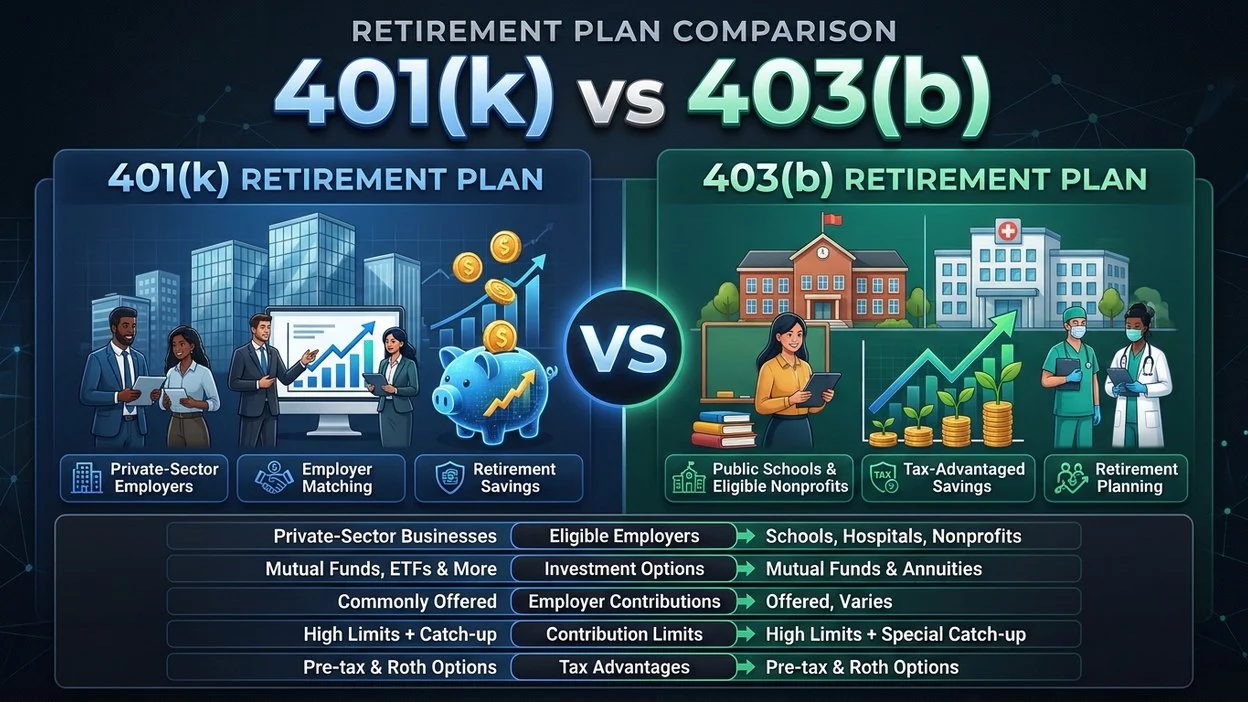
Choosing the right retirement savings plan can help you prepare for your financial future. Two common options in the United States are the 401(k) and 403(b) plans. Both allow eligible employees to save money for retirement, often through automatic deductions from their paychecks. However, the main difference is the type of employer that typically offers each plan.
A 401(k) is commonly offered by private-sector employers, such as businesses and corporations. A 403(b) is generally available to employees of public schools, certain tax-exempt organizations, and qualifying religious organizations. Both plans may offer tax advantages, employer contributions, and investment options. However, their investment arrangements, fees, employer matching policies, and some withdrawal rules can differ. Understanding these differences can help you decide which plan better fits your employment situation and long-term goals. Neither plan is automatically better for everyone because your options depend on your employer, plan documents, and personal financial circumstances.
Quick Answer
A 401(k) is a workplace retirement savings plan commonly offered by private companies, while a 403(b) is generally offered by public schools and eligible nonprofit organizations. Both provide tax advantages and retirement investment opportunities. The best option depends on your employer, available investments, fees, matching contributions, and retirement needs.
Why Do People Confuse 401(k) and 403(b)?
People often confuse these plans because they serve a similar purpose: helping employees save for retirement.
Both plans allow eligible workers to contribute part of their salary toward retirement investments. Depending on the plan, contributions may be made before taxes or through a Roth option using after-tax money. Both can also offer employer contributions.
The biggest difference is who can offer the plan. A private company typically offers a 401(k), while eligible public educational institutions and tax-exempt organizations commonly offer a 403(b).
Although the plans have many similarities, their investment choices, fees, administrative requirements, and certain distribution rules may differ.
First Word: 401(k)
A 401(k) is an employer-sponsored retirement savings plan named after Section 401(k) of the United States Internal Revenue Code.
Private-sector businesses commonly offer this plan to eligible employees. Workers choose how much of their salary to contribute, subject to annual IRS limits and their plan’s rules.
How Does a 401(k) Work?
A 401(k) allows employees to save for retirement through payroll deductions. The money is invested in options available under the employer’s plan.
Traditional 401(k) contributions are generally made before federal income taxes are calculated. The contributions and investment earnings are generally taxed when withdrawn in retirement.
A Roth 401(k), when available, uses after-tax contributions. Qualified withdrawals are generally tax-free.
Some employers also match a portion of employee contributions. For example, an employer might contribute 50 cents for every dollar an employee contributes, up to a specified limit.
Who Usually Offers a 401(k)?
Common examples include:
- Private businesses
- Corporations
- Technology companies
- Manufacturing companies
- Retail businesses
- Professional service firms
- Other eligible private-sector employers
Public-sector and nonprofit employers may also offer 401(k) plans when legally permitted, so employer type alone is not an absolute rule.
Second Word: 403(b)
A 403(b) is an employer-sponsored retirement savings plan named after Section 403(b) of the Internal Revenue Code.
It is designed primarily for eligible employees of public schools, certain tax-exempt organizations, and qualifying religious organizations.
How Does a 403(b) Work?
Like a 401(k), a 403(b) allows eligible employees to contribute part of their salary toward retirement savings.
Depending on the plan, contributions may be made through a traditional pretax arrangement or a Roth option. Investments grow according to the performance of the options selected, minus applicable fees.
Some 403(b) plans use mutual funds, while others may offer annuity contracts. Available investment options depend on the plan and its providers.
Certain eligible 403(b) participants may qualify for a special additional catch-up contribution based on years of service with the same eligible employer. This rule has specific requirements and is not available to everyone.
Who Usually Offers a 403(b)?
Common examples include:
- Public school districts
- Eligible colleges and universities
- Certain nonprofit hospitals
- Charitable organizations that qualify as tax-exempt employers
- Certain religious organizations
- Other eligible educational or nonprofit employers
Not every nonprofit organization qualifies to offer a 403(b), and not every employee of a qualifying organization is necessarily eligible to participate.
401(k) vs 403(b): Comparison Table
| Feature | 401(k) | 403(b) |
| Full name | 401(k) retirement plan | 403(b) retirement plan |
| Typical employers | Private-sector businesses | Public schools and eligible nonprofits |
| Main purpose | Retirement savings | Retirement savings |
| Traditional contributions | Generally pretax | Generally pretax |
| Roth option | Available in many plans | Available in many plans |
| Employer matching | May be available | May be available |
| Investment options | Depends on the plan | Depends on the plan |
| Investment types | Often mutual funds, stocks, bonds, and other plan-approved investments | Mutual funds and/or annuity contracts, depending on the plan |
| Annual contribution limits | Generally shared with 403(b) employee-deferral limits | Generally shared with 401(k) employee-deferral limits |
| Special catch-up rules | Age-based catch-up rules may apply | Age-based rules and a possible special 15-year service catch-up may apply |
| Fees | Vary by plan and investment | Vary by plan and investment |
| Withdrawals | Subject to tax rules and plan restrictions | Subject to tax rules and plan restrictions |
| Best starting point | Review the employer’s 401(k) options | Review the employer’s 403(b) options |
When Should You Use a 401(k)?
A 401(k) is generally the relevant option when your employer offers this plan and you want to save for retirement through payroll deductions.
It may be suitable if you:
- Work for a private-sector business.
- Want to save automatically from each paycheck.
- Have access to employer matching contributions.
- Want traditional pretax or Roth contributions, depending on availability.
- Want to invest through your employer’s retirement plan.
- Expect to change jobs and want to understand your rollover options.
Example: Maria works for a private technology company. Her employer offers a 401(k) and matches part of her contributions. Maria reviews the investment choices and fees before deciding how much to contribute.
Her employer’s matching contribution may provide an additional benefit, subject to the plan’s rules and vesting schedule.
When Should You Use a 403(b)?
A 403(b) is generally the relevant option when you work for an eligible school, tax-exempt organization, or qualifying religious organization that offers this plan.
It may be suitable if you:
- Work for a public school or eligible educational institution.
- Work for a qualifying nonprofit employer.
- Want to save through automatic payroll deductions.
- Have access to employer matching contributions.
- Want to compare traditional and Roth contribution options.
- May qualify for special catch-up contributions under the plan’s rules.
Example: James is a teacher at a public school. His employer offers a 403(b) through a retirement plan provider. He compares the investment options, annual fees, and employer contributions before enrolling.
His decision should be based on the actual plan terms rather than assuming every 403(b) has the same features.
12 Examples of 401(k) and 403(b) Differences
1. Private Company Employee
A worker at a private manufacturing company will commonly have access to a 401(k), depending on the employer’s benefits.
2. Public School Teacher
A public school teacher may be offered a 403(b) through the school district.
3. Nonprofit Employee
An employee of an eligible tax-exempt charitable organization may have access to a 403(b).
4. Employer Matching
A company may match some 401(k) contributions. A qualifying school employer may also provide matching contributions to its 403(b), depending on its benefits policy.
5. Traditional Contributions
Both plans can allow eligible employees to make pretax contributions. These contributions generally reduce current federal taxable income, subject to applicable rules.
6. Roth Contributions
A 401(k) or 403(b) may offer a Roth option. Employees contribute after-tax money, and qualified withdrawals can be tax-free.
7. Investment Choices
One 401(k) might offer a range of index funds and target-date funds, while another offers a different selection.
Similarly, 403(b) investment choices vary by provider and plan.
8. Plan Fees
A 401(k) may charge administrative or investment fees. A 403(b) may also have administrative fees, fund expenses, or annuity-related costs.
Compare the actual fees rather than assuming one plan is always cheaper.
9. Retirement Savings Limits
Both plans generally share the same annual employee salary-deferral limit. Employees participating in multiple eligible plans may need to coordinate their contributions.
10. Catch-Up Contributions
Employees who meet the applicable age requirements may qualify for additional contributions under either plan.
Some eligible 403(b) participants may also qualify for a special service-based catch-up contribution.
11. Changing Jobs
An employee leaving a company with a 401(k) may be able to keep the money in the existing plan, roll it into an eligible retirement account or another qualifying plan, or take a distribution.
A departing 403(b) participant may have similar choices, subject to the plan’s terms and tax rules.
12. Choosing Between Two Job Offers
Suppose one job offers a 401(k) with a generous employer match and another offers a 403(b) with lower investment fees. Comparing the employer contributions, vesting rules, total costs, investment options, salary, and other benefits can help you evaluate the offers.
The plan name alone is not enough to determine which job provides the better retirement benefit.
Common Mistakes About 401(k) vs 403(b)
Mistake 1: Thinking a 401(k) Is Always Better
Neither plan is automatically superior. Employer matching, investment quality, fees, and plan rules can matter more than the plan’s name.
Mistake 2: Assuming Every Nonprofit Offers a 403(b)
Only eligible organizations can sponsor these plans. Some nonprofits may offer a 401(k) or another retirement arrangement instead.
Mistake 3: Believing All Contributions Are Tax-Free
Traditional contributions generally receive tax advantages upfront, but withdrawals are typically taxable. Roth contributions are made with after-tax money, and qualified withdrawals generally receive tax-free treatment.
Mistake 4: Assuming the Plans Have Different Basic Contribution Limits
The annual employee contribution limits for 401(k) and 403(b) plans are generally the same. Certain catch-up rules and special circumstances can affect the amount an eligible participant may contribute.
Mistake 5: Ignoring Investment Fees
Fees can reduce long-term investment growth. Review expense ratios, administrative charges, and any contract-related costs.
Mistake 6: Forgetting Employer Matching Rules
An employer match may come with contribution requirements or a vesting schedule. Check when employer contributions become fully yours.
Mistake 7: Assuming Retirement Money Can Always Be Withdrawn Freely
Withdrawals can trigger income taxes, additional taxes, or plan restrictions. The rules depend on the account type, age, circumstances, and applicable law.
Memory Trick
Use this simple memory trick to remember the difference:
401(k) = commonly associated with companies.
403(b) = commonly associated with schools and eligible nonprofits.
Remember that these are general associations, not absolute rules. Some employers can offer other permitted retirement arrangements.
Both plans help eligible employees save for retirement, but the employer’s plan documents determine the benefits available to you.
American vs British English
The terms 401(k) and 403(b) are specific to the United States retirement system. They refer to plans established under sections of the U.S. Internal Revenue Code.
The United Kingdom does not use these same plan names as standard retirement account categories. UK workers generally save through workplace pensions, personal pensions, and other arrangements governed by UK pension and tax rules.
Although both countries have systems for retirement savings, their contribution rules, tax treatment, employer responsibilities, and withdrawal requirements are different.
Similar Words
Understanding related retirement terms can make it easier to compare workplace savings plans.
- IRA: An Individual Retirement Account that individuals can establish separately from an employer-sponsored plan.
- Roth IRA: An individual retirement account funded with after-tax contributions, subject to eligibility and contribution rules.
- Traditional IRA: An individual retirement account that may allow tax-deductible contributions, depending on eligibility and circumstances.
- Roth 401(k): A Roth contribution option within a 401(k) plan.
- Roth 403(b): A Roth contribution option within a 403(b) plan.
- Employer match: Money an employer contributes based on an employee’s eligible contributions.
- Vesting: The process through which an employee earns a nonforfeitable right to employer contributions.
- Rollover: Moving eligible retirement funds from one retirement account or plan to another under applicable rules.
- Annuity: A financial contract that may provide retirement income and may be offered as an investment option in certain 403(b) plans.
- Target-date fund: An investment fund designed around an expected retirement year, generally adjusting its investment mix over time.
Final Verdict
The main difference between a 401(k) and a 403(b) is the type of employer that typically offers each plan. A 401(k) is commonly associated with private-sector companies, while a 403(b) is generally associated with public schools and eligible tax-exempt organizations.
Both plans can provide valuable tax advantages and opportunities to build retirement savings. Your decision should focus on the employer contributions, investment options, fees, tax treatment, and plan rules available to you.
If your employer offers only one of these plans, you will usually begin by reviewing that plan. If you are comparing jobs or have access to more than one retirement arrangement, examine the actual benefits rather than choosing based only on the plan name.
FAQs:
1. Is a 401(k) better than a 403(b)?
Not necessarily. Both can be effective retirement savings plans. The better option depends on employer matching, fees, investment options, tax preferences, and plan rules.
2. What is the main difference between a 401(k) and a 403(b)?
The main difference is employer eligibility. Private-sector businesses commonly offer 401(k) plans, while eligible public schools and tax-exempt organizations commonly offer 403(b) plans.
3. Can I contribute to both a 401(k) and a 403(b)?
Yes, if you are eligible for both plans. However, employee salary-deferral limits are generally shared across these plans, so contributing to both usually does not give you two separate full annual limits. Certain special rules may apply.
4. Do 401(k) and 403(b) plans have the same contribution limits?
Generally, yes. Both typically follow the same annual employee salary-deferral limit. Additional catch-up contributions may be available to eligible participants, and limits can change each year.
5. Can I lose money in a 401(k) or 403(b)?
Yes. Investments can lose value due to market conditions, and returns are not guaranteed. The level of risk depends on the investments and, where applicable, the terms of the retirement contract.
6. Can I roll over a 403(b) into a 401(k)?
A rollover may be possible if the receiving 401(k) plan accepts the funds and the transaction meets applicable IRS requirements. Check both plans’ rules and consider the tax consequences before moving money.
7. Are 401(k) and 403(b) contributions tax-deductible?
Traditional contributions are generally made before federal income taxes and may reduce current taxable income. Roth contributions are made after tax. The precise treatment depends on the contribution type and applicable tax rules.
8. What happens to my retirement plan when I change jobs?
You may be able to leave the funds in your former employer’s plan, roll them into another eligible retirement plan or IRA, or take a distribution. Your available choices depend on the plan’s terms, account balance, and tax rules.
Remember This
- 401(k): Commonly offered by private-sector employers.
- 403(b): Commonly offered by public schools and eligible tax-exempt organizations.
- Both: Can offer traditional and Roth contributions, investment opportunities, and employer contributions.
- Important: Fees, matching contributions, investment options, and plan rules determine the value of your particular plan.
Conclusion:
A 401(k) and a 403(b) are both designed to help employees prepare financially for retirement. Their core purpose is similar, but they are commonly offered by different types of employers and may have different investment arrangements and plan features. Understanding these differences can help you make a more informed decision about workplace retirement savings.
Before enrolling, compare the employer match, vesting schedule, investment expenses, available funds, tax options, and withdrawal rules. Review the plan documents and consider speaking with a qualified financial or tax professional if you need help understanding your choices. A well-understood retirement plan can be an important part of building long-term financial security.

Sloane Miller creates captivating fiction filled with suspense, emotion, and unforgettable moments. Her engaging storytelling reflects determination, originality, and imagination, leaving readers inspired long after every novel concludes.