
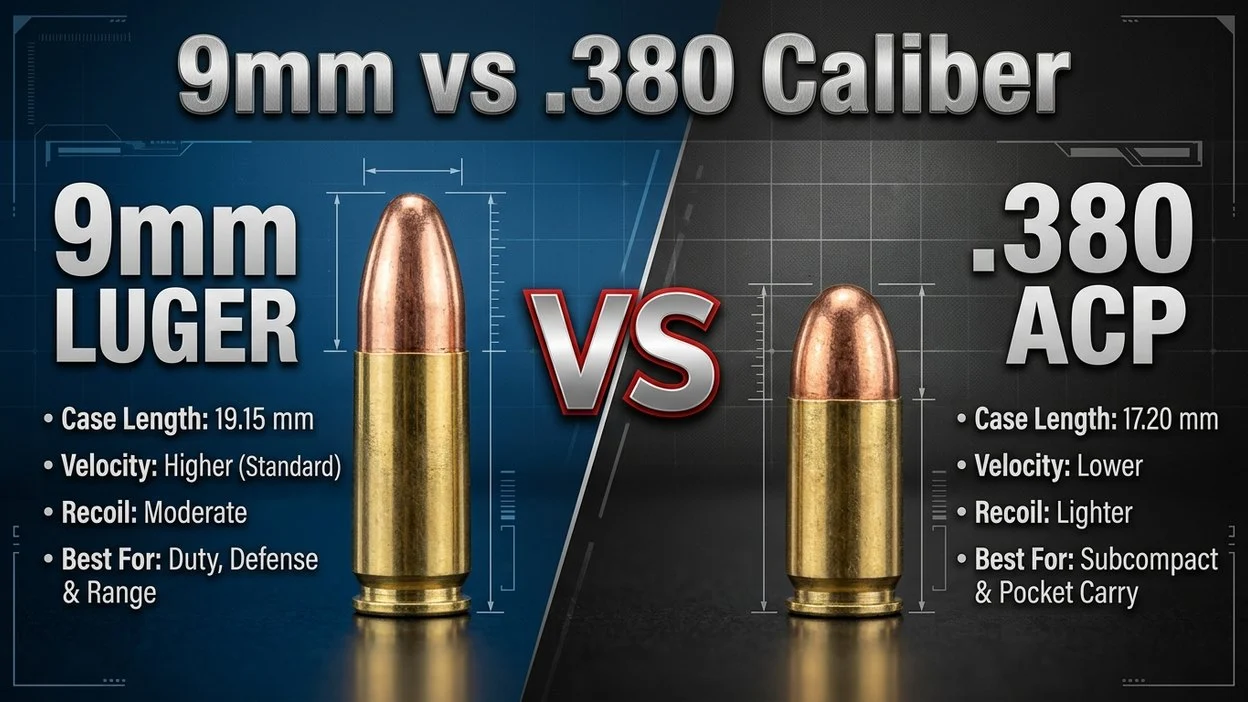
The main difference between 9mm vs .380 ACP is their size, typical performance, recoil, and the handguns designed to use them. Both are popular handgun cartridges, but they serve somewhat different needs. The 9mm Luger, also called 9×19mm Parabellum, generally delivers higher velocity and energy than the .380 ACP when comparing typical commercial loads. The .380 ACP is also known as 9mm Short or 9×17mm.
Although both cartridges use bullets of approximately 9mm diameter, their cases have different dimensions. This means they are not interchangeable. Understanding their differences helps readers learn about cartridge terminology, ammunition specifications, and the basic principles of handgun ballistics.
Quick Answer
9mm vs .380 ACP: The 9mm Luger generally offers higher velocity, greater energy, and broader handgun availability. The .380 ACP typically produces less recoil in comparable firearms, although the individual handgun’s size and design matter. Both are established pistol cartridges, and neither should be used in a firearm unless its manufacturer specifically identifies that cartridge as compatible.
Why Do People Confuse 9mm and .380 ACP?
People often confuse these cartridges because both use bullets approximately 9mm in diameter. Their names also overlap: the .380 ACP is sometimes called 9mm Short, while the 9mm Luger is commonly called simply 9mm.
However, bullet diameter alone does not determine whether ammunition fits or functions safely in a firearm. Cartridge length, case dimensions, pressure specifications, and chamber design also matter.
The important distinction is that 9mm Luger and .380 ACP are separate cartridge specifications, not two names for the same ammunition.
First Word: 9mm Luger
The 9mm Luger is a rimless, centerfire pistol cartridge developed by Georg Luger in the early 20th century. It is also known as 9×19mm Parabellum.
It is widely used in civilian handguns, law enforcement firearms, and military pistols around the world.
Key characteristics include:
- Full name: 9mm Luger or 9×19mm Parabellum
- Bullet diameter: Approximately 9.01mm
- Case length: 19.15mm
- Typical performance: Generally higher velocity and energy than .380 ACP
- Firearm availability: Offered in many handgun models
- Recoil: Varies with firearm weight, grip, ammunition, and design
The 9mm Luger is a common example of a modern service-pistol cartridge.
Second Word: .380 ACP
The .380 ACP stands for .380 Automatic Colt Pistol. It was introduced by John Moses Browning in the early 20th century and is also called 9×17mm or 9mm Short.
It is commonly associated with compact and subcompact handguns.
Key characteristics include:
- Full name: .380 Automatic Colt Pistol
- Other names: .380 Auto and 9mm Short
- Bullet diameter: Approximately 9.02mm
- Case length: 17.3mm
- Typical performance: Generally lower velocity and energy than 9mm Luger
- Firearm availability: Common in compact handguns
- Recoil: Often lower in comparable firearms, but small, lightweight pistols can still feel sharp to shoot
The .380 ACP is a distinct cartridge with its own specifications and compatible firearms.
9mm vs .380 ACP Comparison Table
| Feature | 9mm Luger | .380 ACP |
| Common name | 9mm | .380 Auto |
| Metric designation | 9×19mm | 9×17mm |
| Bullet diameter | About 9.01mm | About 9.02mm |
| Case length | 19.15mm | 17.3mm |
| Typical velocity | Generally higher | Generally lower |
| Typical energy | Generally higher | Generally lower |
| Recoil | Depends on firearm and load | Often lower in comparable firearms |
| Common firearm types | Full-size, compact, and subcompact pistols | Compact and subcompact pistols |
| Ammunition compatibility | Requires a firearm chambered for 9mm Luger | Requires a firearm chambered for .380 ACP |
| Interchangeable? | No | No |
Note: Actual velocity, energy, and recoil depend on the ammunition load and the firearm. Specifications can vary by manufacturer.
When Is Each Cartridge Relevant?
When Discussing 9mm Luger
The 9mm Luger is relevant when discussing common service-pistol ammunition, handgun design, cartridge performance, and the range of firearms manufactured for this cartridge.
It is frequently used as a reference point in discussions of modern handgun ammunition because of its widespread adoption.
When Discussing .380 ACP
The .380 ACP is relevant when learning about smaller pistol cartridges and compact handgun designs. It is often discussed in relation to the dimensions of small firearms and the differences between cartridge size and ballistic performance.
Neither cartridge is universally superior in every situation. The firearm’s design, the user’s familiarity with it, and compliance with local laws all affect practical considerations.
12 Examples of the Differences Between 9mm and .380 ACP
1. Cartridge Naming
A box marked 9mm Luger identifies a different cartridge from a box marked .380 ACP.
2. Metric Measurements
The 9mm Luger is designated 9×19mm, while .380 ACP is designated 9×17mm.
3. Case Length
The 9mm Luger has a longer case than the .380 ACP.
4. Bullet Diameter
Both cartridges use bullets of approximately 9mm diameter, despite their other dimensional differences.
5. Typical Muzzle Velocity
Comparable commercial loads generally show higher muzzle velocity for 9mm Luger, although exact figures depend on the load and barrel length.
6. Muzzle Energy
The 9mm Luger generally produces greater muzzle energy than .380 ACP with typical commercial ammunition.
7. Firearm Compatibility
A firearm designed for .380 ACP must not be assumed to accept 9mm Luger ammunition, or vice versa.
8. Recoil Perception
Recoil depends on several factors, including cartridge performance, firearm mass, grip design, and the shooter’s experience. A smaller pistol may feel less comfortable even when chambered for a lower-energy cartridge.
9. Firearm Dimensions
Both cartridges are used in compact handguns, but the overall dimensions and mechanisms of available firearms vary widely.
10. Ammunition Labels
The cartridge designation printed on the firearm and the ammunition packaging is more important for compatibility than the shared approximate bullet diameter.
11. Historical Development
Both cartridges originated in the early 20th century, but they were developed as separate designs with different dimensions and performance characteristics.
12. Ballistic Comparisons
A fair comparison requires specific ammunition loads, measured velocities, and consistent testing conditions rather than relying only on the cartridge names.
Common Mistakes About 9mm vs .380 ACP
Mistake 1: Assuming They Are the Same Cartridge
They are different cartridges with different case dimensions and pressure specifications.
Mistake 2: Thinking Similar Bullet Diameters Mean Compatibility
A similar bullet diameter does not mean ammunition can be safely substituted between firearms.
Mistake 3: Assuming Every 9mm Cartridge Is 9mm Luger
Several cartridges use the 9mm name. The full cartridge designation is essential when identifying ammunition.
Mistake 4: Assuming .380 ACP Always Has Gentle Recoil
Recoil depends on the complete firearm and ammunition combination. Lightweight handguns can produce noticeable recoil even with lower-energy cartridges.
Mistake 5: Comparing Performance Without Checking the Load
Bullet weight, powder charge, barrel length, and ammunition design can affect measured velocity and energy.
Memory Trick
Use this simple memory trick:
- 9mm Luger = 9×19mm
- .380 ACP = 9×17mm
Remember that the second number represents the approximate case length in millimeters.
The 9mm Luger has the longer case and generally offers higher ballistic performance with typical commercial loads. The .380 ACP has a shorter case, but both require firearms specifically designed for their respective cartridges.
American vs British English
The terminology differs more by region and industry than by spelling.
In the United States, 9mm Luger, 9mm, .380 ACP, and .380 Auto are common ammunition terms.
In the United Kingdom, metric cartridge designations such as 9×19mm are also used, particularly in technical and firearms contexts. The .380 ACP designation may appear in international references, while 9mm Short is another recognized name for that cartridge.
The essential distinction remains the same internationally: 9×19mm and 9×17mm are separate cartridge specifications.
Similar Words and Related Cartridge Terms
- 9mm Luger: Another name for the 9×19mm Parabellum cartridge.
- 9×19mm Parabellum: The full metric designation commonly shortened to 9mm.
- .380 Auto: An alternative name for .380 ACP.
- 9mm Short: A name used for .380 ACP in some countries.
- 9×17mm: The metric designation for .380 ACP.
- .38 Special: A different revolver cartridge that should not be confused with .380 ACP.
- 9mm Makarov: A separate cartridge with different dimensions from both 9mm Luger and .380 ACP.
These names are useful to recognize because cartridge terminology can be confusing when similar numbers appear on ammunition packaging.
Final Verdict
The main difference between 9mm vs .380 ACP is their cartridge dimensions and typical ballistic performance. The 9mm Luger has a longer case and generally produces greater velocity and energy. The .380 ACP has a shorter case and is commonly associated with compact handguns.
Both cartridges have distinct specifications, and they are not interchangeable. Always verify the exact chambering marked on the firearm and follow the manufacturer’s instructions.
FAQs:
1. Is 9mm the same as .380 ACP?
No. The 9mm Luger is a 9×19mm cartridge, while .380 ACP is a 9×17mm cartridge. They have similar bullet diameters but different case dimensions and specifications.
2. Which has more power, 9mm or .380 ACP?
The 9mm Luger generally produces greater muzzle velocity and energy than .380 ACP with typical commercial loads. Exact performance depends on the ammunition and firearm used.
3. Is .380 ACP also called 9mm?
Yes. The .380 ACP is sometimes called 9mm Short or 9×17mm. However, it is not the same cartridge as 9mm Luger, also known as 9×19mm.
4. Can a 9mm firearm use .380 ACP ammunition?
You should not assume that a firearm chambered for 9mm Luger can safely use .380 ACP ammunition. Use only the cartridge specified by the firearm manufacturer.
5. Why is .380 ACP associated with compact pistols?
Its shorter case and the firearm designs developed around it make .380 ACP common in compact and subcompact pistols. However, both cartridges are available in handguns of different sizes.
6. Does 9mm always have more recoil than .380 ACP?
No universal rule applies to every firearm. Although 9mm Luger generally has greater ballistic performance, perceived recoil also depends on firearm weight, grip, design, and ammunition.
7. What does ACP mean in .380 ACP?
ACP stands for Automatic Colt Pistol, a designation used in several cartridge names associated with John Moses Browning’s cartridge designs.
Remember This
- 9mm Luger: 9×19mm, longer case, generally higher velocity and energy.
- .380 ACP: 9×17mm, shorter case, commonly associated with compact pistols.
- Most important rule: Similar bullet diameter does not make two cartridges interchangeable.
Conclusion:
The 9mm Luger and .380 ACP are two distinct handgun cartridges that share a similar bullet diameter but differ in case length, typical ballistic performance, and the firearms designed to use them. Understanding these differences helps readers interpret ammunition labels and avoid confusing similar cartridge names.
When comparing the two, look beyond the numbers and consider the complete cartridge designation, published specifications, and firearm compatibility. Always follow the firearm manufacturer’s guidance and applicable laws when handling or discussing ammunition.

Oliver Owen is an imaginative novelist recognized for thrilling adventures, compelling narratives, and unforgettable characters. His creative works entertain readers while exploring courage, friendship, mystery, and personal growth.