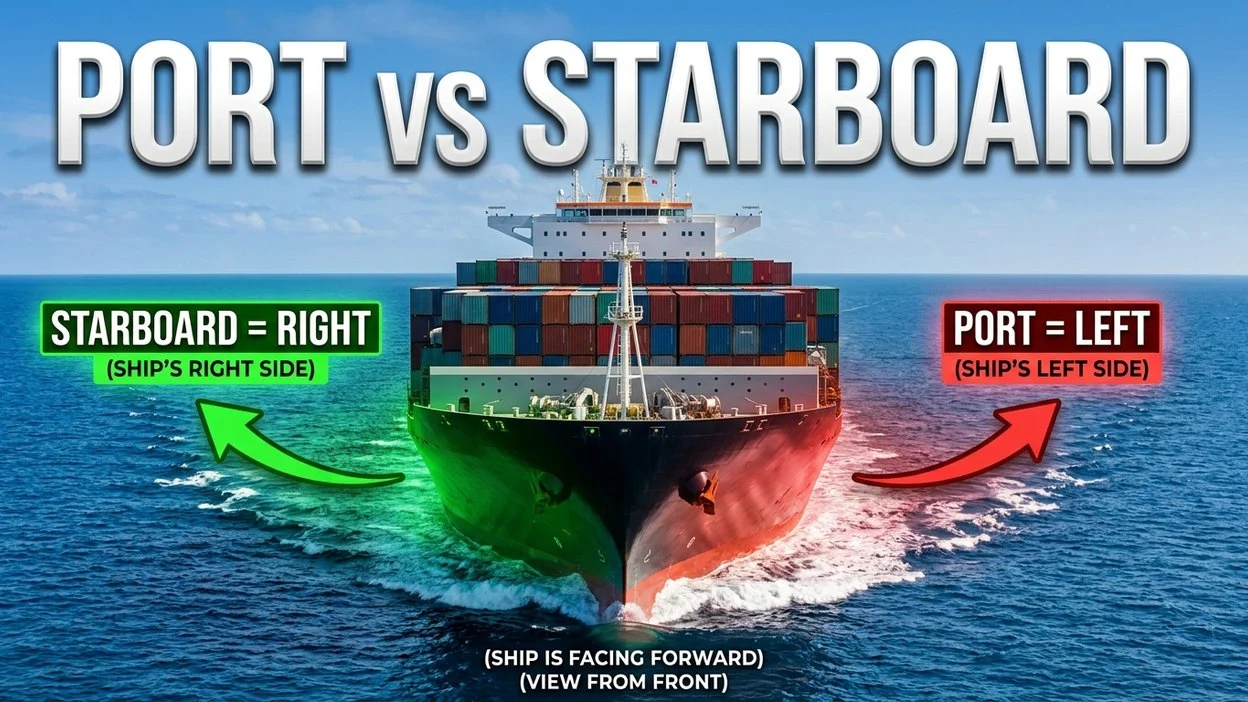
Port and starboard are the standard terms used to describe the left and right sides of a ship or boat. Port means the left side when you are facing forward toward the bow, while starboard means the right side when you are facing forward. These terms are used instead of simply saying “left” or “right” because a vessel can change direction, making ordinary left and right confusing.
Understanding port vs starboard is important for sailors, passengers, pilots, maritime workers, and anyone learning about boats and ships. The terms are used in navigation, safety instructions, marine communication, and international maritime practice. Once you learn which side each word represents, the difference is easy to remember.
Quick Answer
Port = left side of a vessel when facing forward. Starboard = right side when facing forward. These directions stay fixed to the vessel, unlike “left” and “right,” which can change depending on which way a person is facing. A simple memory trick is “port and left both have four letters.”
Why Do People Confuse Port and Starboard?
People often confuse port and starboard because both terms describe sides of a vessel, and their meanings are not as obvious as “left” and “right.”
Another reason is that a person standing on a boat may face different directions. If you turn around, your personal left and right change, but the vessel’s port and starboard sides do not.
For this reason, maritime communication uses fixed terms.
For example:
- Port always refers to the vessel’s left side when facing forward.
- Starboard always refers to the vessel’s right side when facing forward.
- Turning around does not change the vessel’s port or starboard side.
- These terms help reduce confusion during navigation and emergencies.
First Word: Port
Port means the left side of a vessel when facing the bow, or front of the vessel.
Imagine that you are standing on a boat and looking toward the front. The area on your left is the port side.
Port is commonly used in phrases such as:
- Port side
- Port bow
- Port stern
- Port turn
- Port lights
- Port navigation
The word does not mean the left side from every person’s perspective. It refers specifically to the vessel’s fixed left side when facing forward.
Second Word: Starboard
Starboard means the right side of a vessel when facing the bow.
If you stand on a boat and look toward the front, the area on your right is the starboard side.
Common expressions include:
- Starboard side
- Starboard bow
- Starboard stern
- Starboard turn
- Starboard lights
- Starboard navigation
Like port, starboard remains fixed to the vessel regardless of where you are standing.
Port vs Starboard Comparison Table
| Feature | Port | Starboard |
| Meaning | Left side of a vessel | Right side of a vessel |
| Reference direction | Facing forward toward the bow | Facing forward toward the bow |
| Position | Left | Right |
| Fixed to vessel? | Yes | Yes |
| Opposite side | Starboard | Port |
| Common use | Navigation and maritime communication | Navigation and maritime communication |
| Navigation light | Red | Green |
| Memory clue | “Port” has four letters, like “left” | Starboard is the opposite side |
When Should You Use Port and Starboard?
Use port and starboard when you need to describe a fixed side of a boat or ship.
Use “Port” When:
You are referring to the vessel’s left side while facing forward.
Example:
The lifeboat is located on the port side.
Use “Starboard” When:
You are referring to the vessel’s right side while facing forward.
Example:
The crew moved toward the starboard side.
These terms are especially useful when giving navigation instructions or describing the location of equipment, people, or other vessels.
10+ Examples of Port and Starboard
1. Port Side
The passengers gathered on the port side of the ferry.
This means they gathered on the vessel’s left side when facing forward.
2. Starboard Side
The crew inspected the starboard side of the ship.
This refers to the right side when facing forward.
3. Port Bow
The fishing boat appeared near the port bow.
The port bow is the left-front section of the vessel.
4. Starboard Bow
Another vessel was visible off the starboard bow.
The starboard bow is the right-front section.
5. Port Stern
The equipment was stored near the port stern.
The port stern is the left-rear section of the vessel.
6. Starboard Stern
The crew checked the starboard stern area.
This means the right-rear section of the vessel.
7. Turn to Port
The captain ordered the vessel to turn to port.
The vessel was instructed to turn toward its port side.
8. Turn to Starboard
The vessel turned to starboard to change course.
The vessel turned toward its starboard side.
9. Port Navigation Light
The port navigation light is red.
On vessels following the standard navigation-light convention, the port-side light is red.
10. Starboard Navigation Light
The starboard navigation light is green.
The standard starboard navigation light is green.
11. Port and Starboard Together
The crew inspected both the port and starboard sides.
This means they inspected both the left and right sides of the vessel.
12. Emergency Instructions
Passengers were asked to move toward the starboard side.
This gives a fixed direction that does not depend on how individual passengers are facing.
Common Mistakes
Mistake 1: Thinking Port Means the Left Side of the Person
Port does not mean your personal left side.
It means the vessel’s left side when you are facing forward.
Mistake 2: Thinking Starboard Always Means Your Right
The same principle applies to starboard. It describes the vessel’s fixed right side when facing forward.
Mistake 3: Mixing Up the Two Terms
Port and starboard are opposites:
Port = left
Starboard = right
Mistake 4: Forgetting the Bow Reference
The definitions are based on facing toward the bow, which is the front of the vessel.
Mistake 5: Assuming the Terms Change When You Turn Around
If you turn around and face the stern, the vessel’s port side is still port and its starboard side is still starboard.
Memory Trick
One of the easiest ways to remember port vs starboard is:
PORT = LEFT
Both port and left have four letters.
So when you need a quick reminder:
Port = Left = 4 letters
That leaves:
Starboard = Right
Another useful memory trick is to associate the navigation lights with the sides:
Port = Red
Starboard = Green
American vs British English
The terms port and starboard are used in both American and British English. Their meanings do not change between the two varieties of English.
They are standard maritime terms used internationally, so a sailor or maritime professional can generally understand them regardless of whether they use American or British English.
In everyday conversation, people may say “left side” or “right side” when discussing a boat casually. However, port and starboard are preferred when precise maritime directions are important.
Similar Words
Several words are commonly used alongside port and starboard:
- Bow: The front part of a boat or ship.
- Stern: The rear part of a boat or ship.
- Port: The left side when facing the bow.
- Starboard: The right side when facing the bow.
- Abeam: At approximately a right angle to the vessel’s centerline.
- Forward: Toward the bow.
- Aft: Toward the stern.
- Amidships: The central area of a vessel.
- Navigation: The process of planning and controlling a vessel’s movement.
- Helm: The position or equipment used to steer a vessel.
Final Verdict
The difference between port and starboard is simple: port is the left side of a vessel when facing forward, and starboard is the right side.
These terms are fixed to the vessel, so they remain the same even when people turn around or move to different parts of the boat. This makes them much more reliable than simply saying “left” or “right.”
FQAs:
1. Is port left or right?
Port is the left side of a boat or ship when facing forward toward the bow.
2. Is starboard left or right?
Starboard is the right side of a boat or ship when facing forward toward the bow.
3. Why do ships use port and starboard instead of left and right?
Port and starboard are fixed directions. They reduce confusion because a person’s left and right can change depending on which way they are facing.
4. What is the easiest way to remember port and starboard?
Remember “Port and left both have four letters.” Therefore, port is left, and starboard is right.
5. What color is the port navigation light?
The standard port navigation light is red.
6. What color is the starboard navigation light?
The standard starboard navigation light is green.
7. What is the difference between port and portside?
They generally refer to the same side of a vessel. Port side means the left side when facing forward.
8. Do airplanes use port and starboard?
In some aviation contexts, especially historical, military, or maritime aviation contexts, port and starboard may be used. However, standard modern aviation communication generally uses left and right.
Remember This
The most important rule is:
Port = Left
Starboard = Right
Always imagine yourself facing the bow, or front, of the vessel.
If the side is on your left, it is port.
If the side is on your right, it is starboard.
For an even easier memory aid:
Port = 4 letters = Left = 4 letters
Conclusion:
Port and starboard are two basic but important maritime terms. Port refers to the left side of a vessel when facing the bow, while starboard refers to the right side. Unlike personal left and right, these directions stay fixed to the vessel.
Once you remember the simple connection between port and left, the difference becomes much easier. Whether you are learning boating terms, reading a ship’s instructions, or studying maritime navigation, knowing port and starboard helps you understand directions clearly and accurately.

Reagan Hughes writes inspiring contemporary stories blending hope, emotion, and authentic characters. Her thoughtful novels encourage resilience, compassion, self-discovery, and meaningful connections, captivating readers across diverse audiences worldwide.