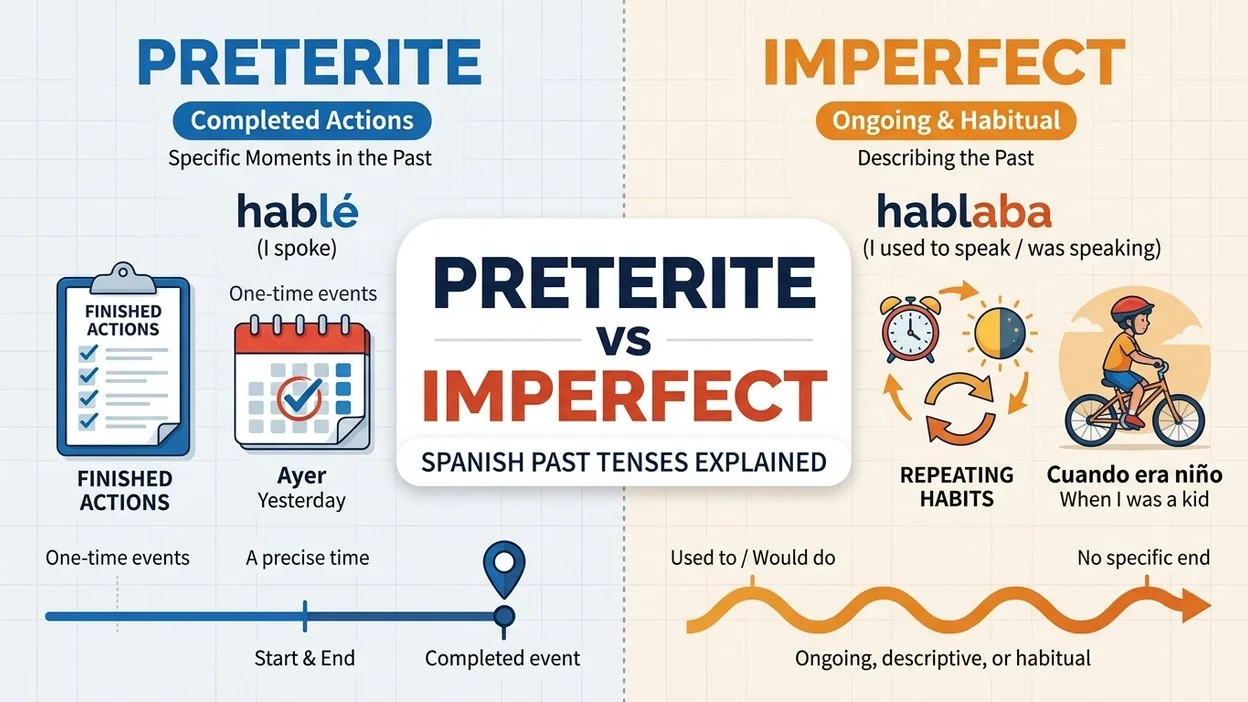
If you are learning Spanish, understanding preterite vs imperfect is one of the most important steps in mastering the past tense. Both tenses describe past events, but they are used in different ways. The preterite usually describes completed actions or events, while the imperfect describes ongoing, repeated, habitual, or background actions in the past.
The difference becomes easier when you focus on the speaker’s view of the event. The preterite presents an action as a completed event, often showing what happened next. The imperfect focuses on what was happening, what used to happen, or what things were like. For example, Ayer estudié español means “Yesterday, I studied Spanish,” while Cuando era niño, estudiaba español means “When I was a child, I used to study Spanish.” Learning these patterns can help you choose the correct Spanish past tense more naturally.
Quick Answer
The preterite is generally used for completed past actions and specific events, while the imperfect is used for ongoing, repeated, habitual actions and descriptions in the past. Think preterite = what happened and imperfect = what was happening or used to happen.
Why Do People Confuse Preterite and Imperfect?
Both the preterite and imperfect talk about the past, so English speakers often find the distinction difficult.
English does not always make the same grammatical distinction that Spanish makes. For example, “I studied” and “I was studying” give different information in English, but Spanish uses the preterite and imperfect in a wider range of situations.
The key is not simply asking, “Is this in the past?”
Instead, ask:
- Was the action completed?
- Was it happening in the background?
- Did it happen repeatedly?
- Was it a habitual action?
- Are you describing what things were like?
- Did one event interrupt another?
These questions can help you choose the correct tense.
First Word: Preterite
The preterite is a Spanish past tense used mainly for actions and events viewed as completed.
It often tells the reader or listener what happened.
Common uses of the preterite
Use the preterite for:
- Completed actions
- Specific past events
- Actions that happened a definite number of times
- A sequence of completed events
- Actions that move a story forward
- Events with a clear beginning and ending
Examples
Ayer estudié español.
Yesterday, I studied Spanish.
Juan llegó a las ocho.
Juan arrived at eight.
Comimos pizza anoche.
We ate pizza last night.
María abrió la puerta y salió.
María opened the door and left.
The preterite often answers the question:
What happened?
Second Word: Imperfect
The imperfect is used for past actions that were ongoing, repeated, habitual, or descriptive.
It often explains what was happening or what things were like.
Common uses of the imperfect
Use the imperfect for:
- Ongoing past actions
- Repeated actions
- Habitual actions
- Descriptions in the past
- Age
- Time
- Weather
- Physical and emotional conditions
- Background information
Examples
Estudiaba español cuando llegaste.
I was studying Spanish when you arrived.
Cuando era niño, jugaba al fútbol.
When I was a child, I used to play soccer.
Hacía frío.
It was cold.
Eran las ocho.
It was eight o’clock.
The imperfect often answers:
What was happening?
or
What was it like?
Preterite vs Imperfect Comparison Table
| Feature | Preterite | Imperfect |
| Main idea | Completed event | Ongoing or habitual action |
| Focus | What happened | What was happening |
| Repeated action | Usually a completed number of times | Habitual or repeated action |
| Storytelling | Moves the story forward | Provides background |
| Descriptions | Less common | Very common |
| Age | Usually not used | Commonly used |
| Time | Specific completed event | Background time |
| Weather | A change or event | General background condition |
| Example | Estudié = I studied | Estudiaba = I was studying / used to study |
When Should You Use the Preterite?
Use the preterite when you want to present an action as a completed event.
Completed action
Terminé mi tarea.
I finished my homework.
Specific event
Llegamos a Madrid el lunes.
We arrived in Madrid on Monday.
Sequence of events
Entré, saludé y me senté.
I entered, greeted everyone, and sat down.
Definite number of times
Fui al cine tres veces.
I went to the cinema three times.
The action is presented as completed and counted.
When Should You Use the Imperfect?
Use the imperfect when the action is viewed as ongoing, habitual, or descriptive.
Habitual action
Siempre caminaba al colegio.
I always used to walk to school.
Ongoing action
Leía un libro.
I was reading a book.
Background description
La casa era grande y tenía un jardín.
The house was large and had a garden.
Age
Tenía diez años.
I was ten years old.
Time
Eran las cinco.
It was five o’clock.
Weather
Llovía mucho.
It was raining a lot.
10+ Examples of Preterite vs Imperfect
1. I studied Spanish.
Estudié español.
I studied Spanish.
The action is presented as completed.
Estudiaba español.
I was studying Spanish / I used to study Spanish.
The imperfect presents the action as ongoing or habitual.
2. I ate dinner.
Comí la cena.
I ate dinner.
The meal is presented as a completed event.
3. I was eating dinner.
Comía la cena.
I was eating dinner.
The focus is on the action in progress.
4. She arrived.
Ella llegó.
She arrived.
The arrival is a completed event.
5. She was sleeping.
Ella dormía.
She was sleeping.
The sleeping provides background information.
6. We went to the beach every Sunday.
Íbamos a la playa todos los domingos.
The repeated habit makes the imperfect appropriate.
7. We went to the beach three times.
Fuimos a la playa tres veces.
The specific number of completed trips makes the preterite appropriate.
8. It was raining when I left.
Llovía cuando salí.
Llovía provides the background, while salí describes the completed event.
9. I was studying when my friend called.
Estudiaba cuando mi amigo llamó.
The ongoing action uses the imperfect. The completed interruption uses the preterite.
10. When I was young, I played soccer.
Cuando era joven, jugaba al fútbol.
Both verbs describe background or habitual information, so the imperfect is natural.
11. I played soccer yesterday.
Jugué al fútbol ayer.
The event is presented as a completed action.
12. The house was beautiful.
La casa era hermosa.
The imperfect describes the house.
13. The door opened.
La puerta se abrió.
The action is presented as a completed event.
14. I read every night.
Leía todas las noches.
This describes a repeated habit.
15. I read the book yesterday.
Leí el libro ayer.
This presents the reading as a completed event.
Common Mistakes
Mistake 1: Thinking “Yesterday” Always Means Preterite
Words such as ayer often appear with the preterite because they can identify a completed event, but the time word itself does not automatically determine the tense.
For example:
Ayer estudié español.
Yesterday, I studied Spanish.
But:
Ayer, mientras estudiaba, mi hermano llamó.
Yesterday, while I was studying, my brother called.
Mistake 2: Using Preterite for Every Past Action
Not every past action is completed in the sense that Spanish grammar focuses on.
Descriptions, habits, and background actions commonly use the imperfect.
Mistake 3: Using Imperfect for Every “Was” Meaning
English “was” can correspond to different Spanish forms.
Era estudiante.
I was a student.
But:
Estuve en Madrid durante una semana.
I was in Madrid for a week.
The correct choice depends on meaning and context.
Mistake 4: Forgetting the Background Action
When one action was happening and another event occurred, Spanish often uses:
Imperfect + preterite
For example:
Dormía cuando sonó el teléfono.
I was sleeping when the phone rang.
Mistake 5: Assuming Repetition Always Means Imperfect
A repeated action can use the preterite when the number of completed occurrences is important.
Fui al museo tres veces.
I went to the museum three times.
The three visits are viewed as completed events.
Memory Trick
Use this simple rule:
Preterite = WHAT HAPPENED
Think of a completed event:
Llegué.
I arrived.
Imperfect = WHAT WAS HAPPENING
Think of background, habits, or descriptions:
Llegaba.
I was arriving / I used to arrive.
Another useful memory trick is:
Preterite = Finished picture
Imperfect = Background picture
When telling a story, the preterite often gives the main events, while the imperfect creates the setting.
American vs British English
The terms preterite and imperfect are used in grammar discussions in both American and British English.
However, English itself does not have a Spanish-style preterite versus imperfect system. English speakers often express similar meanings through different structures.
For example:
I studied Spanish.
I was studying Spanish.
I used to study Spanish.
Spanish can use the preterite or imperfect to express distinctions that English communicates through context, auxiliary verbs, or expressions such as “used to.”
Similar Words and Grammar Terms
Understanding related grammar terms can make the difference easier to remember.
- Past tense: A grammatical form used to talk about past events or situations.
- Preterite: A Spanish past tense commonly used for completed events.
- Imperfect: A Spanish past tense commonly used for ongoing, habitual, or descriptive past situations.
- Past participle: A form used in Spanish compound constructions such as he comido.
- Infinitive: The basic verb form, such as hablar, comer, or vivir.
- Habitual action: Something that happened regularly or repeatedly.
- Background action: An action or condition that provides context for another event.
- Completed action: An event presented as finished.
Final Verdict
The main difference between preterite vs imperfect is how the speaker presents the past action.
The preterite usually presents a completed event or a sequence of events. The imperfect usually presents an ongoing action, habit, repeated situation, or background description.
A useful starting rule is:
Preterite = what happened.
Imperfect = what was happening or what used to happen.
Context still matters, so learners should practice both tenses together rather than memorizing isolated rules.
FQAs:
1. What is the main difference between preterite and imperfect?
The preterite generally presents past actions as completed events, while the imperfect describes ongoing, habitual, repeated, or background situations.
2. Is “was doing” always imperfect in Spanish?
Often, yes, when “was doing” describes an action in progress. For example, estudiaba can mean “I was studying.” However, Spanish tense choice depends on context and the speaker’s intended meaning.
3. Is “used to” always imperfect?
The imperfect is commonly used for habitual actions expressed with “used to.”
For example:
Jugaba al fútbol.
I used to play soccer.
4. Does “yesterday” always require the preterite?
No. Ayer often appears with the preterite for completed events, but it can also occur with an imperfect action that provides background.
5. Which tense is used for age in Spanish?
The imperfect is normally used to describe someone’s age in the past.
Tenía quince años.
I was fifteen years old.
6. Which tense is used for weather in the past?
The imperfect is commonly used for background weather conditions.
Hacía frío.
It was cold.
Llovía.
It was raining.
A specific weather event can sometimes be presented differently depending on the context.
7. Can both preterite and imperfect appear in the same sentence?
Yes. This is extremely common.
Estudiaba cuando llegó María.
“I was studying when María arrived.”
Estudiaba is imperfect because it was ongoing, while llegó is preterite because the arrival is a completed event.
8. Which tense should beginners learn first?
Beginners should learn the basic uses of both. Learning them together makes it easier to understand why Spanish uses different past-tense forms.
Remember This
When deciding between preterite and imperfect, ask yourself:
1. What happened? → Preterite
2. What was happening? → Imperfect
3. What used to happen? → Imperfect
4. What was the background or description? → Imperfect
5. What completed event moved the story forward? → Preterite
The most useful example to remember is:
Estudiaba cuando llamó mi amigo.
“I was studying when my friend called.”
Estudiaba = imperfect
llamó = preterite
Conclusion:
The difference between preterite and imperfect becomes much easier when you stop thinking of them as two simple translations of the English past tense. Instead, think about how you want to present the action. The preterite commonly shows a completed event, while the imperfect gives background, describes ongoing situations, or explains habits and repeated actions.
With regular practice, these patterns become more natural. Start with simple questions such as “What happened?” for the preterite and “What was happening or what used to happen?” for the imperfect. Then practice sentences where both tenses appear together, because that is one of the most common ways Spanish speakers use them.

Autumn Gray is a bestselling storyteller admired for emotional novels, expressive writing, and memorable characters. Her inspiring books celebrate love, resilience, hope, and the transformative power of imagination and literature.