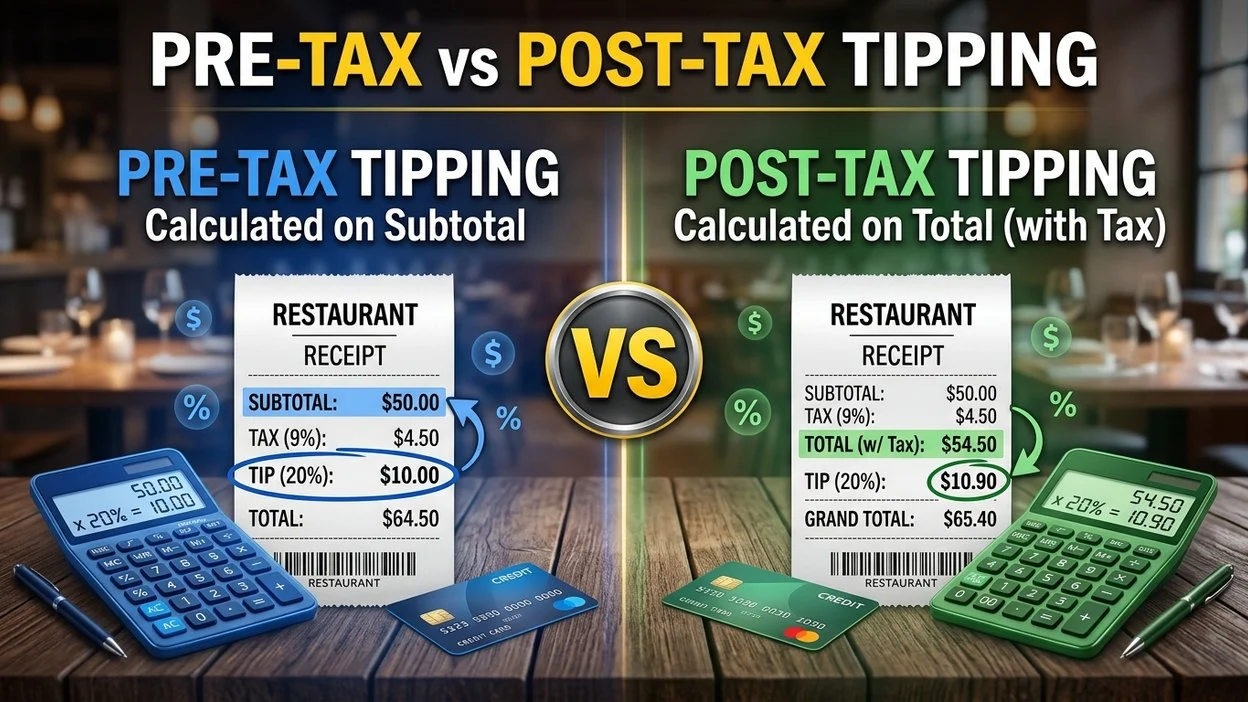
Pre-tax vs post-tax tipping refers to whether a tip is calculated from the bill amount before tax or from the total amount after tax. The difference can seem small on one restaurant bill, but it can become noticeable when you dine out frequently or have a large group. Understanding the two methods makes it easier to check suggested tip amounts and decide how much you want to leave.
In many places, restaurants and payment systems show suggested tip percentages based on different calculation methods. Some screens may calculate the tip on the subtotal before sales tax, while others may calculate it on the final total. There is no single rule that applies everywhere, so checking what the percentage is based on can prevent confusion. Your personal tipping choice can also depend on the service, local customs, and the amount of the bill.
Quick Answer
Pre-tax tipping calculates the tip using the bill before sales tax, while post-tax tipping calculates it using the total after tax. For example, a 20% tip on a $100 pre-tax bill is $20, while a 20% tip after a 10% tax is $22. The difference is $2.
Why Do People Confuse Pre-Tax and Post-Tax Tipping?
People often confuse these methods because restaurant receipts and digital payment screens may display several different totals.
A typical bill can include:
- Food and drinks
- Discounts
- Service charges
- Sales tax
- Tip
- Final amount
The important question is: What amount is the tip percentage being applied to?
If the percentage is applied before tax, it is a pre-tax tip. If it is applied after tax, it is a post-tax tip.
First Word: Pre-Tax
Pre-tax means an amount is calculated before tax is added.
For tipping, a pre-tax tip uses the subtotal as the tip base.
Example
Suppose your restaurant subtotal is $80 and sales tax is 10%.
Tax:
$80 × 10% = $8
Total before tip:
$80 + $8 = $88
A 20% pre-tax tip is:
$80 × 20% = $16
So your final payment would be:
$80 + $8 + $16 = $104
Second Word: Post-Tax
Post-tax means the calculation happens after tax has been added.
Using the same $80 restaurant subtotal and 10% tax:
Tax:
$80 × 10% = $8
Post-tax total:
$80 + $8 = $88
A 20% post-tax tip is:
$88 × 20% = $17.60
The final payment would be:
$88 + $17.60 = $105.60
The difference between the two tips is $1.60.
Pre-Tax vs Post-Tax Tipping Comparison
| Feature | Pre-Tax Tipping | Post-Tax Tipping |
| Tip is calculated on | Subtotal before tax | Total after tax |
| Includes sales tax in tip base? | No | Yes |
| Example subtotal | $100 | $100 |
| Example tax at 10% | $10 | $10 |
| 20% tip | $20 | $22 |
| Final bill | $130 | $132 |
| Tip amount | Lower | Higher |
| Calculation | Subtotal × tip rate | Tax-inclusive total × tip rate |
When Should You Use Pre-Tax Tipping?
Pre-tax tipping may be appropriate when you want to calculate your tip based on the cost of the food and drinks before sales tax.
For example, if your subtotal is $120 and you want to leave 18%:
$120 × 0.18 = $21.60
You would then add the tip to the subtotal and tax to determine the final payment.
Pre-tax tipping can also make calculations easier when the receipt clearly separates the subtotal and tax.
When Should You Use Post-Tax Tipping?
Post-tax tipping means calculating the percentage from the final amount after tax.
For example, if the subtotal is $120 and tax is $12:
$120 + $12 = $132
A 18% post-tax tip would be:
$132 × 0.18 = $23.76
Some people choose this method because they prefer to tip based on the total amount shown on the bill.
10+ Examples of Pre-Tax vs Post-Tax Tipping
1. $50 Bill With 10% Tax
Pre-tax subtotal: $50
Tax: $5
20% pre-tax tip:
$50 × 20% = $10
20% post-tax tip:
$55 × 20% = $11
Difference: $1
2. $75 Bill With 8% Tax
Tax:
$75 × 8% = $6
Post-tax total:
$81
15% pre-tax tip:
$75 × 15% = $11.25
15% post-tax tip:
$81 × 15% = $12.15
Difference: $0.90
3. $100 Bill With 10% Tax
Pre-tax tip at 20%:
$100 × 20% = $20
Post-tax tip:
$110 × 20% = $22
Difference: $2
4. $120 Bill With 8% Tax
Tax:
$9.60
Post-tax total:
$129.60
18% pre-tax tip:
$21.60
18% post-tax tip:
$23.33
Difference: approximately $1.73
5. $150 Bill With 10% Tax
Pre-tax tip at 20%:
$30
Post-tax total:
$165
Post-tax tip:
$33
Difference: $3
6. $200 Bill With 10% Tax
Pre-tax tip at 20%:
$40
Post-tax total:
$220
Post-tax tip:
$44
Difference: $4
7. $60 Bill With 5% Tax
Tax:
$3
Post-tax total:
$63
20% pre-tax tip:
$12
20% post-tax tip:
$12.60
Difference: $0.60
8. $90 Bill With 7% Tax
Tax:
$6.30
Post-tax total:
$96.30
20% pre-tax tip:
$18
20% post-tax tip:
$19.26
Difference: $1.26
9. $250 Bill With 10% Tax
Pre-tax tip at 15%:
$37.50
Post-tax total:
$275
Post-tax tip:
$41.25
Difference: $3.75
10. $300 Bill With 8% Tax
Pre-tax tip at 20%:
$60
Post-tax total:
$324
Post-tax tip:
$64.80
Difference: $4.80
11. Group Dinner
Suppose six people have a combined subtotal of $180 and tax is 10%.
Pre-tax 20% tip:
$36
Post-tax 20% tip:
$39.60
The difference is $3.60 for the entire table.
12. Large Restaurant Bill
For a $500 subtotal with 10% tax:
Pre-tax 20% tip:
$100
Post-tax 20% tip:
$110
The difference becomes $10, showing why the calculation method matters more as the bill gets larger.
Common Mistakes With Pre-Tax and Post-Tax Tipping
Mistake 1: Assuming Every Tip Is Pre-Tax
A suggested tip on a payment terminal may be based on either the subtotal or the tax-inclusive amount. Check the receipt or calculation before assuming.
Mistake 2: Adding Tax Twice
If the displayed total already includes tax, do not add the tax again when calculating a post-tax tip.
Mistake 3: Confusing Tip With Service Charges
A mandatory service charge is not necessarily the same thing as a voluntary tip. Read the bill carefully.
Mistake 4: Forgetting Discounts
A discount can change the amount on which a tip is calculated. Check whether the restaurant calculates the tip on the discounted subtotal.
Mistake 5: Thinking the Difference Is Always Large
The difference between pre-tax and post-tax tipping depends on the tax rate, tip percentage, and bill size. On a small bill, it may be only a few cents or dollars.
Memory Trick
Use this simple rule:
Pre-tax = Before tax
Post-tax = After tax
Think of the word “pre” as meaning before and “post” as meaning after.
So:
Pre-tax tip → tip before tax
Post-tax tip → tip after tax
American vs British English
The terms pre-tax and post-tax are used in both American and British English, although the exact context can differ.
In the United States, restaurant tipping is common in many service situations, and discussions about whether to calculate a tip before or after sales tax are frequent.
In British English, tip is also commonly used for money given to service workers, while service charge is another important term found on restaurant bills.
Tax systems also differ between countries. For example, U.S. sales tax is often added at the point of purchase, while many other countries use systems such as VAT that are commonly incorporated into displayed prices. Therefore, tipping practices and bill calculations can vary by location.
Similar Words
Here are some terms commonly associated with pre-tax and post-tax tipping:
- Tip: Money voluntarily given to a service worker as recognition for service.
- Gratuity: Another word for a tip.
- Subtotal: The amount before tax and usually before the tip.
- Sales tax: A tax added to certain purchases.
- Total: The amount owed after applicable charges have been included.
- Service charge: A charge added by a business for service, which may be different from a voluntary tip.
- Pre-tax: Calculated before tax.
- Post-tax: Calculated after tax.
- Tip percentage: The percentage used to calculate a tip.
- Tip base: The amount to which the tip percentage is applied.
Final Verdict
The difference between pre-tax and post-tax tipping is simply the amount used to calculate the tip. A pre-tax tip uses the subtotal before tax, while a post-tax tip uses the amount after tax has been added.
Neither calculation is automatically the right choice in every situation. The important thing is to understand the calculation and check whether a restaurant or payment system has already included a service charge. Local tipping customs can also influence what customers choose to leave.
FQAs:
1. Is it better to tip before or after tax?
There is no universal rule. A pre-tax tip is calculated from the subtotal, while a post-tax tip is calculated from the tax-inclusive total. Your choice can depend on personal preference and local tipping customs.
2. Do you tip on the total before or after tax?
It depends on the tipping method. A pre-tax tip uses the amount before tax, while a post-tax tip uses the amount after tax.
3. How much more is a post-tax tip?
The difference depends on the tax rate and tip percentage. For example, with a $100 subtotal, 10% tax, and a 20% tip, the pre-tax tip is $20 and the post-tax tip is $22.
4. Should I tip on a service charge?
A service charge and a tip are not necessarily the same thing. Check the bill and the restaurant’s policy before deciding whether an additional tip is appropriate.
5. Do restaurants calculate suggested tips before or after tax?
It varies. Some payment systems calculate suggested tips from the pre-tax subtotal, while others may use the tax-inclusive total. Check the receipt or payment screen to see which amount is being used.
6. Is tipping before tax cheaper?
Yes, if the same percentage is used, a pre-tax tip will normally be lower than a post-tax tip because the tax amount is excluded from the tip base.
7. How do I calculate a 20% tip before tax?
Multiply the pre-tax subtotal by 0.20. For a $100 subtotal, the calculation is $100 × 0.20 = $20.
8. How do I calculate a 20% tip after tax?
First add the tax to the subtotal. Then multiply the tax-inclusive amount by 0.20. For example, $100 plus 10% tax equals $110, and 20% of $110 is $22.
Remember This
The easiest way to remember the difference is:
Pre-tax tipping = calculate the tip before tax.
Post-tax tipping = calculate the tip after tax.
For a $100 subtotal with 10% tax and a 20% tip:
- Pre-tax tip = $20
- Post-tax tip = $22
The calculation method changes the tip amount, but the difference is usually relatively small unless the bill is large.
Conclusion:
Pre-tax and post-tax tipping describe two different ways to calculate a restaurant tip. Pre-tax tipping applies the percentage to the subtotal before tax, while post-tax tipping applies the same percentage to the total after tax. Knowing which method is being used helps you understand suggested tip amounts and avoid calculation mistakes.
When paying a restaurant bill, look at the subtotal, tax, service charges, and suggested tip percentages separately. If the payment screen does not clearly show how the tip was calculated, you can calculate it yourself using the subtotal or tax-inclusive total, depending on the method you prefer and the local custom.

Sloane Miller creates captivating fiction filled with suspense, emotion, and unforgettable moments. Her engaging storytelling reflects determination, originality, and imagination, leaving readers inspired long after every novel concludes.