
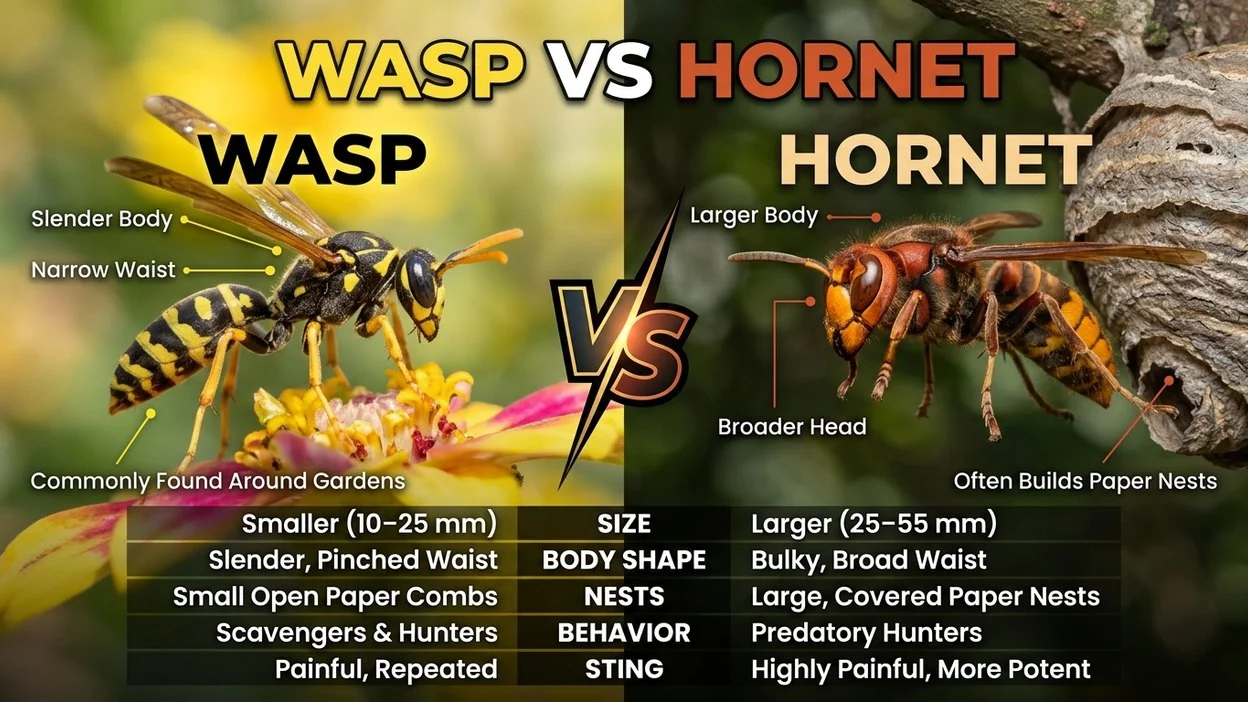
Wasps and hornets are closely related flying insects, but they are not exactly the same. In the comparison of wasp vs hornet, the main difference is that a hornet is a type of wasp. Hornets are generally larger and have broader heads and thicker bodies than many common wasps. However, their appearance, behavior, and size depend on the species.
Both wasps and hornets belong to the insect order Hymenoptera. They can build nests, defend their colonies, and sting when they feel threatened. Some species help control garden pests, while others may become a problem around homes, outdoor meals, and gardens. Knowing how to identify these insects can help you understand their behavior and respond safely when you encounter one.
Quick Answer
A hornet is a type of wasp, but not every wasp is a hornet. Hornets are generally larger and more robust than many common wasps. Both insects can sting, build nests, and defend their colonies. Their exact size, color, aggression, and nesting habits depend on the species.
Why Do People Confuse Wasps and Hornets?
People often confuse wasps and hornets because they share several physical features. Both may have narrow waists, two pairs of wings, antennae, and bodies marked with yellow, black, brown, or reddish colors.
They also behave similarly in some situations. Both can fly around gardens, search for food, and defend their nests.
The main reason for the confusion is that hornets belong to the wasp family Vespidae. In everyday language, people often use the words interchangeably, even though hornets are a particular group of wasps.
Another source of confusion is that different species vary in size and color. A large yellowjacket may look like a hornet, while some hornets have darker markings that make them look quite different from the familiar yellow-and-black wasp.
First Word: Wasp
A wasp is a flying insect belonging to the order Hymenoptera. The word describes a broad group of insects, including paper wasps, yellowjackets, and hornets.
Many wasps have slender bodies and narrow waists. Their colors vary by species, but yellow and black markings are common among familiar social wasps.
Common Characteristics of Wasps
- Body: Often slender, with a narrow waist.
- Size: Varies considerably by species.
- Color: Yellow, black, brown, reddish, or a combination.
- Food: Many feed on insects, nectar, or sugary substances.
- Nesting: Some build paper nests, while others nest underground or in sheltered spaces.
- Sting: Many female wasps can sting, and some species can sting more than once.
- Behavior: Some are social and defend colonies, while others live alone.
What Do Wasps Eat?
Wasps have varied diets. Many adult wasps feed on nectar, fruit juice, and other sugary substances. Some also visit outdoor meals and garbage bins.
Many wasp species hunt insects or collect prey to feed their young. This makes them useful in gardens and natural ecosystems because they help control populations of other insects.
Where Do Wasps Live?
Wasps can live in gardens, forests, fields, and urban areas. Depending on the species, they may build nests under roof edges, inside wall cavities, in trees, underground, or in other protected locations.
Not all wasps build large colonies. Many species are solitary and do not have a large nest to defend.
Second Word: Hornet
A hornet is a type of social wasp. Hornets belong to the genus Vespa and are known for their relatively large bodies and ability to defend their colonies.
Many hornets have broad heads, strong jaws, and thick bodies. Their colors vary: some have yellow and black markings, while others are mostly dark with reddish or orange-brown features.
Common Characteristics of Hornets
- Body: Generally robust and relatively large.
- Size: Often larger than many common wasps, although size varies by species.
- Color: May include yellow, black, brown, reddish, or orange markings.
- Food: Adults often consume sugary liquids and may hunt other insects.
- Nesting: Social hornets typically build nests made from paper-like material.
- Sting: Female hornets can sting repeatedly.
- Behavior: They may aggressively defend their nests when they perceive a threat.
What Do Hornets Eat?
Adult hornets often feed on nectar, tree sap, and other sugary liquids. They may also capture flies, caterpillars, and other insects to provide food for their developing young.
Their hunting behavior can make them beneficial predators in natural environments, although some species may affect honeybee colonies.
Where Do Hornets Live?
Hornets may build nests in trees, shrubs, hollow spaces, roof areas, and other sheltered locations. Nest placement depends on the species.
Their colonies can grow substantially during the warmer months. As a result, disturbing a hornet nest can expose people to multiple defensive stings.
Wasp vs Hornet: Comparison Table
| Feature | Wasp | Hornet |
| Meaning | Broad group of insects | A particular type of wasp |
| Scientific classification | Includes several families and groups | Genus Vespa |
| Body shape | Often slender | Generally thicker and more robust |
| Size | Small to large, depending on species | Often relatively large |
| Color | Yellow, black, brown, or other colors | Varies by species; may be yellow, black, reddish, or brown |
| Nest | Paper nests, underground nests, or solitary nests | Social species typically build paper nests |
| Diet | Nectar, sugary foods, and sometimes other insects | Sugary liquids and other insects |
| Social behavior | Solitary or social, depending on species | Social colony-living insects |
| Sting | Many females can sting | Females can sting repeatedly |
| Nest defense | Varies by species | Can be strong near the colony |
| Ecological role | Pollination and pest control in some species | Predation and other ecological functions |
| Examples | Paper wasps and yellowjackets | European hornet and Asian hornet species |
When to Use Each Term
The words wasp and hornet refer to insects, so the right term depends on which insect you are describing.
When to Use “Wasp”
Use wasp when referring to the broader group or when you cannot confidently identify the species.
Examples:
- “A wasp landed on my garden table.”
- “Wasps can help control certain garden pests.”
- “I found a paper wasp nest under the roof.”
- “A wasp was flying around the flowers.”
The word wasp is especially useful when the insect’s exact type is unknown.
When to Use “Hornet”
Use hornet when the insect has been identified as a hornet species.
Examples:
- “A European hornet was flying near the tree.”
- “Hornets can defend their nests when disturbed.”
- “We saw a hornet nest high in the tree.”
- “The hornet was larger than the other insects nearby.”
Remember that a hornet is technically a wasp, so the two words are related rather than completely separate categories.
12 Examples of Wasps and Hornets in Everyday Situations
1. An Insect Near a Picnic
A yellow-and-black insect lands on your food. You might call it a wasp if you do not know its exact species.
2. A Large Insect Near a Tree
You notice a large, robust flying insect near a tree. It could be a hornet, but size alone is not enough to identify it confidently.
3. A Paper Nest Under a Roof
You find a paper-like nest beneath the roof. Social wasps and hornets can both build paper nests, so the nest alone may not reveal the species.
4. An Insect Hunting a Caterpillar
A wasp catches a caterpillar in the garden. Some wasp species hunt caterpillars and other insects to feed their young.
5. A Hornet Visiting a Flower
A hornet visits a flower for nectar. Like many other insects, hornets may consume sugary plant fluids.
6. A Wasp Near a Garbage Bin
An insect flies around a garbage bin containing sweet food waste. Social wasps are often attracted to sugary substances.
7. A Nest in the Ground
You notice insects entering a hole in the soil. Some wasps and yellowjackets nest underground, but the location alone does not establish the species.
8. A Nest in a Tree
A large nest hangs from a tree branch. It could belong to a social wasp or hornet species, depending on the region and nest characteristics.
9. An Insect Defending Its Nest
Several insects fly toward someone who approaches their nest. Both wasps and hornets can defend their colonies.
10. A Solitary Insect in the Garden
You see one wasp-like insect digging in the soil. It could be a solitary wasp that nests alone rather than a social species.
11. An Insect Catching a Fly
A wasp captures a fly. Predatory wasps can help control other insect populations.
12. Identifying an Insect Safely
You see a large, yellow-and-brown insect and want to know whether it is a hornet. Observe it from a safe distance and consider its shape, markings, location, and regional species rather than relying on color alone.
Common Mistakes When Comparing Wasps and Hornets
Mistake 1: Thinking Hornets Are Not Wasps
Hornets are a type of wasp. The word wasp is the broader term.
Mistake 2: Assuming Every Large Wasp Is a Hornet
Some yellowjackets and other wasps can look large or robust. Accurate identification depends on more than size.
Mistake 3: Believing All Wasps Are Aggressive
Wasp behavior varies considerably. Some solitary species are unlikely to defend anything other than themselves, while social species may defend their nests.
Mistake 4: Assuming Hornets Always Have Yellow-and-Black Bodies
Hornet coloration differs by species. Some have reddish or brown markings, while others have darker bodies.
Mistake 5: Thinking Wasps and Hornets Die After Stinging
Unlike honeybees, wasps and hornets generally can sting multiple times because their stingers are not typically lost during the process.
Mistake 6: Assuming Every Nest Is Dangerous in the Same Way
Risk depends on the species, the nest’s location, and how close people are to it. However, it is safest not to disturb an unidentified nest.
Memory Trick: Wasp vs Hornet
Use this simple memory trick:
Wasp = the broad group.
Hornet = one particular type of wasp.
Think of the relationship like this:
- Every hornet is a wasp.
- Not every wasp is a hornet.
If you remember only one fact, remember that a hornet is a specific kind of wasp, not a completely unrelated insect.
American vs British English
The words wasp and hornet are used in both American and British English, but the species people commonly encounter can differ by region.
In the United States, people frequently encounter yellowjackets, paper wasps, and other native or introduced wasps. The term hornet is also used for certain species, including the European hornet.
In the United Kingdom, wasp commonly refers to familiar social wasps, while hornet often refers to the European hornet. Asian hornets have also become an important identification concern in parts of Europe.
The terms are not simply American and British spelling variations. They refer to different types of insects, and local species determine which ones people are likely to see.
Similar Words
Several insect names are related to wasps and hornets, but they do not all mean the same thing.
- Yellowjacket: A group of social wasps commonly known for yellow-and-black markings.
- Paper wasp: A wasp that builds an exposed, paper-like nest, often with visible open cells.
- European hornet: A large hornet species native to Europe and parts of Asia and introduced elsewhere.
- Asian hornet: A common name used for hornets originating in Asia; the exact species should be specified when possible.
- Bee: A flying insect group that includes honeybees and bumblebees. Bees are not wasps, although they are related.
- Bumblebee: A typically hairy bee that feeds on nectar and collects pollen.
- Hoverfly: A fly that may resemble a wasp or bee but belongs to a different insect order.
- Ant: An insect in the same order as wasps and bees, with many species living in colonies.
Final Verdict: Wasp vs Hornet
The main difference between a wasp and a hornet is their classification. A hornet is a type of wasp, while wasp refers to a much broader group of insects.
Hornets are generally larger and more robust than many common wasps, and social hornets can strongly defend their colonies. However, size, color, nesting habits, and behavior vary by species. Neither appearance nor nest location alone is always enough for reliable identification.
FAQs:
1. Is a hornet more dangerous than a wasp?
Not always. Both can sting, and either can cause serious allergic reactions in susceptible people. Risk depends on the species, the number of stings, the circumstances, and the person’s sensitivity. Hornets can be especially dangerous when their nests are disturbed.
2. What is the main difference between a wasp and a hornet?
A hornet is a specific type of wasp. Hornets are generally larger and more robust than many common wasps, but their physical characteristics vary by species.
3. Which is bigger, a wasp or a hornet?
Hornets are often larger than familiar wasps, but the wasp group contains many species with different body sizes. Size alone cannot reliably identify an insect.
4. Do wasps and hornets both sting?
Yes. Females of many wasp and hornet species can sting. Unlike honeybees, they generally can sting more than once.
5. Are hornets more aggressive than wasps?
It depends on the species and situation. Hornets and other social wasps can defend their nests when they perceive a threat. Their behavior away from a nest may be quite different.
6. Do wasps and hornets build the same kind of nest?
Many social wasps and hornets build nests from paper-like material made by chewing plant fibers. However, nest shape, location, and size differ among species, and many solitary wasps use other nesting methods.
7. Do wasps and hornets help the environment?
Yes. Many species hunt insects that would otherwise feed on crops or garden plants. Some also visit flowers and contribute to pollination, although their ecological roles vary.
8. What should I do if I find a wasp or hornet nest?
Keep your distance and do not hit, shake, block, or spray the nest yourself. If it is near a doorway, walkway, or other frequently used area, contact a qualified pest-control professional. Seek emergency medical care if a sting causes difficulty breathing, swelling of the tongue or throat, or other signs of a severe allergic reaction.
Remember This
- Wasp: A broad group of insects.
- Hornet: A particular type of wasp.
- Size: Hornets are often larger, but size varies by species.
- Sting: Both can sting, and both may sting repeatedly.
- Safety: Never disturb a nest to identify its occupants.
The easiest way to remember the difference is that every hornet is a wasp, but not every wasp is a hornet.
Conclusion:
Understanding wasp vs hornet becomes easier when you remember that hornets belong to the larger wasp group. Although hornets are generally larger and more robust than many common wasps, both groups include insects with different colors, nesting habits, diets, and behaviors. Learning these differences can help you identify insects more accurately and understand their roles in nature.
If you encounter one near your home or garden, avoid making assumptions based only on its size or color. Observe it from a safe distance, leave its nest undisturbed, and seek professional help when necessary. Both wasps and hornets can be useful parts of the ecosystem, even when they need to be managed carefully around people.

Sloane Miller creates captivating fiction filled with suspense, emotion, and unforgettable moments. Her engaging storytelling reflects determination, originality, and imagination, leaving readers inspired long after every novel concludes.