
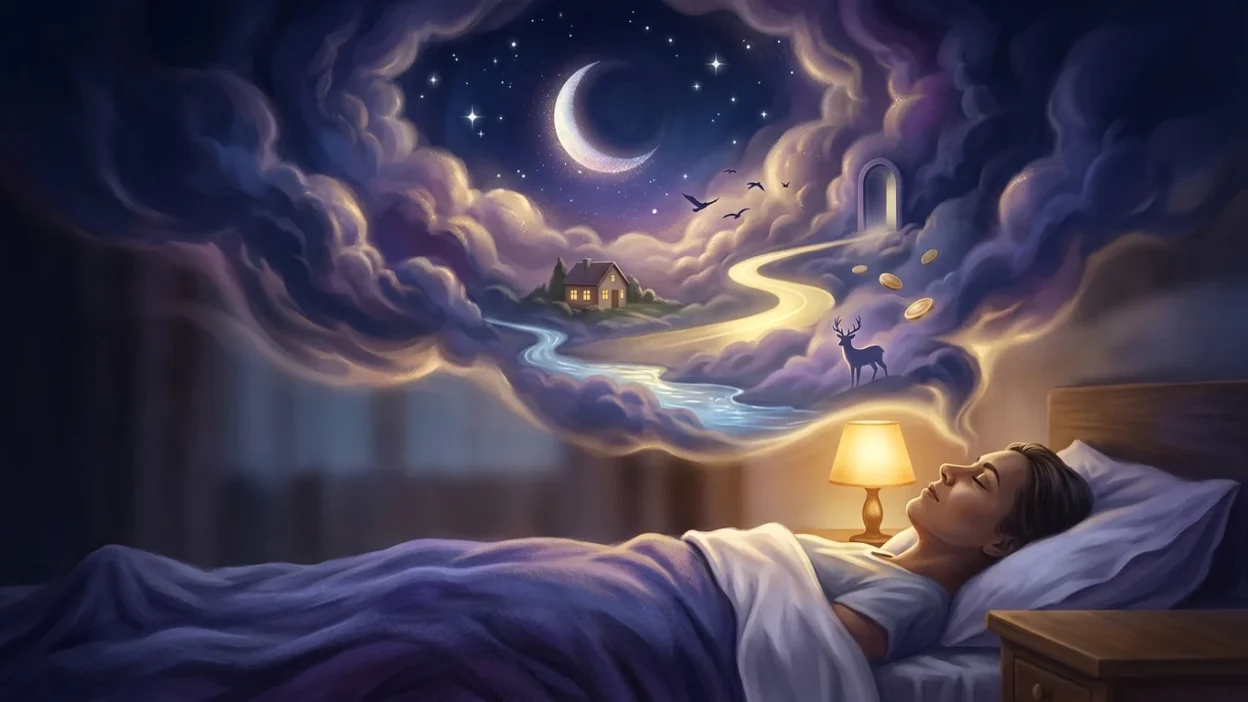
Dreams can feel mysterious, emotional, exciting, or even frightening. One night you may dream about flying, while another night you may see a person from your past, lose your teeth, encounter an animal, or find yourself in a strange unfamiliar place.
Dream meaning interpretation is the process of exploring what these images, emotions, situations, and experiences may represent in your waking life. While there is no single meaning that applies to every dream, understanding symbolism, emotions, personal experiences, and spiritual beliefs can help you uncover a deeper message.
Quick Answer: What Does Dream Meaning Interpretation Mean?
Dream meaning interpretation means examining the symbols, emotions, people, places, and events in a dream to understand what they might represent in your waking life.
A dream may reflect:
- Your current emotions or worries
- Recent experiences and memories
- Unresolved problems or relationships
- Personal hopes, fears, or desires
- Changes happening in your life
- Your subconscious thoughts
- Spiritual beliefs or personal symbolism
The most important clue is often how you felt during the dream, rather than the symbol itself.
What Is Dream Interpretation?
Dream interpretation is the practice of looking beyond the literal events of a dream and considering their possible symbolic meaning.
For example, dreaming about water does not automatically mean the same thing for everyone. Calm water might represent peace and emotional balance, while dark or overflowing water could reflect uncertainty, stress, or feeling emotionally overwhelmed.
Your personal circumstances matter.
A symbol that represents success to one person could represent fear to another. That is why effective dream interpretation combines common symbolism with your own experiences and emotions.
Dream Symbolism: Why Do Dreams Use Symbols?
Dreams often communicate through images rather than direct statements. The subconscious mind can combine memories, emotions, fears, wishes, and everyday experiences into unusual stories.
Common dream symbols can include:
- Water: emotions, cleansing, uncertainty, or emotional change
- Animals: instincts, personality traits, protection, or fears
- Houses: your inner self, family life, or personal identity
- Roads: life direction and choices
- Flying: freedom, ambition, confidence, or escape
- Falling: insecurity, loss of control, or fear of failure
- Teeth: confidence, communication, appearance, or anxiety
- Money: value, security, opportunity, or self worth
- Death: endings, transformation, or major life changes
These interpretations are possibilities rather than fixed rules. The same dream symbol can have completely different meanings depending on the dreamer.
Spiritual Meaning of Dreams
For many people, dreams have a spiritual dimension. Throughout history, people have viewed dreams as opportunities for reflection, guidance, warnings, or communication with something greater than themselves.
A spiritual interpretation may encourage you to ask:
What is this dream trying to make me notice?
A peaceful dream might inspire gratitude or reassurance, while a disturbing dream may encourage self reflection, caution, or emotional healing.
However, it is wise not to assume every dream is a supernatural message. Dreams can also arise from ordinary psychological processes, memories, stress, and daily experiences.
The spiritual meaning of a dream is therefore best considered alongside your beliefs and personal circumstances.
Psychological Interpretation of Dreams
From a psychological perspective, dreams can reflect thoughts and emotions that may not receive much attention during waking life.
Your brain processes memories, experiences, emotions, and information while you sleep. This can sometimes create strange combinations that feel deeply meaningful.
For example, if you are worried about an important decision, you might dream about being lost. If you are experiencing relationship tension, you might dream about arguing, separation, or chasing someone.
A dream does not necessarily predict what will happen.
Instead, it may reveal how you are currently processing what has already happened or what you are afraid might happen.
Common Dream Scenarios and Their Possible Meanings
The details of a dream can dramatically change its interpretation. Here are some common scenarios to consider.
Dream About a Single Symbol
Dreaming about one prominent object, animal, person, or event often means that your attention is focused on a particular issue.
Ask yourself what immediately comes to mind when you think about that symbol.
Your personal association may be more meaningful than a general dream dictionary definition.
Dream About Many Symbols
Seeing many similar objects, animals, people, or events may suggest that a particular theme feels overwhelming or impossible to ignore.
For example, dreaming about many snakes could represent multiple fears, complicated relationships, or a situation that feels threatening from several directions.
The emotion accompanying the dream provides important context.
Dream About a Baby
Babies in dreams can symbolize new beginnings, vulnerability, innocence, responsibility, or something that is developing in your life.
A happy baby may represent hope and growth, while a crying baby might symbolize an unmet emotional need or something requiring your attention.
Dream About Someone Who Is Dead
Dreaming about a deceased person can be emotionally powerful.
Such dreams may reflect grief, memories, unfinished emotions, longing, or a desire for comfort. They do not necessarily mean that something bad is going to happen.
Sometimes the person represents a quality, lesson, or period of your life that you associate with them.
Dream About Being Attacked
An attack dream may reflect feelings of vulnerability, conflict, fear, or emotional pressure.
Consider whether someone or something in waking life makes you feel threatened, criticized, controlled, or powerless.
The attacker can also symbolize an internal struggle rather than another person.
Dream About Being Chased
Being chased is one of the most common dream experiences.
It may suggest that you are avoiding something in waking life, such as a difficult conversation, responsibility, decision, fear, or uncomfortable emotion.
Ask yourself: What am I running away from?
The answer may provide an important clue to the dream’s subconscious message.
Dream About Holding Something
Holding a person, animal, object, or baby can symbolize attachment, protection, responsibility, love, or a desire to maintain control.
The meaning depends heavily on your emotions. Holding something lovingly can suggest connection, while desperately holding onto something may indicate fear of losing it.
Dream About a Friendly Symbol
When an animal, stranger, unusual creature, or mysterious figure behaves peacefully, the dream may have a more positive emotional tone.
A friendly symbol could represent acceptance of a part of yourself, growing confidence, protection, companionship, or an opportunity you are beginning to recognize.
Positive vs. Negative Dream Meanings
| Dream Feature | Possible Positive Meaning | Possible Negative Meaning |
| Water | Emotional healing, renewal | Overwhelm, uncertainty |
| Flying | Freedom, confidence | Escaping reality |
| Animals | Instinct, protection | Fear, aggression |
| Baby | New beginning, growth | Vulnerability, responsibility |
| Money | Opportunity, self worth | Anxiety about security |
| Death | Transformation, closure | Grief, fear of change |
| Chasing | Motivation, confronting fears | Avoidance, anxiety |
| House | Stability, identity | Family conflict, insecurity |
| Falling | Letting go, change | Loss of control, fear |
| Light | Hope, clarity | Exposure or unwanted attention |
The table shows why dream symbols should not automatically be labeled “good” or “bad.” Context determines meaning.
Cultural and Biblical Dream Interpretation
Dreams have played an important role in many cultures and religious traditions.
In biblical traditions, dreams sometimes appear as meaningful experiences involving warnings, guidance, revelations, or symbolic events. Stories involving figures such as Joseph and Daniel are commonly associated with dream interpretation and spiritual insight.
However, biblical dream interpretation should be approached carefully. Not every modern dream should be treated as a divine prediction.
Cultural beliefs can also influence symbolism. An animal, color, number, or event may carry one meaning in one culture and a completely different meaning somewhere else.
Your cultural background, spiritual beliefs, and personal experiences can therefore influence how you understand a dream.
What Is Your Dream Trying to Tell You?
Instead of immediately asking, “What does this symbol mean?” try asking:
“Why did this dream affect me?”
That question can lead to a more personal interpretation.
Your dream may be encouraging you to:
- Face something you have been avoiding
- Pay attention to your emotional needs
- Let go of an outdated situation
- Recognize an opportunity
- Protect your boundaries
- Deal with unresolved conflict
- Accept an important change
- Understand a recurring fear
- Give yourself time to heal
- Trust your own feelings and judgment
The subconscious message may not be a literal instruction. Sometimes a dream simply brings an emotion to your attention.
How to Interpret Your Dreams More Accurately
You do not need to memorize hundreds of dream symbols to understand your dreams. A simple process can be surprisingly effective.
1. Write Down the Dream
Record your dream as soon as possible after waking.
Include people, locations, colors, objects, conversations, actions, and anything unusual.
2. Identify the Strongest Emotion
Were you afraid, excited, embarrassed, peaceful, angry, confused, or relieved?
Emotion is often one of the strongest clues in dream interpretation.
3. Look for Personal Connections
Think about what each major symbol means specifically to you.
A dog may symbolize friendship for one person and fear for another because of different life experiences.
4. Consider Recent Events
Ask whether something from the previous few days or weeks could have influenced the dream.
A conversation, movie, argument, major decision, stressful event, or exciting opportunity can appear indirectly in dreams.
5. Look for Repeated Patterns
Recurring dreams deserve special attention.
If the same location, person, animal, problem, or emotion keeps appearing, your mind may be repeatedly processing a particular concern or theme.
6. Separate Symbolism From Prediction
A dream can feel incredibly real without predicting the future.
Focus first on what the dream may reveal about your emotions, thoughts, relationships, and current circumstances.
Why Do We Have Recurring Dreams?
Recurring dreams often occur when a particular emotional theme remains unresolved or repeatedly activated.
For example, you may repeatedly dream about:
- Being late
- Failing an exam
- Losing something important
- Being chased
- Falling
- Returning to an old home
- Meeting someone from your past
- Being unable to speak
The exact imagery matters, but the recurring emotion may matter even more.
If every version of the dream makes you feel powerless, for example, the central theme may be about control rather than the literal events.
Can Dreams Predict the Future?
There is no reliable rule that dreams predict future events.
Some dreams may appear prophetic because dreams can incorporate subtle observations, expectations, fears, and predictions your brain has already made without your conscious awareness.
For this reason, it is better to use dreams as tools for reflection rather than guaranteed forecasts.
A dream can help you understand what you expect, fear, desire, or need, even when it cannot tell you exactly what will happen next.
Final Thoughts on Dream Meaning Interpretation
Dream meaning interpretation is less about finding one universal definition and more about understanding the relationship between symbols, emotions, memories, and your waking life.
A dream about falling, being chased, meeting a stranger, seeing an animal, or losing something may carry an important emotional theme—but the meaning becomes clearer when you consider your personal circumstances.
Pay attention to recurring symbols, powerful emotions, and situations that resemble something happening in your life.
Most importantly, treat dream interpretation as a tool for self reflection rather than an absolute prediction. Your own experiences are often the key to understanding what your dreams are trying to express.
Frequently Asked Questions About Dream Meaning Interpretation
1. What is the meaning of dream interpretation?
Dream interpretation is the process of exploring the possible meaning of dream symbols, emotions, people, places, and events. It combines common symbolism with personal experiences and feelings.
2. Do dreams have meanings?
Dreams can have personal meaning, particularly when they reflect strong emotions, memories, concerns, relationships, or life changes. However, there is no universal meaning for every dream.
3. What is the spiritual meaning of dreams?
The spiritual meaning of dreams depends on a person’s beliefs and cultural background. Some people view dreams as guidance or reflection, while others understand them primarily through psychological or emotional processes.
4. Why do I keep having the same dream?
Recurring dreams may reflect an unresolved emotion, repeated stress, an ongoing conflict, or a situation your mind continues to process. Identifying the emotion behind the recurring dream can help reveal its possible meaning.
5. Can dream interpretation predict the future?
Dream interpretation should not be treated as a guaranteed method of predicting the future. Dreams are more reliably used as a way to explore emotions, expectations, memories, fears, and personal concerns.
6. How can I remember and interpret my dreams?
Keep a dream journal beside your bed and write down your dream immediately after waking. Record the main symbols, emotions, people, events, and any connections you notice with your waking life.

Autumn Gray is a bestselling storyteller admired for emotional novels, expressive writing, and memorable characters. Her inspiring books celebrate love, resilience, hope, and the transformative power of imagination and literature.