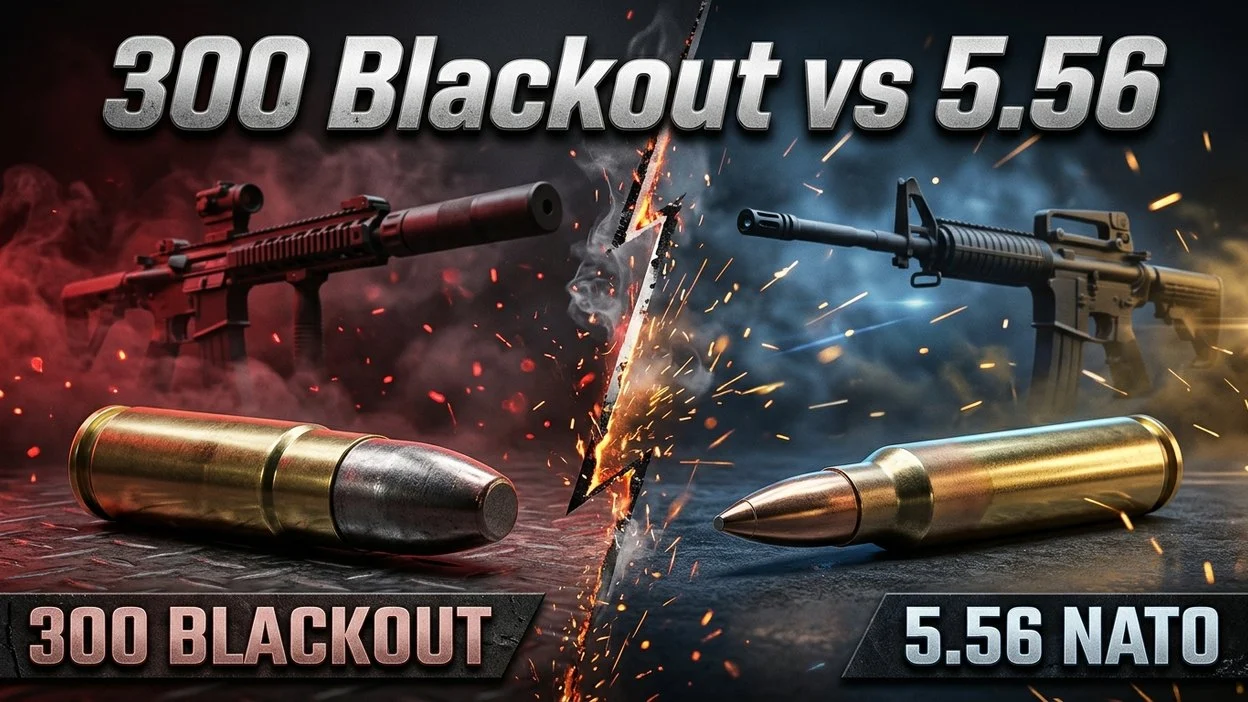
The difference between 300 Blackout vs 5.56 NATO comes down to cartridge design, intended use, and performance characteristics. Both are rifle cartridges commonly associated with the AR-15 platform, but they were developed with different goals. The .300 AAC Blackout, often called .300 BLK or 300 Blackout, uses a wider bullet, while 5.56×45mm NATO uses a narrower, lighter bullet that generally travels at a higher velocity.
These differences affect factors such as bullet weight, trajectory, recoil, ammunition availability, and performance in different barrel configurations. The cartridges also have different historical backgrounds and technical requirements. Although both may be used in compatible firearm platforms, they are not interchangeable. A firearm must be specifically configured and marked for the cartridge being used.
Understanding 300 Blackout vs 5.56 can help readers learn about ammunition terminology, compare their general characteristics, and understand why manufacturers design different cartridges for different purposes.
Quick Answer
300 Blackout vs 5.56: .300 Blackout generally uses heavier, wider bullets and can accommodate both subsonic and supersonic ammunition. The 5.56 NATO cartridge typically uses lighter bullets at higher velocities, producing a flatter trajectory in many common configurations. Their performance depends on ammunition and firearm specifications, and the cartridges are not interchangeable.
Why Do People Confuse 300 Blackout and 5.56?
People often compare these cartridges because both are associated with the AR-15-style rifle platform and share some broad design features. However, similar platform compatibility does not mean that two cartridges have the same dimensions or performance.
The confusion often comes from three factors:
- Similar platforms: Some firearm designs can be configured for either cartridge.
- Different ammunition options: Both cartridges are available in multiple bullet weights and designs.
- Different performance goals: Each cartridge was developed around a different set of ballistic requirements.
The most important distinction is that .300 Blackout and 5.56 NATO have different chamber specifications. Using the wrong cartridge can create a dangerous situation.
First Word: 300 Blackout
300 Blackout, formally known as .300 AAC Blackout, is a rifle cartridge developed to provide different ballistic options within a compact rifle platform.
It uses a bullet approximately .30 inches in diameter, although the exact bullet dimensions and specifications depend on the applicable standard. Ammunition is available in both subsonic and supersonic loads.
Important characteristics include:
- A wider bullet than 5.56 NATO.
- A range of bullet weights, including relatively heavy options.
- Availability of subsonic and supersonic ammunition.
- Different ballistic characteristics depending on the load.
- A design that can be used in appropriately configured firearms.
Subsonic ammunition travels below the speed of sound, while supersonic ammunition travels above it. These categories describe velocity, not whether a cartridge is inherently safe or quiet.
Second Word: 5.56 NATO
5.56 NATO, formally known as 5.56×45mm NATO, is a rifle cartridge developed for military service and widely used in modern sporting rifles and other compatible firearms.
It generally uses a narrower, lighter bullet than .300 Blackout. Many common loads produce relatively high muzzle velocities, which can contribute to a flatter trajectory over certain distances.
Important characteristics include:
- A bullet approximately .224 inches in diameter.
- A broad selection of ammunition types.
- Generally high velocity with common supersonic loads.
- Extensive use in military and civilian shooting contexts.
- Broad commercial availability in many markets.
Actual performance varies with bullet design, barrel length, ammunition specifications, and environmental conditions.
300 Blackout vs 5.56 Comparison Table
| Feature | .300 Blackout | 5.56 NATO |
| Full name | .300 AAC Blackout | 5.56×45mm NATO |
| Bullet diameter | Approximately .308 inches | Approximately .224 inches |
| General bullet weight | Often heavier | Often lighter |
| Common velocity profile | Subsonic and supersonic options | Commonly supersonic |
| Trajectory | Often more curved with comparable supersonic setups | Often flatter with common loads |
| Recoil | Depends on load and firearm | Often relatively light |
| Ammunition availability | Varies by market | Broadly available in many markets |
| Platform | Requires the correct chamber configuration | Requires the correct chamber configuration |
| Cartridge compatibility | Not interchangeable with 5.56 NATO | Not interchangeable with .300 Blackout |
| Performance | Depends on load and setup | Depends on load and setup |
When to Use Each: Understanding Their Intended Roles
The phrase “when to use each” depends on the lawful purpose, the firearm’s specifications, and the ammunition manufacturer’s guidance. Their technical differences can be understood without assuming that one cartridge is universally superior.
Understanding .300 Blackout
The .300 Blackout cartridge is associated with applications where its range of bullet weights and subsonic ammunition options are relevant. Its ballistic characteristics vary significantly between subsonic and supersonic loads.
For example, subsonic .300 Blackout ammunition has a different velocity and trajectory profile from supersonic ammunition of the same cartridge family.
Understanding 5.56 NATO
The 5.56 NATO cartridge is associated with high-velocity rifle applications. Its relatively light bullets and common supersonic loads can produce a flatter trajectory than many heavier, slower loads under comparable conditions.
It is also widely represented in commercial ammunition markets, although local availability and regulations vary.
12 Examples of Important Differences
1. Bullet Diameter
A typical .300 Blackout bullet measures approximately .308 inches in diameter. A typical 5.56 NATO bullet measures approximately .224 inches.
2. Bullet Weight
.300 Blackout ammunition often includes heavier bullets, while 5.56 NATO commonly uses lighter bullets. Exact weights depend on the load.
3. Muzzle Velocity
Common 5.56 NATO loads often have higher muzzle velocities than many .300 Blackout loads. However, the comparison depends on the ammunition and firearm configuration.
4. Subsonic Ammunition
Subsonic ammunition is available for .300 Blackout. This means the cartridge can be loaded to travel below the speed of sound.
5. Supersonic Ammunition
Both cartridge families can use supersonic ammunition. The resulting velocity depends on the specific load and barrel configuration.
6. Trajectory
A higher-velocity load often has a flatter trajectory under comparable conditions. A lower-velocity load generally experiences more pronounced bullet drop over the same distance.
7. Recoil
Recoil depends on several factors, including projectile mass, velocity, firearm weight, and operating system. It should not be judged by cartridge name alone.
8. Ammunition Availability
5.56 NATO ammunition is widely available in many markets. .300 Blackout availability can vary more by region and retailer.
9. Firearm Configuration
A firearm intended for one cartridge must not automatically be assumed compatible with the other. The chamber marking and manufacturer’s documentation determine the approved cartridge.
10. Sound Characteristics
Ammunition velocity, firearm design, and other factors affect sound. Subsonic ammunition avoids the ballistic crack associated with a projectile breaking the sound barrier, but it does not eliminate the firearm’s other noise.
11. Barrel Length
Barrel length can influence velocity and overall performance. The effect varies with cartridge design, ammunition, and the specific firearm.
12. Ammunition Cost
The price of either cartridge depends on the manufacturer, bullet type, production conditions, and local market. Neither cartridge is always cheaper.
Common Mistakes When Comparing 300 Blackout and 5.56
Mistake 1: Assuming the Cartridges Are Interchangeable
They are not interchangeable. Only use ammunition explicitly approved for the firearm’s chambering.
Mistake 2: Assuming Every .300 Blackout Load Is Subsonic
.300 Blackout ammunition is available in both subsonic and supersonic versions. The cartridge name alone does not establish the velocity of a particular load.
Mistake 3: Assuming 5.56 Is Always More Accurate
Accuracy depends on the firearm, ammunition quality, bullet design, barrel, and shooter. Neither cartridge is automatically more accurate in every configuration.
Mistake 4: Comparing Velocity Without Considering Bullet Weight
Velocity alone does not describe all aspects of ballistic performance. Bullet mass, construction, trajectory, and the intended application also matter.
Mistake 5: Assuming a Similar Platform Means Identical Specifications
Two firearms may look similar but have different chambers and ammunition requirements. Always follow the manufacturer’s instructions.
Memory Trick
Use this simple memory trick:
300 Blackout = wider bullet and subsonic options.
5.56 NATO = narrower bullet and commonly high-velocity loads.
Remember that these are general descriptions, not universal rules for every ammunition load.
American vs British English
The names .300 Blackout and 5.56 NATO are cartridge designations, not alternative American and British spellings.
In American English, the cartridge may be called “300 Blackout,” “.300 Blackout,” or “.300 AAC Blackout.” The 5.56 cartridge is commonly called “5.56 NATO” or “5.56×45mm NATO.”
British English generally uses the same technical designations, although terminology and legal classifications for firearms and ammunition can differ between the United Kingdom and the United States.
Local firearm laws, licensing requirements, and ammunition restrictions should always be checked in the relevant jurisdiction.
Similar Terms
These related terms help explain the differences between the two cartridges:
- .223 Remington: A rifle cartridge closely related to 5.56 NATO, but with distinct chamber and pressure specifications.
- 7.62×39mm: A different rifle cartridge with a larger bullet than 5.56 NATO.
- .308 Winchester: A larger rifle cartridge with different dimensions and ballistic characteristics.
- Subsonic ammunition: Ammunition designed to propel a projectile below the speed of sound.
- Supersonic ammunition: Ammunition that propels a projectile above the speed of sound.
- Muzzle velocity: The speed of a projectile as it leaves the firearm’s barrel.
- Trajectory: The path a projectile follows through the air.
- Ballistics: The study of projectile motion and behavior.
Final Verdict
The main difference between 300 Blackout vs 5.56 NATO is their design and typical ballistic performance. .300 Blackout uses a wider bullet and offers both subsonic and supersonic ammunition. 5.56 NATO generally uses a lighter, narrower bullet and commonly achieves higher velocities.
Neither cartridge is universally better. Their characteristics depend on the ammunition, firearm configuration, and intended application. Most importantly, they have different chamber specifications and must never be treated as interchangeable.
FAQs:
1. Is 300 Blackout the same as 5.56?
No. .300 Blackout and 5.56 NATO are different rifle cartridges with different bullet diameters, cartridge dimensions, and ballistic characteristics. They are not interchangeable.
2. Which has a higher velocity, 300 Blackout or 5.56?
Common 5.56 NATO loads generally have higher muzzle velocities than many .300 Blackout loads. Exact figures depend on ammunition type, barrel length, and firearm configuration.
3. Is 300 Blackout always subsonic?
No. .300 Blackout ammunition is available in both subsonic and supersonic loads. The velocity category depends on the specific ammunition.
4. Are 300 Blackout and 5.56 bullets the same size?
No. Typical .300 Blackout bullets are approximately .308 inches in diameter, while typical 5.56 NATO bullets are approximately .224 inches.
5. Are 300 Blackout and 5.56 ammunition interchangeable?
No. Each cartridge requires a firearm with the appropriate chamber specifications. Using incompatible ammunition can cause serious injury or damage.
6. Is 300 Blackout more accurate than 5.56?
Not necessarily. Accuracy depends on ammunition quality, bullet design, firearm configuration, barrel characteristics, and other factors. Neither cartridge is inherently more accurate in all circumstances.
7. Why are there different rifle cartridges?
Different cartridges are designed to meet different ballistic and engineering requirements. Factors include bullet diameter, projectile weight, velocity, cartridge dimensions, and the firearm systems for which they are intended.
Remember This
- .300 Blackout: Wider bullets, with subsonic and supersonic options.
- 5.56 NATO: Narrower bullets, commonly associated with higher-velocity loads.
- Velocity: Depends on ammunition and firearm configuration.
- Accuracy: Depends on the complete firearm-and-ammunition system.
- Compatibility: The two cartridges are not interchangeable.
Conclusion:
The comparison between 300 Blackout and 5.56 NATO shows why different rifle cartridges exist. Although both are associated with similar firearm platforms, they differ in bullet diameter, typical bullet weight, velocity characteristics, and available ammunition types. These differences influence their ballistic behavior and technical applications.
The best way to understand the two cartridges is to compare their specifications rather than assume that one is always superior. Always verify the firearm’s chamber marking, follow the manufacturer’s documentation, and comply with applicable firearm and ammunition laws.

Reagan Hughes writes inspiring contemporary stories blending hope, emotion, and authentic characters. Her thoughtful novels encourage resilience, compassion, self-discovery, and meaningful connections, captivating readers across diverse audiences worldwide.