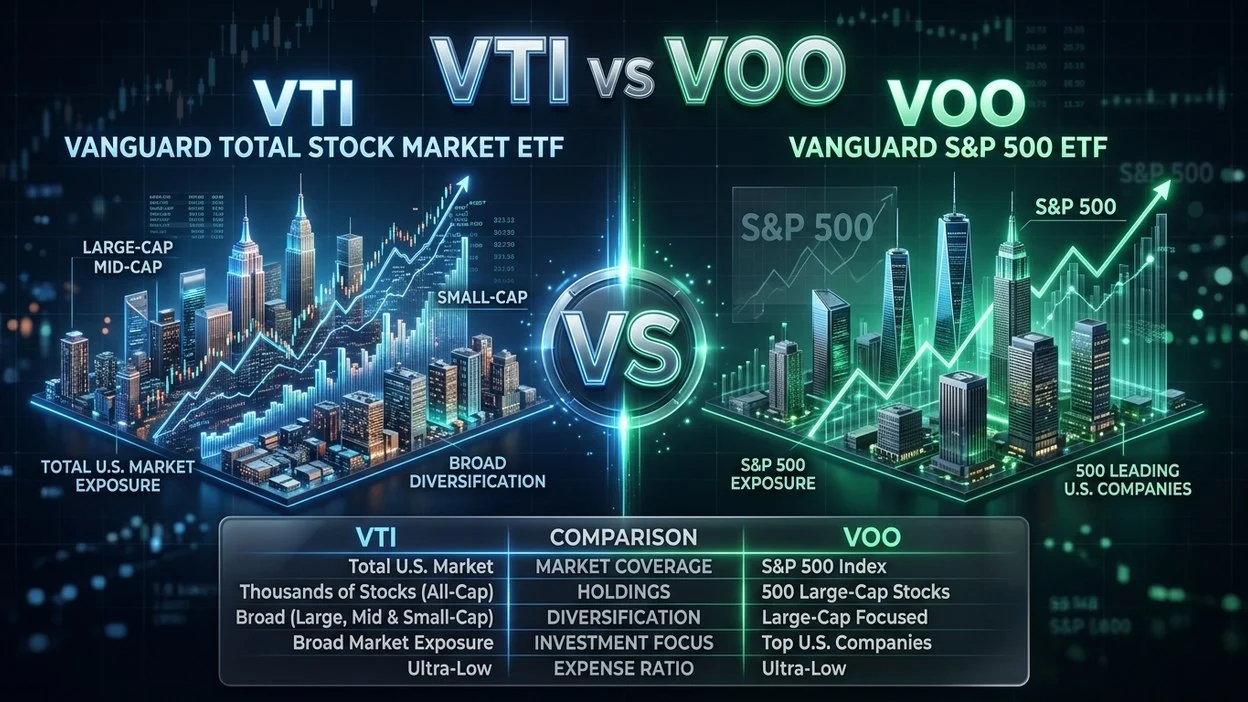
Choosing between VTI and VOO can be confusing if you are building a long-term investment portfolio. Both are popular Vanguard exchange-traded funds (ETFs), both provide exposure to the U.S. stock market, and both are commonly used by investors who want to grow their money over time. However, they follow different stock market indexes and offer different levels of diversification.
VTI tracks the CRSP US Total Market Index, giving investors exposure to large, mid-sized, small, and micro-cap U.S. companies. VOO tracks the S&P 500 Index, which focuses on approximately 500 leading large-cap U.S. companies. This means VTI offers broader coverage of the U.S. stock market, while VOO concentrates on large businesses. Their holdings overlap significantly, so owning both does not necessarily provide as much additional diversification as investors might expect. Understanding their fees, holdings, risk, and historical performance can help you decide which ETF better fits your investment goals, time horizon, and risk tolerance.
Quick Answer: VTI vs VOO
VTI and VOO are low-cost Vanguard ETFs designed for long-term stock market investing. VTI covers nearly the entire investable U.S. stock market, including small and mid-sized companies, while VOO focuses on large-cap stocks in the S&P 500. VTI offers broader diversification; VOO provides more concentrated exposure to large U.S. companies.
Why Do People Confuse VTI and VOO?
Investors often compare VTI and VOO because they have several important similarities:
- Both are offered by Vanguard.
- Both invest in U.S. stocks.
- Both provide exposure to many major American companies.
- Both are commonly used for long-term investing.
- Both have historically had low expense ratios.
- Both can be bought and sold through brokerage accounts.
Their similarities can make them appear almost identical. However, the main difference is the number and size of the companies they cover.
VTI includes large, medium-sized, and small U.S. companies, while VOO concentrates on the large-cap segment represented by the S&P 500. Because large companies make up a substantial portion of the total U.S. stock market’s value, their performance can be very similar.
First Word: VTI
VTI stands for Vanguard Total Stock Market ETF.
VTI is designed to track the CRSP US Total Market Index. It gives investors exposure to a broad range of publicly traded U.S. companies across different market capitalizations.
What Does VTI Include?
VTI holds thousands of U.S. stocks, although the exact number changes over time. Its portfolio includes:
- Large-cap stocks: Major companies with large market values.
- Mid-cap stocks: Medium-sized businesses.
- Small-cap stocks: Smaller publicly traded companies.
- Micro-cap exposure: Very small companies represented in its underlying market coverage.
Its largest holdings generally include major U.S. companies such as Apple, Microsoft, and Nvidia, although the weights change with market prices and index adjustments.
Advantages of VTI
- Broader diversification: Exposure to companies of different sizes.
- One-fund convenience: Provides access to much of the U.S. stock market through a single ETF.
- Low operating costs: Designed to keep annual fund expenses low.
- Small-company exposure: Includes businesses outside the S&P 500.
Potential Disadvantages of VTI
- Smaller companies can experience greater price volatility.
- It remains heavily influenced by the largest U.S. companies.
- It does not provide comprehensive international stock or bond diversification.
VTI may appeal to investors who want broad U.S. market exposure without having to select individual companies or separate large-, mid-, and small-cap funds.
Second Word: VOO
VOO stands for Vanguard S&P 500 ETF.
VOO is designed to track the S&P 500 Index, which represents approximately 500 leading large-cap U.S. companies. The index covers a substantial share of the total U.S. stock market’s value.
What Does VOO Include?
VOO primarily holds large, established American businesses across multiple sectors, including:
- Information technology
- Healthcare
- Financial services
- Consumer goods
- Communication services
- Industrials
- Energy
Its holdings commonly include companies such as Apple, Microsoft, and Nvidia, depending on current index composition and market weights.
Advantages of VOO
- Large-cap exposure: Focuses on leading U.S. companies.
- Low expense ratio: Keeps ongoing fund costs low.
- Simple portfolio choice: Provides a straightforward way to invest in S&P 500 companies.
- Established benchmark: Tracks a widely followed U.S. stock market index.
Potential Disadvantages of VOO
- It excludes most U.S. companies outside the S&P 500.
- Its performance can be strongly influenced by its largest holdings.
- It does not provide broad international stock or bond exposure.
VOO may suit investors who specifically want to follow the S&P 500 rather than own the broader U.S. stock market.
VTI vs VOO: Comparison Table
| Feature | VTI | VOO |
| Full name | Vanguard Total Stock Market ETF | Vanguard S&P 500 ETF |
| Benchmark | CRSP US Total Market Index | S&P 500 Index |
| Main focus | Broad U.S. stock market | Large-cap U.S. stocks |
| Number of holdings | Thousands, varying over time | Approximately 500 |
| Company sizes | Large, mid, small, and micro-cap exposure | Primarily large-cap |
| Diversification | Broader across company sizes | More concentrated in large companies |
| Expense ratio | Historically very low; verify current rate | Historically very low; verify current rate |
| Geographic exposure | Primarily U.S. companies | Primarily U.S. companies |
| International stocks | No broad international allocation | No broad international allocation |
| Bonds | No broad bond allocation | No broad bond allocation |
| Main appeal | Total U.S. market exposure | S&P 500 exposure |
| Suitable approach | Broad U.S. equity investing | Large-cap U.S. equity investing |
Both funds can be useful long-term investments, but neither guarantees a profit. Their market values can fall, sometimes significantly.
When Should You Choose VTI or VOO?
The better ETF depends on what you want your portfolio to accomplish. Neither fund is automatically better for every investor.
When to Choose VTI
VTI may be a good fit if you want:
- Exposure to large, medium-sized, and small U.S. companies.
- A single ETF covering a broad range of the domestic stock market.
- Less dependence on the S&P 500 segment alone.
- A straightforward option for long-term U.S. equity investing.
For example, a beginner who wants broad exposure to the U.S. stock market might choose VTI rather than purchasing separate large-cap, mid-cap, and small-cap funds.
When to Choose VOO
VOO may be a good fit if you want:
- Exposure specifically to the S&P 500.
- A portfolio focused on large U.S. companies.
- A simple way to follow a widely recognized stock market benchmark.
- An ETF that complements an investment strategy built around large-cap stocks.
For example, an investor who wants to track the performance of leading American companies may prefer VOO.
12 Practical Examples of VTI vs VOO
These examples explain how different investment goals can influence the choice. They are illustrations, not personalized financial advice.
- A beginner investing for retirement: VTI offers broad exposure to U.S. companies through one fund.
- An investor following the S&P 500: VOO directly targets that index.
- Someone seeking small-company exposure: VTI includes small-cap stocks, while VOO generally does not.
- An investor who already owns an S&P 500 fund: Adding VTI broadens company-size coverage, but much of the portfolio may overlap.
- A person building a simple portfolio: Either fund can serve as a U.S. stock allocation.
- An investor concerned about diversification: VTI covers more companies, although both funds remain exposed to the U.S. stock market.
- Someone investing for 20 years or more: Either fund could be considered, depending on the investor’s risk tolerance and wider portfolio.
- An investor seeking international stocks: Neither fund alone meets this goal; an international stock fund may be considered separately.
- Someone who wants lower risk: Neither ETF eliminates stock market risk. Adding bonds or other suitable assets may help manage overall portfolio risk.
- An investor comparing annual costs: Both funds are known for low fees, so the current expense ratios should be checked before choosing.
- Someone investing a fixed amount each month: Either ETF can support a regular investing plan if the brokerage offers suitable purchasing options.
- An investor who wants both funds: Owning both increases the portfolio’s allocation to overlapping large-cap stocks. It does not necessarily add much diversification.
Common Mistakes When Comparing VTI and VOO
Mistake 1: Assuming More Stocks Always Mean Higher Returns
VTI owns more companies, but the number of holdings does not determine investment returns. Performance depends on the underlying stocks, their weights, and market conditions.
Mistake 2: Thinking VOO Is Risk-Free
VOO invests in established large companies, but large businesses can lose value. The fund can experience substantial declines during market downturns.
Mistake 3: Assuming VTI and VOO Are Completely Different
Their portfolios overlap significantly. Many of VOO’s largest holdings are also among VTI’s largest holdings.
Mistake 4: Choosing Based Only on Past Performance
One fund may outperform the other over a particular period. That does not guarantee the same result in the future.
Mistake 5: Ignoring International Diversification
Both ETFs focus on U.S. stocks. Holding either one does not automatically provide broad exposure to companies in other countries.
Mistake 6: Ignoring Taxes and Brokerage Rules
Tax treatment, dividend taxation, trading access, and investment regulations depend on your country of residence and account type. Investors outside the United States should also check whether U.S.-domiciled ETFs are suitable for their circumstances.
Memory Trick: How to Remember VTI vs VOO
Use this simple memory trick:
- VTI = Total market: Think of investing across the U.S. stock market, including smaller companies.
- VOO = S&P 500: Think of investing in the large-cap companies represented by the S&P 500 Index.
Remember: VTI covers a broader range of U.S. company sizes, while VOO focuses on large-cap stocks.
American vs British English
VTI and VOO are ticker symbols, so their meanings do not change between American and British English.
However, financial terminology can vary slightly:
- ETF: Exchange-traded fund, a term commonly used in both countries.
- Stock: More common in American financial language.
- Share: Common in British financial language, although Americans use it too.
- Expense ratio: The annual operating expenses of a fund expressed as a percentage of its assets.
- Index: A benchmark used to track the performance of a group of investments.
VTI and VOO are U.S.-listed funds. Investors in the United Kingdom and other countries should check local tax rules, brokerage availability, and applicable investment restrictions before buying them.
Similar Words and Investment Terms
Understanding these related terms makes comparing ETFs easier.
- ETF: An investment fund traded on a stock exchange.
- Index fund: A fund designed to track a particular market index.
- S&P 500: An index representing approximately 500 leading U.S. large-cap companies.
- Total stock market fund: A fund designed to cover a broad portion of the stock market.
- Expense ratio: The annual fund operating cost expressed as a percentage of assets.
- Dividend: A payment a company may distribute to shareholders.
- Market capitalization: The total market value of a company’s outstanding shares.
- Diversification: Spreading investments across different assets to avoid relying too heavily on one investment.
- International ETF: An exchange-traded fund that invests in markets outside a specified home market.
- Bond ETF: An exchange-traded fund that invests in bonds rather than primarily in stocks.
Final Verdict: Is VTI Better Than VOO?
VTI may be the better fit if you want broader exposure to the U.S. stock market. VOO may be the better fit if you specifically want S&P 500 exposure.
Both funds offer a straightforward way to invest in U.S. equities. Their performance can be similar because they share many holdings, but differences in smaller-company exposure can cause their returns to diverge.
Instead of choosing based only on which fund performed better recently, consider your time horizon, risk tolerance, other investments, costs, and tax situation.
FAQs:
1. Is VTI better than VOO for beginners?
Either fund can be suitable for beginners seeking U.S. stock market exposure. VTI covers more company sizes, while VOO focuses on large-cap companies. The appropriate choice depends on the investor’s goals and overall portfolio.
2. Which ETF has higher returns, VTI or VOO?
Neither fund consistently delivers higher returns in every period. Their relative performance changes with market conditions, especially the performance of large-cap versus smaller companies. Compare returns over the same dates and include dividends when evaluating historical performance.
3. Is VTI more diversified than VOO?
Yes, in terms of company coverage and market capitalization. VTI includes large-, mid-, and small-cap U.S. stocks, while VOO concentrates on S&P 500 companies. However, both remain primarily U.S. stock investments.
4. Can I invest in both VTI and VOO?
Yes. You can hold both if your brokerage and account allow it. However, they share many holdings, so owning both increases exposure to overlapping companies rather than providing an entirely separate investment.
5. Which ETF has lower fees, VTI or VOO?
Both Vanguard ETFs are known for low expense ratios. The exact rates can change, so check the latest published fund expenses before investing. Also consider brokerage charges, taxes, and other applicable costs.
6. Is VTI safer than VOO?
Not necessarily. VTI’s broader company coverage does not eliminate market risk, and its smaller-company holdings can introduce additional volatility. VOO is also exposed to substantial losses when large U.S. stocks decline.
7. Which ETF is better for long-term investing?
Both can be considered for long-term investing. VTI provides broader U.S. market exposure, while VOO provides large-cap exposure. Your investment horizon, ability to tolerate losses, and allocation to other assets are important factors.
8. Do VTI and VOO pay dividends?
Yes. Both funds distribute dividends from their underlying holdings, subject to their distribution schedules and applicable policies. Dividend amounts vary, and distributions are not guaranteed.
Remember This
- VTI: Broad U.S. stock market exposure across different company sizes.
- VOO: Exposure to the S&P 500 and leading large-cap U.S. companies.
- VTI’s advantage: Broader coverage of the U.S. equity market.
- VOO’s advantage: Direct exposure to the S&P 500.
- Shared limitation: Neither fund alone provides broad international stock and bond diversification.
Conclusion:
VTI and VOO are both established choices for investors who want exposure to U.S. stocks. VTI covers a wider range of companies, while VOO concentrates on large-cap businesses in the S&P 500. Because their holdings overlap substantially, the differences between them may be smaller than their names suggest.
The right choice depends on your investment goals rather than a universal winner. Compare current fees, portfolio composition, taxes, and your wider asset allocation before investing. Remember that both ETFs can lose value, and past performance does not guarantee future results.

Autumn Gray is a bestselling storyteller admired for emotional novels, expressive writing, and memorable characters. Her inspiring books celebrate love, resilience, hope, and the transformative power of imagination and literature.