
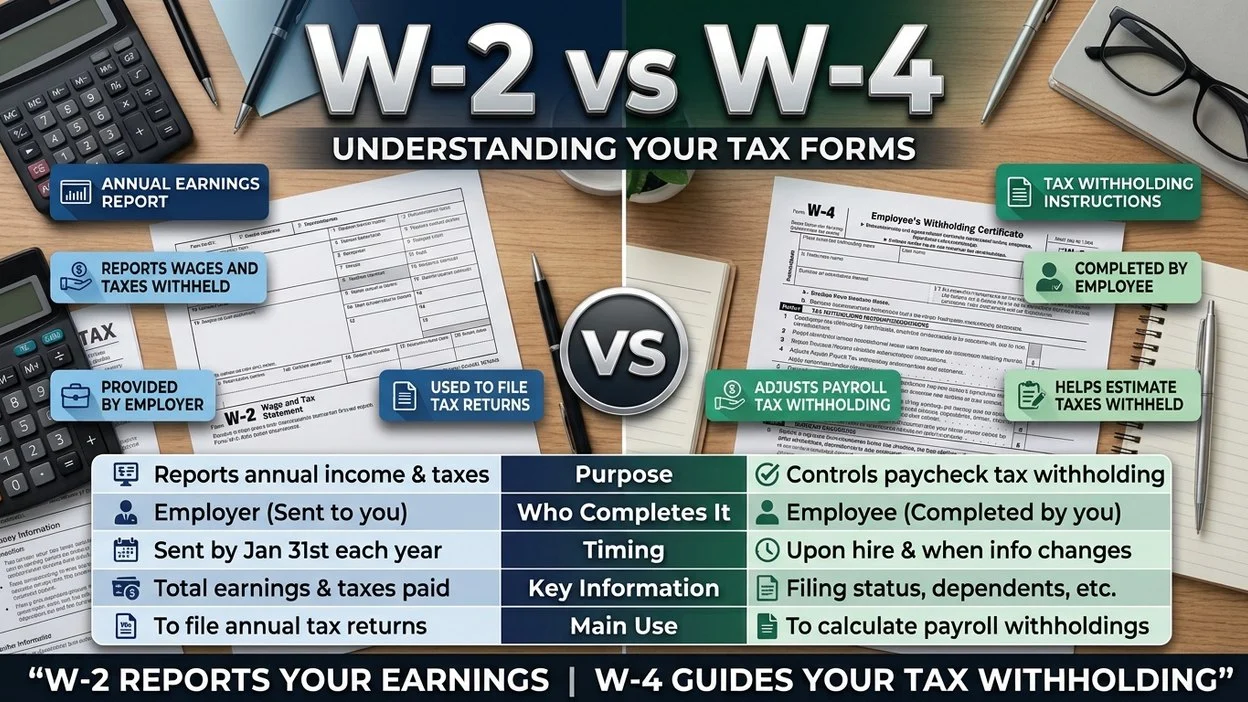
If you work in the United States, you may hear about two important tax forms: the W-2 and the W-4. Although their names look similar, they serve different purposes. A W-2 reports how much an employee earned and how much tax was withheld during the year, while a W-4 tells an employer how to calculate federal income tax withholding from an employee’s paycheck.
Understanding W-2 vs W-4 can help you complete employment paperwork, review your paychecks, and prepare for tax season. Most employees complete a W-4 when starting a job or when they need to update their withholding information. Employers generally provide a W-2 after the end of the tax year so employees can report their income on their tax returns. Knowing when to use each form can help you avoid confusion and make better decisions about your taxes.
Quick Answer
A W-2 is an annual wage and tax statement that reports your earnings and taxes withheld. A W-4 is a form you give your employer to help determine how much federal income tax to withhold from your paycheck. In simple terms, the W-4 helps calculate withholding, while the W-2 reports the final yearly figures.
Why Do People Confuse W-2 and W-4?
People often confuse these forms because both relate to employment, payroll, and income taxes in the United States. Both also contain information that helps employers and employees manage tax obligations.
However, the forms serve different purposes:
- W-2: Reports wages and tax withholding for the year.
- W-4: Provides information used to calculate federal income tax withholding from paychecks.
Another important difference is timing. Employees generally complete a W-4 when they begin a job, while employers provide a W-2 after the tax year ends.
First Word: W-2
The W-2, officially called the Wage and Tax Statement, is a tax document that an employer provides to an employee and files with the Social Security Administration, with applicable copies and information provided to tax authorities and the employee.
It summarizes an employee’s wages and certain taxes withheld during the calendar year.
What Information Does a W-2 Include?
A W-2 typically includes:
- Employee and employer identifying information
- Total wages, tips, and other compensation
- Federal income tax withheld
- Social Security wages and tax withheld
- Medicare wages and tax withheld
- Certain state and local wage and tax information, when applicable
- Other compensation or benefit information in designated boxes
Employees use their W-2 information when preparing their federal and, if applicable, state or local income tax returns.
When Do You Receive a W-2?
Employers generally must furnish W-2 forms to employees by January 31 following the tax year, subject to applicable deadline rules.
For example, your employer provides your 2026 W-2 in early 2027. You then use the information to prepare your 2026 income tax return.
Second Word: W-4
The W-4, officially called the Employee’s Withholding Certificate, is a form employees complete and give to their employer.
Its main purpose is to help the employer calculate the appropriate amount of federal income tax to withhold from each paycheck.
What Information Does a W-4 Include?
Depending on your circumstances, a W-4 may ask for information about:
- Filing status
- Multiple jobs or a working spouse
- Dependents and certain tax credits
- Other income
- Deductions
- Any additional federal income tax you want withheld
You do not necessarily need to complete every optional section. The information you provide should reflect your actual circumstances.
When Should You Complete a W-4?
You typically complete a W-4 when starting a new job. You may also submit an updated form if your circumstances change, such as when you get married, have a child, start another job, or want to adjust your withholding.
An updated W-4 can help align your paycheck withholding with your expected tax situation. However, withholding is not the same as your final tax liability.
W-2 vs W-4: Comparison Table
| Feature | W-2 | W-4 |
| Official name | Wage and Tax Statement | Employee’s Withholding Certificate |
| Main purpose | Reports annual wages and taxes withheld | Helps determine federal income tax withholding |
| Completed by | Employer prepares and files it | Employee completes it |
| Given to | Employee and relevant tax authorities | Employer |
| Timing | Generally issued after the tax year ends | Usually completed when starting a job or updating withholding |
| Reports annual wages | Yes | No |
| Helps calculate paycheck withholding | Not its main purpose | Yes |
| Used for tax returns | Yes | Indirectly, through withholding calculations |
| Updated during the year | Usually reflects year-end reporting and corrections | Can be updated when circumstances change |
| Typical example | Reports wages earned in 2026 | Helps determine withholding from 2026 paychecks |
When Should You Use a W-2 or W-4?
When to Use a W-2
You use your W-2 when you need to report employment income and tax withholding.
Common situations include:
- Preparing your annual federal income tax return
- Filing a state income tax return, if required
- Checking your yearly wages
- Confirming how much federal income tax your employer withheld
- Comparing reported wages with your payroll records
Example: If your W-2 reports $48,000 in wages and $4,000 in federal income tax withheld, those figures help you prepare your tax return. The $4,000 is not automatically your final tax bill or refund.
When to Use a W-4
You use a W-4 to provide your employer with information for calculating federal income tax withholding.
Common situations include:
- Starting a new job
- Getting married or divorced
- Having a child
- Starting a second job
- Adjusting withholding after reviewing your tax situation
- Requesting additional federal income tax withholding
Example: If you expect to owe more tax than your current withholding will cover, you may review your W-4 and consider requesting additional withholding.
12 Examples of W-2 vs W-4
1. Starting a New Job
You generally complete a W-4 so your employer can calculate federal income tax withholding. Your employer later provides a W-2 showing your yearly wages and withholding.
2. Preparing Your Tax Return
You use your W-2 to enter your employment income and federal tax withholding when preparing your tax return.
3. Getting Married
You may need to review your W-4 because your household income and tax circumstances may have changed. Your W-2 will later report the wages and withholding recorded for the year.
4. Having a Child
You may be eligible for certain tax benefits, depending on your circumstances. You can review your W-4 to account for eligible dependents and credits, while your W-2 reports annual employment information.
5. Working Two Jobs
You may need to account for multiple jobs on your W-4 to help avoid underwithholding. Each employer generally issues a separate W-2 for the wages it reports.
6. Checking Your Annual Salary
Your W-2 reports your wages for the year, subject to the way wages are reported in the applicable boxes. Your W-4 does not serve as an annual salary statement.
7. Reviewing a Tax Refund
Your W-2 shows federal income tax withheld by your employer. Your refund depends on your total tax liability, payments, credits, and other relevant factors.
8. Changing Your Tax Withholding
You can submit an updated W-4 to your employer. You do not normally change your W-2 simply because you want different withholding in future paychecks.
9. Moving to Another State
Your W-4 may need attention if your work or tax circumstances change, but state withholding requirements vary. Your W-2 may include state wage and withholding information when applicable.
10. Receiving Your First Paycheck
Your employer uses your W-4 information, along with payroll rules and other relevant details, to calculate federal income tax withholding. Your W-2 generally comes later, after the year ends.
11. Discovering an Error on Your W-2
Contact your employer if your W-2 contains incorrect wage or tax information. The employer may need to issue a corrected form, commonly called Form W-2c.
12. Wanting More Tax Withheld
You can generally request additional federal income tax withholding through your W-4. This may help reduce the risk of owing tax when you file, depending on your overall financial situation.
Common Mistakes About W-2 vs W-4
Mistake 1: Thinking Both Forms Are Tax Returns
Neither form is an income tax return. The W-2 reports employment wages and withholding, while the W-4 provides withholding instructions.
Mistake 2: Thinking a W-4 Reports Annual Earnings
A W-4 does not report how much you earned during the year. Your W-2 provides that annual employment information.
Mistake 3: Assuming a W-2 Guarantees a Refund
A W-2 reports taxes withheld, not the final result of your tax return. You may receive a refund, owe additional tax, or have little difference between the two.
Mistake 4: Forgetting to Update a W-4
Major life changes or a second job can affect the amount of tax you need to pay. Reviewing your withholding can help you avoid unexpected tax bills.
Mistake 5: Confusing Federal and State Withholding
The standard W-4 is used for federal income tax withholding. Some states have separate withholding forms and rules.
Memory Trick: How to Remember W-2 vs W-4
Use this simple memory trick:
- W-2 = What you earned: Think of your annual wage and tax report.
- W-4 = Withholding instructions: Think of the information your employer uses to calculate federal income tax withholding.
Remember the sequence: You generally complete a W-4 when you start working, receive paychecks throughout the year, and later receive a W-2 for that year’s wages and withholding.
American vs British English
W-2 and W-4 are forms used in the United States federal tax system. They are not standard tax form names in the United Kingdom.
In the United States, employers use W-4 information to calculate federal income tax withholding and provide W-2 forms to report employee wages and taxes.
In the United Kingdom, employers generally use the Pay As You Earn (PAYE) system to collect income tax and National Insurance contributions. Employees may receive a P60 summarizing their pay and tax deductions for a tax year, while a P45 provides information when they leave a job.
These documents have related purposes but are not exact equivalents of the US W-2 and W-4.
Similar Words and Tax Forms
Here are several related tax terms that can help you understand US payroll paperwork.
- W-2: Reports employee wages and taxes withheld during the year.
- W-4: Helps employers calculate federal income tax withholding.
- W-9: Provides a person’s taxpayer identification information to a requester, often for certain payments to nonemployees.
- 1099-NEC: Commonly reports qualifying nonemployee compensation.
- W-2c: Corrects errors on a previously issued W-2.
- Pay stub: Shows details about an individual paycheck, including earnings and deductions.
- Tax return: Reports income, deductions, credits, and other information used to calculate tax owed or a refund.
- Withholding: Money an employer deducts from wages and sends to tax authorities toward an employee’s tax obligations.
Final Verdict: W-2 vs W-4
The main difference between a W-2 and a W-4 is their purpose.
A W-2 reports your annual employment income and taxes withheld, while a W-4 helps your employer determine how much federal income tax to withhold from your paychecks.
You generally complete a W-4 when you start a job or need to update your withholding. You receive a W-2 after the tax year ends and use it when preparing your tax return.
FAQs:
1. Is a W-2 the same as a W-4?
No. A W-2 reports your annual wages and taxes withheld, while a W-4 provides information used to calculate federal income tax withholding from your paychecks.
2. Do I fill out a W-2 or W-4 when starting a job?
You generally complete a W-4 when starting a job. Your employer prepares your W-2 after the tax year ends.
3. Does a W-4 determine my tax refund?
Not directly. A W-4 affects paycheck withholding, which can influence whether you receive a refund or owe additional tax. Your final result depends on your overall tax situation.
4. Can I change my W-4 during the year?
Yes. You can generally submit an updated W-4 when your circumstances change or when you want to adjust your withholding.
5. What happens if I do not submit a W-4?
Your employer must generally apply the IRS default withholding rules when you do not provide a valid W-4. This may not reflect your personal tax circumstances, so completing the form is usually helpful.
6. When should I receive my W-2?
Employers generally must furnish W-2 forms by January 31 following the calendar year being reported, subject to applicable deadline rules. If the deadline falls on a weekend or legal holiday, the due date may shift.
7. Do independent contractors receive a W-2?
Independent contractors generally do not receive a W-2 for their contractor payments. Depending on the payment and reporting rules, they may receive Form 1099-NEC instead.
8. Can I use my W-4 to file my tax return?
A W-4 is not a substitute for a W-2 or a tax return. You may refer to your withholding choices when reviewing your tax situation, but your W-2 and other relevant tax documents provide the information needed for filing.
Remember This
- W-2: Shows what your employer reports about your annual wages and taxes withheld.
- W-4: Tells your employer how to calculate federal income tax withholding.
- W-2 comes after the tax year ends.
- W-4 is usually completed when you start a job and can be updated later.
Conclusion:
Understanding W-2 vs W-4 makes US employment paperwork easier to manage. Although both forms relate to income taxes, they perform different jobs: the W-4 helps determine how much federal income tax is withheld from your paycheck, while the W-2 summarizes your annual wages and withholding.
If you are starting a new job, make sure you understand your W-4 and review it when your circumstances change. When tax season arrives, check your W-2 carefully and keep it with your other tax records. If you are unsure how to complete a form or correct a tax issue, consult the IRS guidance or a qualified tax professional.

Delaney Brooks is a contemporary author celebrated for heartfelt fiction, vivid storytelling, and relatable characters. Her engaging novels inspire readers through emotional depth, creativity, resilience, and memorable literary journeys.