
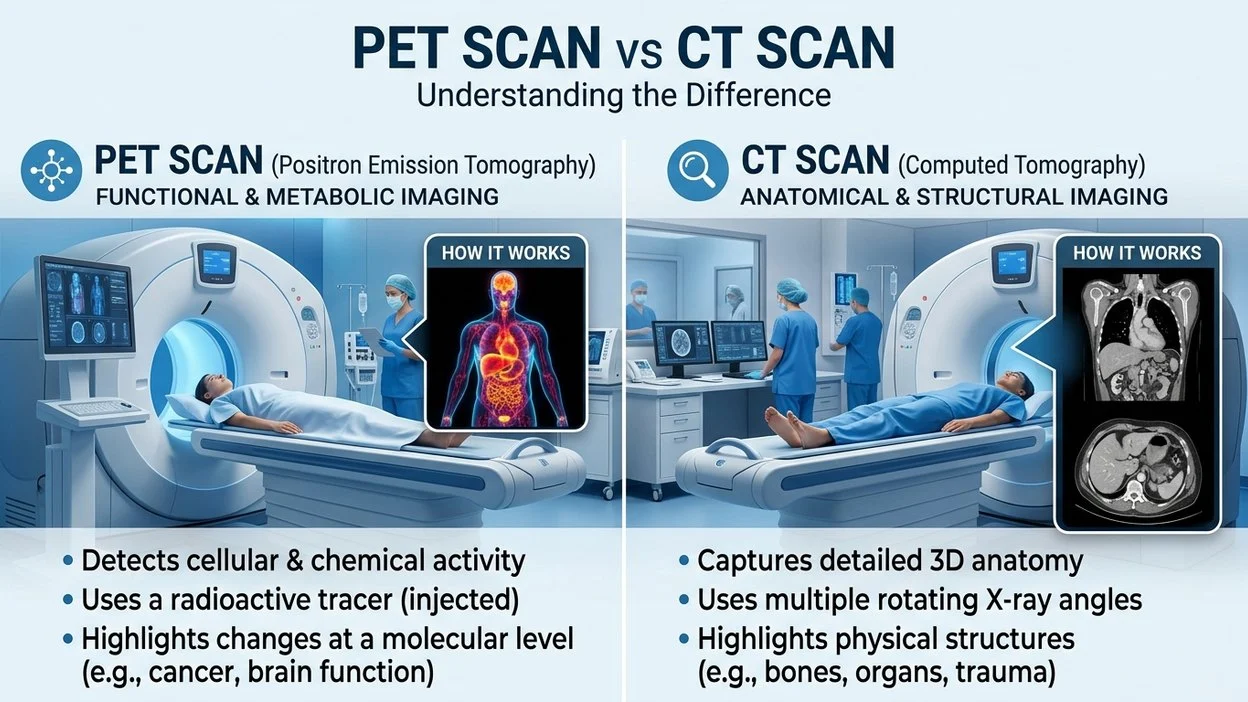
A PET scan and a CT scan are both medical imaging tests, but they show different kinds of information. A PET scan shows how tissues and organs are functioning by using a small amount of radioactive tracer, while a CT scan uses X-rays to create detailed pictures of the body’s internal structures. Doctors may use either test alone or combine them depending on the medical question.
The choice between a PET scan and a CT scan depends on what a healthcare professional needs to examine. CT scans are especially useful for showing anatomy, such as bones, organs, blood vessels, and other structures. PET scans can reveal areas with unusual metabolic activity. In some situations, doctors use a combined PET/CT scan, which provides both functional and anatomical information in one examination.
Quick Answer
A CT scan mainly provides detailed images of the body’s structure using X-rays, while a PET scan shows areas of increased or decreased metabolic activity using a radioactive tracer. CT is often useful for detecting structural problems, while PET can help evaluate metabolic changes. Doctors sometimes combine both as a PET/CT scan.
Why Do People Confuse PET Scans and CT Scans?
People often confuse PET and CT scans because both are imaging tests performed in hospitals and diagnostic centers. Both can produce detailed images that help doctors investigate diseases and monitor treatment.
The major difference is what the scan measures.
A CT scan focuses mainly on anatomy and structure. A PET scan focuses mainly on function and metabolic activity.
They can also be used together. A PET/CT examination combines metabolic information from PET with anatomical information from CT.
First Word: PET Scan
PET stands for Positron Emission Tomography.
A PET scan uses a small amount of a radioactive substance called a tracer. The tracer is introduced into the body, often through an injection. A scanner detects signals from the tracer and creates images showing areas where it accumulates.
One commonly used PET tracer is fluorodeoxyglucose (FDG), which behaves similarly to glucose. Some tissues use more glucose than others, and certain diseases can change how tissues use glucose.
PET scans can be useful for:
- Evaluating certain cancers
- Looking for areas of abnormal metabolic activity
- Assessing some heart conditions
- Evaluating certain neurological conditions
- Monitoring how some diseases respond to treatment
A PET scan does not simply show whether an area is physically large or small. It can provide information about how active that tissue is.
Second Word: CT Scan
CT stands for Computed Tomography.
A CT scan uses X-rays and computer processing to create cross-sectional images of the body. These images can provide detailed information about organs, bones, blood vessels, and other anatomical structures.
CT scans are commonly used to evaluate:
- Injuries
- Bone fractures
- Internal bleeding
- Lung conditions
- Abdominal problems
- Tumors and masses
- Blood vessels
- Certain infections
- Other structural abnormalities
A CT scan is particularly useful when a doctor needs a detailed picture of the body’s physical structures.
PET Scan vs CT Scan Comparison Table
| Feature | PET Scan | CT Scan |
| Full name | Positron Emission Tomography | Computed Tomography |
| Main purpose | Shows metabolic or functional activity | Shows detailed body structures |
| Technology | Radioactive tracer and PET imaging | X-rays and computer processing |
| Best known for | Identifying areas with abnormal activity | Detailed anatomical imaging |
| Radiation | Yes | Yes |
| Contrast | May use a radioactive tracer; CT component may also use contrast in PET/CT | Sometimes uses contrast material |
| Common cancer use | Helps assess metabolic activity and treatment response | Shows size, location, and anatomy of tumors |
| Scan time | Often longer because tracer uptake may be needed | Usually relatively quick |
| Images | Functional/metabolic information | Anatomical information |
| Combined test | Often performed as PET/CT | Can be part of PET/CT |
| Main limitation | Less detailed anatomical information by itself | Does not directly measure tissue metabolism |
When Should You Use a PET Scan?
A PET scan may be recommended when a healthcare professional needs information about tissue activity or metabolism.
It can be particularly useful in certain cancer evaluations, where PET imaging may help identify areas that are metabolically active. It can also have applications in some neurological and cardiac conditions.
The exact usefulness of PET depends on the tracer being used and the medical condition being investigated.
When Should You Use a CT Scan?
A CT scan may be preferred when detailed information about body structures is needed.
For example, CT can provide useful images of:
- The chest
- Abdomen
- Pelvis
- Brain
- Bones
- Lungs
- Blood vessels
- Soft tissues
CT is also frequently used in urgent situations because many CT examinations can be completed quickly.
When Is PET/CT Used?
A PET/CT scan combines the two technologies.
The PET component provides information about metabolic activity, while the CT component provides anatomical detail. Combining these images can help doctors determine both where an abnormality is located and how metabolically active it appears.
PET/CT is commonly used in the evaluation of certain cancers, although its use depends on the specific disease and clinical situation.
10+ Examples of PET Scan vs CT Scan
1. Finding a Fracture
A CT scan can provide detailed images of bones and help doctors evaluate complex fractures.
A PET scan is generally not the first imaging test used simply to look for a broken bone.
2. Evaluating a Lung Mass
CT can show the size, shape, and location of a lung mass.
A PET scan may provide additional information about metabolic activity when clinically appropriate.
3. Cancer Staging
PET/CT may be used for certain cancers to help evaluate disease distribution and metabolic activity.
CT provides important anatomical information about the size and location of abnormalities.
4. Checking Internal Injuries
CT can be especially useful in emergency settings for evaluating internal injuries and bleeding.
PET is generally not used as the first-line emergency imaging test for acute trauma.
5. Evaluating Brain Structure
CT can provide images of brain structures and may be used quickly in certain emergency situations.
PET can provide functional information about brain activity in selected clinical situations.
6. Monitoring Certain Cancer Treatments
PET may help assess changes in metabolic activity during or after treatment for some cancers.
CT can show whether a tumor or other abnormality has changed in size.
7. Examining Blood Vessels
Specialized CT techniques can provide detailed images of blood vessels.
PET is not primarily an anatomical blood-vessel imaging test.
8. Investigating Abdominal Pain
CT can help identify structural causes of abdominal pain, depending on the clinical situation.
PET is usually not the first test chosen for routine acute abdominal pain.
9. Looking at Bone Anatomy
CT provides detailed structural images of bones.
PET can sometimes show abnormal metabolic activity involving bone, but it answers a different question.
10. Evaluating Certain Neurological Conditions
PET can provide information about brain metabolism in selected conditions.
CT can show structural abnormalities such as bleeding, swelling, or certain masses.
11. Detecting Internal Bleeding
CT, particularly when performed with appropriate protocols, can be highly useful for identifying internal bleeding.
PET is generally not used for rapid detection of acute internal bleeding.
12. Combining Information
A PET/CT can provide both metabolic and anatomical information, which can be more informative than either type of information alone in selected cases.
Common Mistakes About PET and CT Scans
Mistake 1: Thinking PET and CT Are the Same
They are different imaging technologies. PET focuses primarily on metabolic activity, while CT focuses primarily on anatomy.
Mistake 2: Assuming PET Is Always Better
Neither test is universally better. The appropriate scan depends on the medical question.
Mistake 3: Thinking CT Uses No Radiation
CT uses ionizing radiation because it uses X-rays.
Mistake 4: Thinking PET Has No Radiation
PET involves exposure to radiation from the radioactive tracer. If PET is combined with CT, the CT portion also involves X-ray radiation.
Mistake 5: Assuming Every Tumor Is Best Evaluated With PET
Different cancers and clinical situations require different imaging strategies. PET may be useful for some conditions but not appropriate for every tumor or every patient.
Mistake 6: Thinking a PET Scan and PET/CT Are Exactly the Same
A PET scan provides PET imaging, while a PET/CT examination combines PET with CT imaging.
Memory Trick
Use this simple rule:
PET = Performance
Think of PET as showing how tissues are performing or functioning metabolically.
CT = Construction
Think of CT as showing the body’s construction or structure.
So:
PET → activity
CT → anatomy
And:
PET/CT → activity + anatomy
American vs British English
The terms PET scan and CT scan are widely understood in both American and British English.
The terminology is generally the same:
- PET scan = Positron Emission Tomography scan
- CT scan = Computed Tomography scan
In British medical writing, CT may sometimes be described as computed tomography, while the underlying technology and abbreviation remain the same.
Similar Words
Several medical imaging terms are related to PET and CT scans:
- MRI: Magnetic Resonance Imaging, which uses magnetic fields and radio waves rather than X-rays.
- X-ray: An imaging technique that uses X-rays to create pictures of internal structures.
- Ultrasound: Uses sound waves to create images.
- PET/CT: Combines PET metabolic imaging with CT anatomical imaging.
- Contrast CT: A CT examination performed using contrast material when appropriate.
- Nuclear medicine: A field that uses radioactive substances for diagnosis or treatment.
- Tracer: A radioactive substance used to help visualize biological activity during certain nuclear medicine scans.
Final Verdict
The main difference between a PET scan and a CT scan is what they are designed to show. PET provides information about metabolic activity, while CT produces detailed anatomical images.
A CT scan can be especially useful for examining structures such as bones, organs, lungs, and blood vessels. PET can provide additional information about how certain tissues are functioning. In selected cases, doctors use PET/CT to combine both types of information.
FQAs:
1. Which is better, PET scan or CT scan?
Neither is automatically better. A CT scan is generally better for detailed anatomical information, while PET provides metabolic information. The appropriate test depends on the patient’s symptoms and the clinical question.
2. Is a PET scan more powerful than a CT scan?
PET is not simply more powerful than CT. The two tests provide different information. PET shows metabolic activity, while CT shows detailed anatomy.
3. Does a PET scan show cancer?
PET can help identify areas of abnormal metabolic activity associated with some cancers. However, increased tracer uptake does not automatically mean cancer, and PET findings must be interpreted with other clinical and imaging information.
4. Does a CT scan show tumors?
Yes. CT can show tumors or masses and can provide information about their size, location, and relationship to surrounding structures.
5. Which scan has more radiation, PET or CT?
Radiation exposure varies depending on the specific examination, tracer, CT protocol, and other factors. PET involves radiation from the tracer, while CT involves X-ray radiation. A PET/CT involves radiation from both components.
6. How long does a PET scan take compared with a CT scan?
A CT scan is often relatively quick. PET examinations can take longer because the tracer may need time to distribute through the body before imaging begins. The total time varies by examination type and facility.
7. Why would a doctor order a PET/CT instead of one scan?
A PET/CT can provide both metabolic and anatomical information. This combination can be useful in selected clinical situations, particularly when doctors need to understand both the location and activity of an abnormal area.
8. Can PET and CT scans be done on the same day?
Yes. PET and CT imaging are often performed together as a PET/CT examination when clinically appropriate.
Remember This
The easiest way to remember the difference is:
PET = metabolic activity
CT = anatomical structure
PET/CT = metabolic activity + anatomical structure
A PET scan uses a radioactive tracer to show biological activity, while a CT scan uses X-rays to create detailed images of the body’s structures.
Conclusion:
PET and CT scans are valuable medical imaging tools, but they answer different questions. CT is mainly used to create detailed pictures of anatomy, while PET provides information about metabolic activity. Because of these differences, one scan cannot always replace the other.
In some situations, combining the two technologies through a PET/CT examination gives doctors a more complete view. The appropriate imaging test depends on the patient’s condition, symptoms, medical history, and the specific information the healthcare team needs.

Delaney Brooks is a contemporary author celebrated for heartfelt fiction, vivid storytelling, and relatable characters. Her engaging novels inspire readers through emotional depth, creativity, resilience, and memorable literary journeys.


