
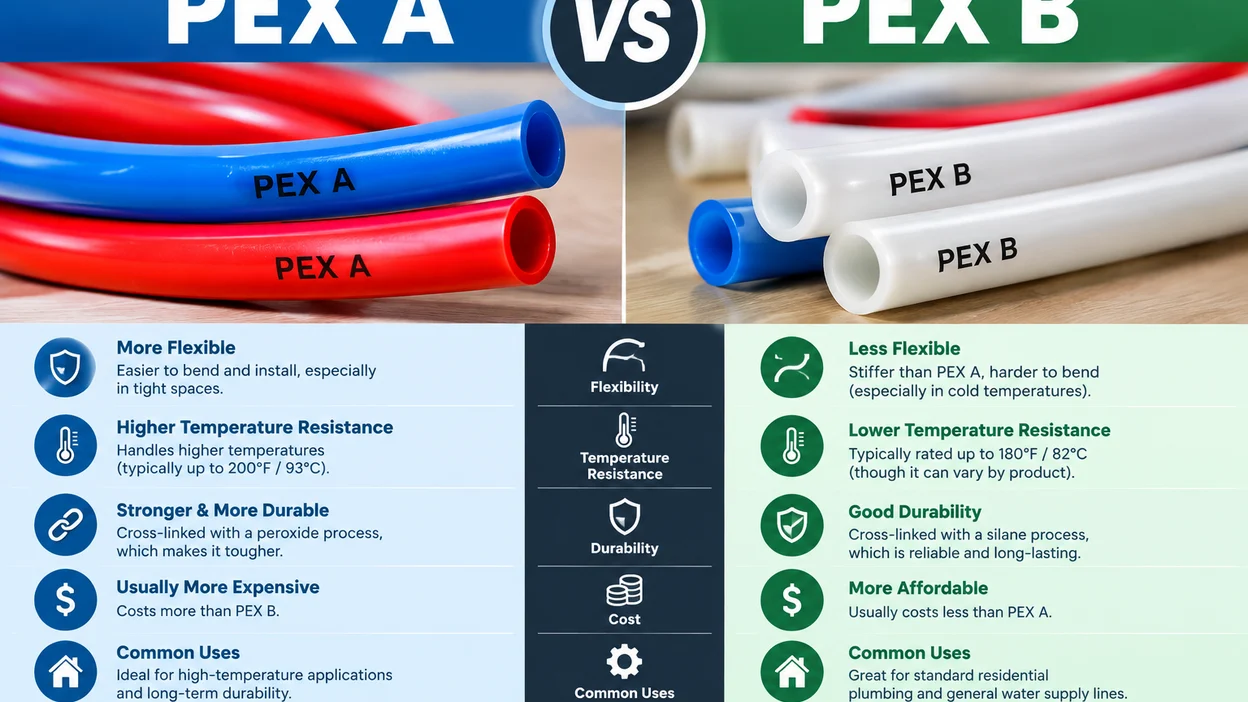
PEX-A and PEX-B are two common types of cross-linked polyethylene (PEX) tubing used for plumbing. The main difference is how they are manufactured, which affects flexibility, expansion behavior, fitting options, cost, and installation. PEX-A is generally more flexible and works with expansion-style fittings, while PEX-B is usually stiffer and commonly uses crimp or clamp fittings.
Both types can be suitable for residential plumbing, radiant heating, and other approved applications. However, they are not exactly the same in performance or installation. Your choice may depend on the plumbing design, local building codes, available fittings, installation method, and budget.
Understanding the differences between PEX-A vs PEX-B can help homeowners, plumbers, builders, and DIY users choose the right tubing for a particular project. The best option is not necessarily the most expensive one; it depends on where and how the PEX will be installed.
Quick Answer
PEX-A is generally more flexible, has better resistance to kinking, and can be used with expansion fittings. PEX-B is typically stiffer, often costs less, and commonly uses crimp or clamp connections. Both can provide reliable plumbing performance when properly installed with compatible, code-approved components.
Why Do People Confuse PEX-A and PEX-B?
PEX-A and PEX-B look very similar because both are types of cross-linked polyethylene tubing. They are often available in the same colors and diameters and can be used for many of the same plumbing applications.
The letters A and B do not mean that one is automatically better than the other. They identify different manufacturing methods used to create cross-linked polyethylene.
The manufacturing process affects properties such as:
- Flexibility
- Resistance to kinking
- Fitting systems
- Expansion and contraction behavior
- Installation methods
- Cost
- Repair options
First Word: PEX-A
PEX-A is PEX tubing manufactured using the Engel method, a peroxide-based cross-linking process.
One of its main advantages is flexibility. PEX-A can generally make tighter bends than PEX-B and is particularly well suited to systems using expansion-style fittings.
PEX-A is also known for its ability to recover from certain types of kinks when properly heated and repaired according to the manufacturer’s instructions.
Common characteristics of PEX-A include:
- High flexibility
- Good resistance to kinking
- Compatible with expansion-style fittings
- Easier routing around obstacles
- Often suitable for fewer connections in some installations
- Typically more expensive than PEX-B
The exact performance depends on the specific product and manufacturer.
Second Word: PEX-B
PEX-B is generally produced using a silane-based moisture-cure process.
PEX-B is commonly more rigid than PEX-A. It is widely used with mechanical connection systems such as copper crimp rings and stainless-steel clamp systems, depending on the manufacturer’s approvals.
PEX-B can be an economical choice for many plumbing projects.
Common characteristics of PEX-B include:
- Generally lower material cost
- More rigid than PEX-A
- Commonly used with crimp fittings
- Commonly used with clamp fittings
- Widely available
- Reliable when properly installed
- More difficult to make tight bends compared with PEX-A
PEX-B is not simply a lower-quality version of PEX. It has different characteristics and can be an excellent choice for many applications.
PEX-A vs PEX-B Comparison Table
| Feature | PEX-A | PEX-B |
| Full name | Cross-linked polyethylene, Type A | Cross-linked polyethylene, Type B |
| Common manufacturing method | Engel/peroxide | Silane/moisture-cure |
| Flexibility | Generally higher | Generally lower |
| Kink resistance | Generally better | Generally lower |
| Kink repair | Can often recover with proper heat | Typically more limited |
| Common fittings | Expansion and compatible mechanical fittings | Crimp, clamp, and compatible mechanical fittings |
| Installation | Easy to route around obstacles | Often straightforward but somewhat stiffer |
| Material cost | Usually higher | Usually lower |
| Expansion fitting compatibility | Yes, when product is approved | Depends on product/system |
| Tight bends | Easier | More difficult |
| Availability | Widely available | Widely available |
| Best known advantage | Flexibility | Value and availability |
When Should You Use PEX-A?
PEX-A can be a good choice when flexibility is especially important.
Consider PEX-A for:
- Plumbing with many bends
- Tight installation spaces
- Projects requiring expansion fittings
- Long continuous runs
- Installations where reducing fittings is useful
- Areas where kink resistance is important
- Certain radiant heating applications
For example, if a water line needs to travel around several corners, the flexibility of PEX-A can make installation easier.
When Should You Use PEX-B?
PEX-B can be a good choice when affordability and common mechanical fittings are priorities.
Consider PEX-B for:
- Standard residential plumbing
- Straightforward water-supply runs
- Projects using crimp fittings
- Projects using clamp fittings
- Cost-conscious installations
- Applications where the tubing does not require extremely tight bends
For a relatively simple plumbing layout, PEX-B can provide excellent value.
10+ Examples of PEX-A vs PEX-B
1. Tight Corner
PEX-A is generally easier to bend around a tight corner because it is more flexible.
2. Straight Water Line
PEX-B can work very well for a straightforward, mostly straight plumbing run.
3. Expansion Fittings
PEX-A is commonly associated with expansion-style connection systems.
4. Crimp Fittings
PEX-B is commonly used with copper crimp-ring connections when the tubing and fittings are approved for that system.
5. Clamp Fittings
PEX-B is also frequently used with stainless-steel clamp-style connections.
6. Crowded Plumbing Space
PEX-A can be easier to route through a crowded wall or ceiling because of its flexibility.
7. Budget Plumbing Project
PEX-B may be attractive when keeping material costs under control is important.
8. Repairing a Kink
PEX-A has an advantage because certain PEX-A products can recover from a kink using the manufacturer’s approved repair method.
9. Long Plumbing Runs
Both PEX-A and PEX-B can be used for long runs when the product, sizing, support, and installation method are appropriate.
10. Radiant Heating
Both types can be used in approved radiant-heating applications. Always verify that the specific tubing is rated and approved for the intended system.
11. DIY Plumbing
PEX-B may appeal to DIY users who prefer widely available crimp or clamp connection systems, while PEX-A can be attractive to users who want flexible tubing and expansion connections.
12. Professional Plumbing
Professional plumbers may choose either type depending on their preferred connection system, project requirements, local codes, and material availability.
Common Mistakes
Mistake 1: Thinking PEX-A Is Always Better
PEX-A has advantages, especially flexibility, but that does not mean it is automatically the best option for every project.
Mistake 2: Thinking PEX-B Is Cheap Because It Is Poor Quality
PEX-B can be a reliable plumbing material when it meets the required standards and is correctly installed.
Mistake 3: Mixing Incompatible Fittings
Do not assume every fitting works with every PEX product. Always verify compatibility and follow the fitting and tubing manufacturer’s instructions.
Mistake 4: Ignoring Local Plumbing Codes
Plumbing requirements can vary by location. A product that is suitable in one application may have different requirements elsewhere.
Mistake 5: Using the Wrong Connection Tool
Expansion fittings require the appropriate expansion tool and compatible components. Crimp and clamp systems require their own proper tools and procedures.
Mistake 6: Focusing Only on Price
The cheapest tubing may not be the best choice if the installation requires greater flexibility or a particular connection system.
Mistake 7: Assuming Color Determines PEX Type
Red and blue tubing commonly indicate hot and cold water, but color alone does not reliably tell you whether the tubing is PEX-A or PEX-B.
Memory Trick
A simple way to remember the difference is:
PEX-A = A for Agile
Think flexible and easy to bend.
PEX-B = B for Budget
Think often economical and commonly used with crimp or clamp connections.
This is only a memory aid, not a technical rule. Always check the product specifications before installation.
American vs British English
The term PEX is widely used in American plumbing terminology. It stands for cross-linked polyethylene.
In British English, plumbing terminology can differ depending on the application and region. PEX tubing is also used internationally, but product standards, terminology, and installation requirements may vary.
For readers in the United States, PEX-A and PEX-B are familiar classifications of PEX tubing. International users should check the relevant local standards and product approvals.
Similar Words
Several terms are closely related to PEX-A and PEX-B:
- PEX: Cross-linked polyethylene tubing.
- PEX-A: A type of PEX produced using the Engel/peroxide method.
- PEX-B: A type of PEX generally produced using a silane/moisture-cure process.
- PEX-C: Another PEX manufacturing type, commonly produced using an irradiation method.
- Crimp fitting: A connection system that commonly uses a crimp ring and tool.
- Clamp fitting: A connection system using a clamp ring tightened with an appropriate tool.
- Expansion fitting: A connection system in which PEX tubing is expanded before inserting a compatible fitting.
- Manifold: A component used to distribute water to multiple plumbing lines.
- Cross-linked polyethylene: The polymer material from which PEX tubing is made.
Final Verdict
When comparing PEX-A vs PEX-B, the biggest practical difference is usually flexibility and the connection system. PEX-A is generally more flexible and works particularly well with expansion-style fittings. PEX-B is generally stiffer and is commonly paired with crimp or clamp connections.
Neither option is universally better. Choose based on the plumbing layout, fitting system, product certification, local code requirements, installation tools, and budget. For a complex project, following manufacturer instructions and applicable plumbing regulations is more important than simply choosing PEX-A or PEX-B.
FAQs:
1. Is PEX-A better than PEX-B?
Not in every situation. PEX-A is generally more flexible and has advantages for tight bends and expansion fittings, while PEX-B is often more economical and works well with common crimp and clamp systems.
2. Which is cheaper, PEX-A or PEX-B?
PEX-B is generally less expensive than PEX-A, although prices vary by manufacturer, size, location, and supplier.
3. Can PEX-B be used with expansion fittings?
Do not assume that all PEX-B tubing is compatible with expansion fittings. Use only a tubing-and-fitting system that the manufacturer specifically approves for that connection method.
4. Which PEX is more flexible?
PEX-A is generally more flexible than PEX-B. This can make it easier to route through tight spaces and around corners.
5. Which PEX is best for DIY plumbing?
Either can work for DIY projects. PEX-B may appeal to users who prefer common crimp or clamp systems, while PEX-A may be easier to route because of its flexibility. The connection system and available tools should be considered.
6. Can PEX-A and PEX-B be used for the same plumbing?
They can often be used for many of the same approved applications, but their fitting systems and installation requirements may differ. Always verify compatibility, ratings, and local code requirements.
7. Can PEX-A and PEX-B be used for drinking water?
PEX tubing can be approved for potable-water applications, but the specific product must have the appropriate certification and approval for that use. Always check the product markings and local requirements.
8. Does PEX-A last longer than PEX-B?
There is no simple rule that PEX-A always lasts longer. Service life depends on the specific product, installation quality, operating conditions, water conditions, and whether the tubing is used within its approved limits.
Remember This
The easiest way to remember PEX-A vs PEX-B is:
PEX-A → More flexible → Expansion fittings
PEX-B → More rigid → Often crimp or clamp fittings
Both can be dependable choices when the correct product and connection system are used properly.
Conclusion:
PEX-A and PEX-B are both widely used types of cross-linked polyethylene tubing, but they have different characteristics. PEX-A generally stands out for flexibility, kink resistance, and compatibility with approved expansion systems. PEX-B is commonly valued for its affordability, availability, and compatibility with widely used crimp and clamp connections.
The best choice depends on your specific plumbing project rather than a simple “A is better than B” rule. Consider flexibility, fittings, tools, cost, local plumbing requirements, and the manufacturer’s instructions before making a decision.

Reagan Hughes writes inspiring contemporary stories blending hope, emotion, and authentic characters. Her thoughtful novels encourage resilience, compassion, self-discovery, and meaningful connections, captivating readers across diverse audiences worldwide.