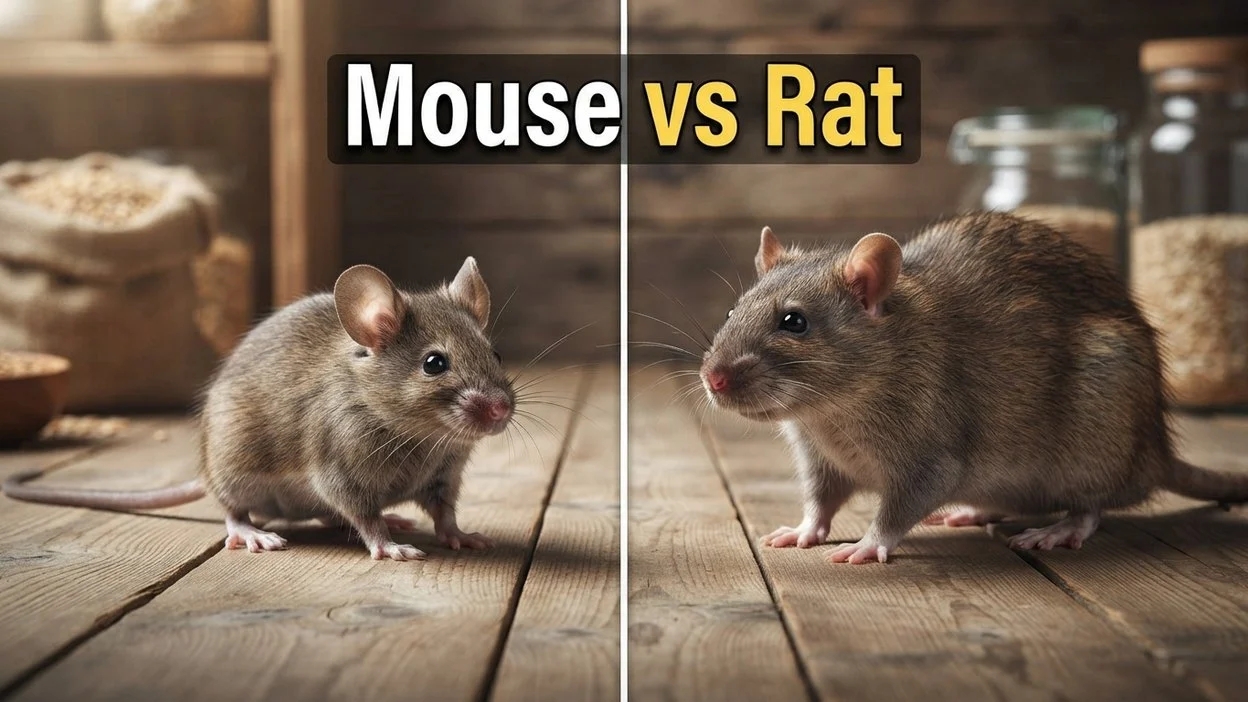
Mouse and rat are two different animals, and the easiest way to tell them apart is size. A mouse is small, with large ears and a thin tail. A rat is much bigger, with a thick tail, a blunt nose, and a heavier body. Many people mix them up because both are furry rodents that live near humans.
In this guide, you will learn how the two animals differ in size, ears, tails, droppings, and behavior. You will also see how the words are used in everyday English, from the computer mouse to phrases like “smell a rat.” Whether you are a student, a language learner, or someone dealing with a pest problem, the simple examples below will help you choose the right word with confidence.
Quick Answer: What Is the Difference Between a Mouse and a Rat?
A mouse is a small rodent with big ears, a pointed nose, and a thin tail. A rat is a larger rodent with a thicker tail, a blunt nose, and smaller ears for its head. Adult mice weigh about 20 grams, while adult rats often weigh 200 grams or more.
Why Do People Confuse Mice and Rats?
The two animals share many features, so confusion is common:
- Both are rodents with fur, whiskers, and sharp front teeth.
- Both often live in homes, barns, and city areas.
- Both have long tails and move quickly.
- Both are often seen at night or in dark places.
- A young rat can look like an adult mouse, which makes size alone misleading.
Language adds to the confusion. Both words appear in idioms, cartoons, and technology, so learners often wonder which one fits a sentence.
What Is a Mouse?
A mouse (plural: mice) is a small rodent. The most common type is the house mouse. It has a small body, a pointed snout, large round ears, and a thin tail with very fine hair.
Key facts about mice:
- Size: The body is about 7 to 10 cm (3 to 4 inches) long, not counting the tail.
- Weight: About 12 to 30 grams.
- Behavior: Mice are curious. They explore new objects quickly.
- Droppings: Small and pointed, about the size of a grain of rice.
The word “mouse” also names the device you use with a computer. Its shape and cable once reminded people of the animal.
What Is a Rat?
A rat (plural: rats) is a larger rodent. Common types are the Norway rat and the black rat (also called the roof rat). Rats have a thick body, a blunt nose, small ears, and a long, thick, scaly-looking tail.
Key facts about rats:
- Size: The body of a Norway rat is about 20 to 25 cm (8 to 10 inches) long, not counting the tail.
- Weight: About 250 to 500 grams for Norway rats. Black rats are lighter.
- Behavior: Rats are careful. They often avoid new objects at first.
- Droppings: Larger and capsule-shaped, about 12 to 20 mm long.
Rats are also popular pets and lab animals because they are smart and can learn tricks.
Mouse vs Rat: Comparison Table
| Feature | Mouse | Rat |
| Body size | Small (7–10 cm without tail) | Large (up to 25 cm without tail) |
| Weight | About 12–30 g | About 150–500 g |
| Ears | Large compared to the head | Smaller compared to the head |
| Nose | Pointed | Blunt |
| Tail | Thin, finely haired | Thick, scaly-looking |
| Droppings | Small, rice-sized, pointed | Larger, capsule-shaped |
| Behavior | Curious, explores new things | Cautious around new things |
| Plural form | Mice | Rats |
| Gap it can squeeze through | About 6 mm (¼ inch) | About 12 mm (½ inch) or more |
| Common uses of the word | Computer mouse, “quiet as a mouse” | “Smell a rat,” “rat race,” “lab rat” |
When to Use Each Word
Use mouse when you mean:
- A small rodent with big ears and a thin tail
- The computer device you click
- A shy, quiet, or timid person (as in “a mousy person”)
Use rat when you mean:
- A larger rodent with a thick tail
- A person who betrays others (informal and negative)
- A person who loves a place or hobby, as in “gym rat” (informal and often friendly)
If you are unsure about an animal’s size, look at the droppings, the tail, and the ears. These clues are more reliable than size alone.
12 Examples of Mouse and Rat in Sentences
- A small mouse ran across the kitchen floor.
- We found two mice behind the fridge.
- Please move the mouse to the left and click the icon.
- The rat was almost as long as a cat’s head.
- Rats are very smart and can learn their names.
- She is as quiet as a mouse in the library.
- I think someone broke the rule. I smell a rat.
- He is tired of the rat race and wants a calmer job.
- My brother is a gym rat who trains every morning.
- The scientist used a lab rat in the study.
- The cat chased the mouse around the garden. It was a real game of cat and mouse.
- He ratted on his friend and told the teacher the truth.
Common Mistakes with Mouse vs Rat
- Using “mouses” for the animal. The plural of the animal is always “mice.”
- Calling a baby rat a mouse. Young rats can be small, but they have thicker tails and bigger feet.
- Judging only by size. A baby rat and a large mouse can look similar. Check the ears, nose, and droppings.
- Using “rat” for a harmless shy person. “Rat” is an insult in most cases. Use “mousy” or “shy” instead.
- Writing “rats” when you mean “computer mice.” Only “mouse” is used for the device.
- Assuming all rats are dirty. Pet rats are clean animals that groom themselves often. The problem is wild rats that carry germs.
Memory Trick
Think of the letters: Mouse = Mini, Rat = Really big.
Another tip: a mouse has big ears and a thin tail. A rat has a thick tail and a heavy body. If the ears look too big for the head, it is probably a mouse.
American vs British English
The spelling of both words is the same in American and British English. The difference is in small word choices:
- Mousy is the common spelling in both. Mousey is a less common variant, more often seen in British writing.
- A mouse-colored coat in American English is mouse-coloured in British English.
- Pest control workers are often called exterminators in the US. In the UK, they are usually called pest controllers.
- “Rat” idioms like “smell a rat” and “rat race” are understood in both varieties.
Similar Words to Know
- Rodent: The group name for animals like mice, rats, squirrels, and hamsters.
- Vole: A small rodent with a rounder face, shorter tail, and smaller ears than a mouse.
- Shrew: A tiny animal that looks like a mouse but is not a rodent. It has a long, pointed snout.
- Hamster and gerbil: Common pet rodents, usually with shorter tails.
- Mousse: A soft dessert or hair product, pronounced “moos.”
- Moose: A large deer-like animal from North America.
- Rate, rot, and root: Look similar to “rat” but have different meanings.
Final Verdict
Choose mouse for a small, big-eared animal with a thin tail, and for the computer device. Choose rat for a larger animal with a thick tail and a blunt nose. In idioms, “mouse” suggests quietness or shyness, while “rat” often suggests betrayal or hard work in a busy world. When identifying a pest, use several clues together: size, ears, tail, and droppings.
FAQs:
How can I tell if it is a mouse or a rat?
Look at the size, ears, tail, and droppings. Mice are smaller, with big ears and thin tails. Rats are larger, with thick tails and smaller ears compared to their heads. Mouse droppings are rice-sized, while rat droppings are larger and capsule-shaped.
Is a rat just a big mouse?
No. Mice and rats are separate species, and they belong to different groups within the rodent family. A rat is not a grown-up mouse, and a mouse never grows into a rat.
What is the plural of mouse?
The plural of mouse is “mice.” For the computer device, “mice” is the usual plural, though “mouses” is also accepted by many dictionaries.
Which is bigger, a mouse or a rat?
A rat is bigger. A Norway rat can weigh over 250 grams, while a house mouse usually weighs under 30 grams.
Are mice or rats more dangerous?
Both can spread germs and damage food, wires, and walls. Rats are larger and can bite harder, but mice are more likely to enter homes through tiny gaps. If you see either animal in your home, contact a pest control service.
Which one is smarter?
Rats are widely considered more intelligent. They can learn tricks, solve mazes, and recognize people. This is one reason they are popular pets and research animals.
Can a mouse and a rat live together?
They are not friendly with each other, and they should not share a cage. In the wild, rats may even kill and eat mice, so keep them separate.
What does “smell a rat” mean?
It means you suspect something is wrong or that someone is being dishonest. For example: “The offer sounded too good to be true, so I smelled a rat.”
Remember This
- Mouse = small, big ears, thin tail.
- Rat = large, smaller ears, thick tail.
- The plural of the animal “mouse” is “mice.”
- The plural of “rat” is “rats.”
- “Mousy” describes a shy person. “Rat” is usually an insult.
- Use droppings, ears, and tail as clues, not size alone.
Conclusion:
Mouse and rat may seem like simple words, but they describe two very different animals. A mouse is small, curious, and quick. A rat is bigger, stronger, and more cautious. Once you notice the ears, tail, nose, and droppings, telling them apart becomes much easier.
The words also play a big role in everyday English. You can click a mouse, join the rat race, or smell a rat. Practice the examples above, and you will use both words correctly in speech, writing, and daily life.

Reagan Hughes writes inspiring contemporary stories blending hope, emotion, and authentic characters. Her thoughtful novels encourage resilience, compassion, self-discovery, and meaningful connections, captivating readers across diverse audiences worldwide.