
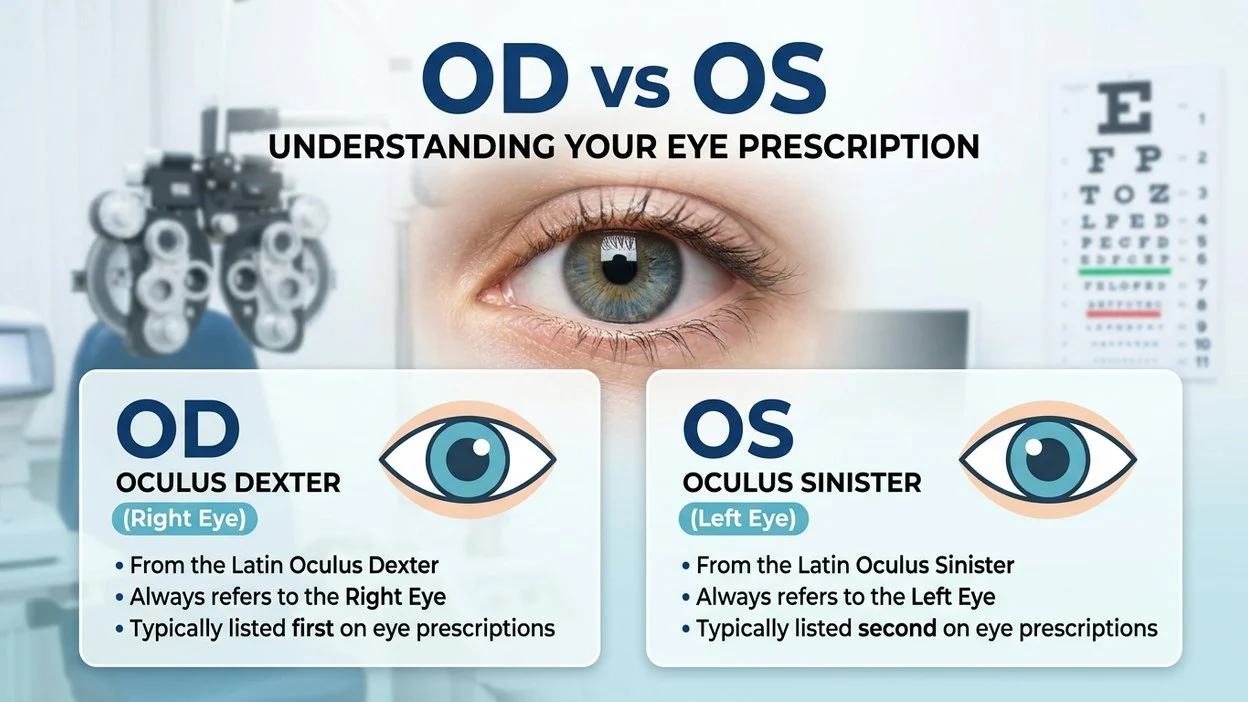
OD and OS are two short abbreviations you will see on almost every eye prescription. OD means the right eye. OS means the left eye. Both come from Latin, which is why they look strange to most English speakers. Once you know the pattern, your prescription becomes much easier to read.
Many people mix these terms up because the letters look alike and the Latin words are not part of everyday English. Others get confused because OD can also mean an overdose, a doctor of optometry, or “once daily” on a medicine label. In this guide, you will learn what each abbreviation stands for, how to tell them apart, and how to read them correctly on a glasses or contact lens prescription.
Quick Answer
OD stands for oculus dexter, which is Latin for right eye. OS stands for oculus sinister, which means left eye. On an eye prescription, OD is usually listed first and OS second. A third term, OU, means both eyes. If a prescription shows different numbers for OD and OS, each eye needs its own lens strength.
Why Do People Confuse OD and OS?
There are a few simple reasons these two terms cause trouble:
- They are Latin. Most English learners and native speakers never study Latin, so the letters feel random.
- They look almost the same. Both start with the letter O, and only the second letter changes.
- They have other meanings. OD is also used for “overdose” and “doctor of optometry.” OS can mean “operating system” or “bone” (os is the Latin word for bone) in other fields.
- The order can feel backwards. The right eye is listed first, but when you look at a paper in front of you, “first” often feels like “left.”
What Does OD Mean?
OD is short for oculus dexter. Oculus means eye, and dexter means right. You may already know the root from English words like dexterity (skill with the hands) and ambidextrous (able to use both hands equally well).
On a prescription, the OD line shows the lens power for your right eye. It is often written as O.D. with periods, but the meaning is the same.
OD can also be used as a title. An OD is a Doctor of Optometry, the professional who tests your eyes and prescribes glasses or contact lenses.
What Does OS Mean?
OS is short for oculus sinister. Sinister is the Latin word for left. In English, “sinister” later took on a negative meaning, but in Latin it simply described the left side.
On a prescription, the OS line shows the lens power for your left eye. You may also see it written as O.S.
OD vs OS: Comparison Table
| Feature | OD | OS |
| Full Latin term | Oculus dexter | Oculus sinister |
| Meaning | Right eye | Left eye |
| Latin root meaning | Dexter = right | Sinister = left |
| Usual position on prescription | First line | Second line |
| Related English word | Dexterity | Sinister |
| Other common meaning | Doctor of Optometry | Operating system (in computing) |
When Should You Use OD and When Should You Use OS?
In everyday speech, most people simply say “right eye” and “left eye.” The abbreviations are mainly for written prescriptions, eye charts, and medical notes. If you are writing a school essay or a casual message, plain English is clearer.
12 Examples of OD and OS in Use
On a prescription:
- OD: −2.00 means your right eye needs a lens power of minus 2.00.
- OS: −1.50 means your left eye needs a lens power of minus 1.50.
- OD: +1.25 −0.50 × 180 gives the right eye’s strength, astigmatism correction, and angle.
- OS: Plano means your left eye needs no lens power.
- OU: −3.00 means both eyes need the same strength.
In sentences:
- “The optometrist wrote OD first because the right eye is always listed before the left.”
- “My OS vision is weaker than my OD vision.”
- “Please check the OD lens. It looks scratched.”
- “The doctor said my OS prescription changed since last year.”
- “Your OD and OS numbers are different, so each lens is made separately.”
- “Dr. Khan, OD, will see you for your eye exam today.”
- “The contact lens box says OS on the left package and OD on the right.”
Common Mistakes with OD and OS
- Swapping the eyes. Reading OD as left and OS as right can lead to wearing a contact lens in the wrong eye.
- Assuming both eyes are the same. Many people have different strengths in each eye, so the two lines often differ.
- Ignoring OU. If you see OU, the same number applies to both eyes.
- Mixing OD with medicine terms. On a drug label, OD (or “od”) can mean once daily, not right eye. Always check the context.
- Reading the numbers without the labels. The minus and plus signs matter just as much as the eye labels.
Memory Trick to Remember OD vs OS
Try these simple tricks:
- D for Dexter, D for “Dominant hand.” Most people are right-handed, and dexter means right. So OD is the right eye.
- S for Sinister, S for “Side” left over. If OD is right, OS is the other side, the left.
- Alphabet order. D comes before S in the alphabet, and the right eye comes before the left eye on most prescriptions.
OD vs OS in American and British English
Both American and British English use OD and OS, because the abbreviations come from Latin and not from either variety of English.
There is one practical difference. In the UK, many opticians now prefer RE (right eye) and LE (left eye), or simply R and L, to avoid mistakes. In the US, OD and OS are still very common on printed prescriptions, though more clinics are switching to plain “right” and “left” too.
Be careful with OD on medicine labels. In British medical writing, “OD” has traditionally meant “once daily,” and health organizations have warned that it can be confused with right eye. That is one reason clear wording is encouraged.
Similar Words and Abbreviations
- OU (oculus uterque): both eyes.
- RE / LE: right eye / left eye, the plain English versions.
- SPH (sphere): the main lens power for nearsightedness or farsightedness.
- CYL (cylinder): the extra power that corrects astigmatism.
- AXIS: the angle, from 1 to 180, for the astigmatism correction.
- ADD: extra magnifying power for reading in bifocal or progressive lenses.
- PD (pupillary distance): the distance between your pupils, in millimeters.
Final Verdict: OD or OS?
Neither one is better, because they describe different eyes. OD is your right eye, and OS is your left eye. Remember that OD is listed first, OS comes second, and OU covers both. If you are ever unsure what a number or label means, ask your eye doctor or optician to explain it before ordering lenses.
Frequently Asked Questions:
What does OD mean on an eye prescription?
OD stands for oculus dexter, the Latin term for right eye. It shows the lens power for your right eye.
Is OD the right or left eye?
OD is the right eye. OS is the left eye.
What does OS mean in an eye exam?
OS stands for oculus sinister, which means left eye. It appears on the line with your left eye’s measurements.
Which comes first on a prescription, OD or OS?
OD usually comes first, followed by OS. This is the standard order for most eye prescriptions.
What does OU mean?
OU stands for oculus uterque, meaning both eyes. It is used when the same measurement applies to each eye.
Why are my OD and OS numbers different?
Most people have slightly different vision in each eye. Your optometrist measures them separately so each lens fits that eye.
Can OD mean something else?
Yes. OD can mean a Doctor of Optometry, an overdose, or “once daily” on some medicine labels. The meaning depends on where you see it.
Remember This
- OD = right eye (oculus dexter)
- OS = left eye (oculus sinister)
- OU = both eyes
- OD is listed first, OS second
- Different numbers for each eye are normal
- Check the context, because OD can mean other things outside eye care
Conclusion:
OD and OS may look confusing at first, but they follow a simple Latin pattern. OD is the right eye, OS is the left eye, and OU means both. Once you remember that the right eye is listed first, reading a prescription becomes much less stressful.
The next time you receive a glasses or contact lens prescription, check each line carefully and match it to the correct eye. If anything looks unclear, ask your optometrist or optician. A quick question can prevent mistakes and help you see clearly.

Reagan Hughes writes inspiring contemporary stories blending hope, emotion, and authentic characters. Her thoughtful novels encourage resilience, compassion, self-discovery, and meaningful connections, captivating readers across diverse audiences worldwide.