
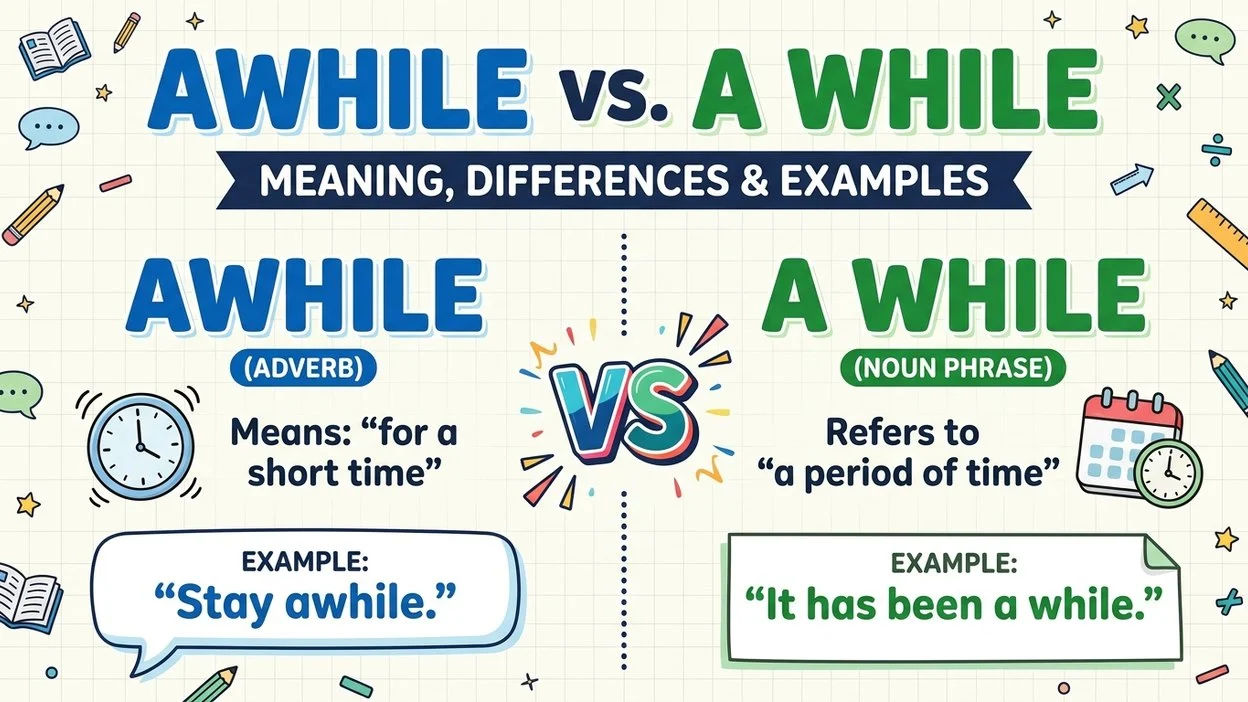
The words “awhile” and “a while” look almost identical, but they have different grammatical uses. Both refer to a period of time, which is why many English learners, students, and even native speakers sometimes confuse them. However, knowing when to write each form can make your sentences clearer and grammatically correct.
The main difference is that “awhile” is an adverb meaning “for a short time,” while “a while” is a noun phrase referring to a period of time. For example, you can say, “Please wait awhile” or “Please wait for a while.” Both sentences are correct, but their grammatical structures are different. Understanding this simple rule will help you choose the correct expression in everyday conversations, emails, school assignments, and professional writing.
Quick Answer
Awhile is one word and means “for a short time.” It is an adverb that describes how long an action happens. A while is two words and refers to a period of time. It usually follows a preposition such as “for.” Example: “Stay awhile” and “Stay for a while.”
Why Do People Confuse Awhile and A While?
People confuse “awhile” and “a while” because both expressions describe time and often communicate almost the same meaning.
For example:
- Please sit awhile.
- Please sit for a while.
Both sentences tell someone to remain seated for some time.
The confusion happens because the difference is grammatical rather than a major difference in meaning.
The easiest way to understand the distinction is to remember:
- Awhile: An adverb that means for a short time.
- A while: A noun phrase that means a period of time.
First Word: Awhile
Awhile is a single word that functions as an adverb. It means “for a short time” or “for some time.”
It describes the duration of an action without needing the preposition “for.”
When Should You Use Awhile?
Use “awhile” when you want to describe how long an action continues.
Examples include:
- Please wait awhile.
- Let’s rest awhile.
- She stayed awhile.
- He sat awhile before leaving.
- You should relax awhile.
In these examples, “awhile” explains the duration of the action.
Simple Definition of Awhile
Awhile = For a short time.
Example: The children played awhile in the garden.
This means the children played in the garden for some time.
Second Word: A While
A while is a two-word noun phrase. The word “while” refers to a period or length of time, and “a” is the article that comes before it.
It commonly appears after prepositions such as “for,” “after,” and “in.”
When Should You Use A While?
Use “a while” when referring to a period of time as a noun phrase.
Examples include:
- Please wait for a while.
- I haven’t seen him in a while.
- She stayed for a while.
- After a while, he started smiling.
- It took a while to finish the project.
Simple Definition of A While
A while = A period of time.
Example: We talked for a while after dinner.
This means we talked for some time after dinner.
Awhile vs A While: Comparison Table
| Feature | Awhile | A While |
| Spelling | One word | Two words |
| Grammar | Adverb | Noun phrase |
| Meaning | For a short time | A period of time |
| Main purpose | Describes duration | Refers to a length of time |
| Common usage | After verbs | Often after prepositions |
| Example | Wait awhile. | Wait for a while. |
| Correct phrase | Rest awhile. | Rest for a while. |
| Common mistake | Using it after “for” | Forgetting “for” when needed |
When to Use Each
Understanding the correct situations for “awhile” and “a while” makes English writing easier.
When to Use Awhile
Use “awhile” when it works as an adverb meaning “for a short time.”
Examples:
- Stay awhile.
- Let’s talk awhile.
- He rested awhile.
- Sit awhile and enjoy the view.
Remember: You generally do not need to put “for” directly before “awhile.”
When to Use A While
Use “a while” when you are talking about a period of time as a noun phrase.
Examples:
- Wait for a while.
- I haven’t visited for a while.
- It happened a while ago.
- After a while, the rain stopped.
Remember: If you can use “a period of time” in place of the expression, “a while” is usually the correct choice.
12 Examples of Awhile vs A While in Sentences
Here are 12 practical examples to help you understand the difference.
Examples of Awhile
- Please sit awhile and enjoy the sunshine.
- She decided to rest awhile after work.
- Let’s stay awhile before going home.
- He waited awhile for his friend.
- You can relax awhile before starting your homework.
- The baby slept awhile in the afternoon.
Examples of A While
- I haven’t seen my cousin for a while.
- We waited for a while outside the restaurant.
- After a while, everyone started laughing.
- It took me a while to understand the lesson.
- She has been working here for a while.
- I haven’t visited that place in a while.
These examples show that “awhile” works as an adverb, while “a while” functions as a noun phrase.
Common Mistakes When Using Awhile and A While
Even experienced English writers sometimes use these expressions incorrectly. Here are some common mistakes to avoid.
Mistake 1: Writing “For Awhile”
Incorrect: Please wait for awhile.
Correct: Please wait awhile.
Correct: Please wait for a while.
Explanation: The word “awhile” already means “for a short time,” so adding “for” directly before it is generally unnecessary and grammatically incorrect in standard usage.
Mistake 2: Writing “Stay A While” When Using the Adverb
Incorrect: Please stay a while.
Correct: Please stay awhile.
However, “Please stay for a while” is also correct.
Explanation: When using the adverb, write “awhile” as one word. When using the noun phrase, write “a while” as two words.
Mistake 3: Confusing “A While Ago” and “Awhile Ago”
Incorrect: I met her awhile ago.
Correct: I met her a while ago.
Explanation: Use “a while” because the expression refers to a period of time in the past.
Mistake 4: Forgetting the Preposition
Incorrect: We talked a while after lunch.
Better: We talked for a while after lunch.
Also correct: We talked awhile after lunch.
Explanation: Use the noun phrase with “for,” or use the adverb without it.
Memory Trick: How to Remember Awhile vs A While
Here is an easy trick to remember the difference.
Awhile = One word = Adverb
Think of “awhile” as meaning “for a short time.”
Example: Stay awhile.
A While = Two words = Period of time
Think of “a while” as a noun phrase referring to a length of time.
Example: Stay for a while.
Quick Memory Test
Ask yourself:
Can I replace the expression with “for a short time”?
- If yes, “awhile” may be correct when no additional “for” is needed.
- If the sentence uses “for a period of time,” write “a while.”
American vs British English
There is no major spelling difference between American and British English when using “awhile” and “a while.”
Both forms are recognized in standard American and British English.
The grammatical rules are also the same:
- Awhile: One-word adverb.
- A while: Two-word noun phrase.
Examples in both varieties:
American English: I’ll wait awhile.
British English: I’ll wait for a while.
Both forms are grammatically correct in their respective sentence structures. The choice depends on grammar, not geographical location.
Similar Words and Expressions
Several English expressions are related to “awhile” and “a while.” Understanding them can improve your vocabulary.
- For a moment: Refers to a very short period of time.
- For some time: Refers to an unspecified period.
- For a short time: Describes a brief duration.
- Temporarily: Means something happens for a limited period.
- Briefly: Means for a short duration.
- A moment: A very short period of time.
- A little while: An informal expression referring to a short period.
- After some time: Refers to something happening later.
Example: Instead of saying, “Please wait awhile,” you can say, “Please wait for a short time.”
Final Verdict: Awhile vs A While
The difference between “awhile” and “a while” is simple once you understand their grammatical roles.
Awhile is a one-word adverb meaning “for a short time.” Use it to describe how long an action happens.
A while is a two-word noun phrase referring to a period of time. It commonly appears after prepositions such as “for” and “in.”
Both expressions are correct, but they cannot always replace each other without changing the sentence structure.
FAQs:
1. Is awhile one word or two words?
“Awhile” is one word. It is an adverb that means “for a short time.” For example: “Please wait awhile.”
2. Is it correct to say for awhile or for a while?
“For a while” is the standard correct expression. “For awhile” is generally considered incorrect in standard edited English because “awhile” already means “for a short time.”
3. What is the difference between awhile and a while?
“Awhile” is an adverb meaning “for a short time,” while “a while” is a noun phrase referring to a period of time. For example, “Stay awhile” and “Stay for a while.”
4. Is awhile grammatically correct?
Yes, “awhile” is grammatically correct when used as an adverb. Example: “She rested awhile before continuing her journey.”
5. Is it a while ago or awhile ago?
The correct expression is “a while ago.” It refers to an unspecified period of time before the present.
Example: I visited my hometown a while ago.
6. Should I write wait awhile or wait a while?
Both can be correct, depending on the sentence structure. “Wait awhile” uses the adverb, while “wait for a while” uses the noun phrase. “Wait a while” is also accepted in common English usage.
7. Is awhile formal or informal?
“Awhile” is a standard English word and can be used in both formal and informal writing. However, “a while” is often more common in expressions such as “for a while” and “a while ago.”
Remember This
Keep these simple rules in mind:
- Awhile: One word, an adverb meaning “for a short time.”
- A While: Two words, a noun phrase meaning “a period of time.”
- For awhile: Generally incorrect in standard edited English.
- For a while: Correct.
- A while ago: Correct.
- Stay awhile: Correct.
The easiest way to remember the difference is that “awhile” describes duration, while “a while” names a period of time.
Conclusion:
Understanding “awhile vs a while” is easy when you focus on grammar instead of spelling. Although both expressions communicate a similar idea, they serve different grammatical purposes. “Awhile” is an adverb used to describe an action that continues for a short time, while “a while” is a noun phrase that refers to a period of time.
To avoid mistakes, remember that “stay awhile” and “stay for a while” are both correct, but “for awhile” is generally not accepted in standard edited English. Practice using these expressions in everyday sentences, and you will quickly become more confident when choosing between them.

Autumn Gray is a bestselling storyteller admired for emotional novels, expressive writing, and memorable characters. Her inspiring books celebrate love, resilience, hope, and the transformative power of imagination and literature.