
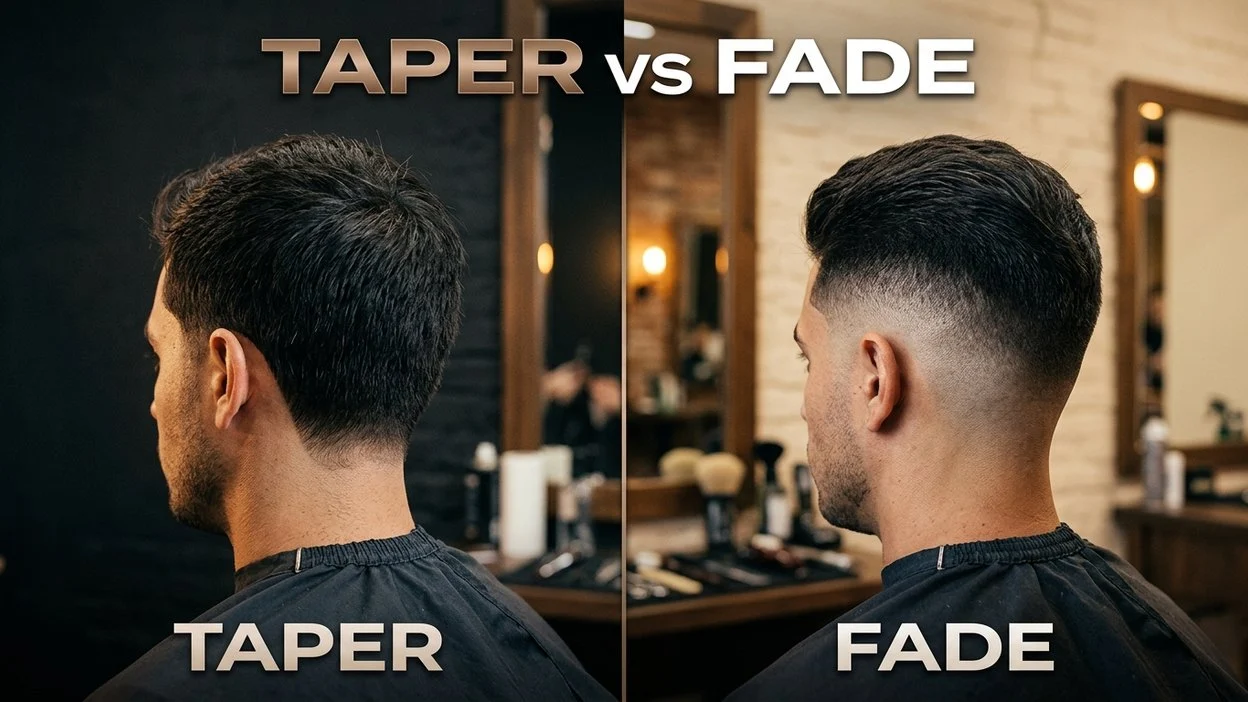
Choosing between a taper and a fade can be confusing, especially if you are getting a haircut for the first time. Both styles create a gradual change in hair length, but they differ in how much hair is removed and how the sides and back look. Understanding the difference between a taper vs fade can help you choose a haircut that matches your personal style.
A taper gradually shortens the hair around specific areas, usually the sideburns and neckline, while leaving more length on the sides and back. A fade blends the hair from longer lengths into very short hair, often down to the skin. Both haircuts can look clean and modern, but the final result depends on the fade height, taper placement, hair texture, and styling preference. Whether you prefer a subtle, professional appearance or a sharp, modern look, knowing how these haircuts work will help you explain exactly what you want to your barber.
Quick Answer
A taper gradually shortens hair around the sideburns and neckline while keeping more length on the sides and back. A fade blends the sides and back into progressively shorter hair, sometimes down to bare skin. Choose a taper for a subtle, classic look or a fade for a sharper, more noticeable finish.
Why Do People Confuse Taper and Fade?
People confuse taper and fade because both haircuts use a gradual transition between different hair lengths. Barbers use clippers, guards, and blending techniques to create both styles.
However, the main difference is the area of the haircut and how short the hair becomes.
A traditional taper usually focuses on the sideburns and neckline. The rest of the hair remains relatively full. A fade generally extends farther up the sides and back, creating a more noticeable transition.
There is some overlap between the terms. For example, a low fade can look similar to a taper, and barbers may use the terms differently. Explaining the desired length and placement is often more helpful than relying on the haircut’s name alone.
First Word: Taper
A taper is a haircut technique in which the hair gradually becomes shorter toward particular areas, especially the sideburns and neckline.
The hair around the temples and neck is shortened neatly, while the sides and back usually retain more length than they would in a typical fade.
What Does a Taper Haircut Look Like?
A taper usually creates a natural, understated appearance. The transition is concentrated around the edges rather than extending high up the head.
Common taper styles include:
- Classic taper: A traditional, neat haircut with gradually shorter hair around the sideburns and neckline.
- Low taper: A subtle transition near the ears and lower neckline.
- Temple taper: A shorter blend around the temples and sideburns.
- Taper with textured top: Longer, textured hair on top combined with clean edges.
- Taper with a side part: A classic style that works well in professional settings.
Who Should Choose a Taper?
A taper may suit you if you want a clean haircut without making the sides extremely short. It works well with many hairstyles, including short crops, side parts, curls, waves, and longer hair on top.
It is also a useful option for people who prefer a conservative haircut for school, work, or formal occasions.
Second Word: Fade
A fade is a haircut in which the hair gradually transitions from longer lengths on top to shorter lengths along the sides and back. Depending on the style, the hair may blend down to very short stubble or completely bare skin.
Unlike a traditional taper, a fade often covers a larger area of the head.
What Does a Fade Haircut Look Like?
A fade creates a sharper contrast between the hair on top and the sides. The transition can begin low near the ears, around the middle of the head, or high near the temples.
Common fade styles include:
- Low fade: The transition begins close to the ears and neckline.
- Mid fade: The transition begins around the middle of the sides.
- High fade: The shorter section extends higher up the sides.
- Skin fade: The hair gradually blends down to bare skin.
- Drop fade: The fade curves downward behind the ears, following the shape of the head.
- Burst fade: The fade forms a curved pattern around the ears.
- Taper fade: A style that combines tapering around the edges with fading through the sides or back.
Who Should Choose a Fade?
A fade may suit you if you prefer a modern, defined haircut with shorter sides. It pairs well with textured crops, pompadours, quiffs, curly tops, buzz cuts, and many other styles.
The best fade height depends on your preferred appearance, hair texture, head shape, and how much contrast you want.
Taper vs Fade: Comparison Table
| Feature | Taper | Fade |
| Main meaning | Gradually shortens selected areas | Gradually blends hair across a larger area |
| Typical location | Sideburns and neckline | Sides and back, often extending higher |
| Hair length | Usually keeps more length on the sides | Often much shorter on the sides |
| Appearance | Subtle and classic | Sharp and modern |
| Skin exposure | Usually little or none | Possible, especially with a skin fade |
| Contrast | Generally lower | Often more noticeable |
| Styling options | Side parts, curls, textured tops, classic cuts | Crops, quiffs, pompadours, buzz cuts |
| Professional settings | Often a conservative choice | Can also look professional, depending on the style |
| Maintenance | Often easier to grow out naturally | Short fades may need frequent touch-ups |
| Best for | People who prefer understated edges | People who want defined, shorter sides |
When Should You Use Each Style?
When Should You Choose a Taper?
Choose a taper if you want a neat haircut that keeps the sides and back relatively full.
A taper may be the better option when:
- You prefer a classic or professional appearance.
- You want to keep more hair around the sides.
- You have longer hair on top and want clean edges.
- You prefer a gradual grow-out.
- You want a subtle change rather than a dramatic haircut.
Example: If you have medium-length hair with a side part, a classic taper can clean up the neckline and sideburns without removing too much hair.
When Should You Choose a Fade?
Choose a fade if you want shorter sides with a clearly blended transition.
A fade may be the better option when:
- You prefer a sharp, modern appearance.
- You want a strong contrast between the top and sides.
- You like short crops or textured hairstyles.
- You want the sides to look especially clean.
- You prefer a low, mid, high, or skin fade.
Example: If you wear a textured crop with short sides, a low or mid fade can create a defined shape while keeping the top prominent.
12 Examples of Taper vs Fade Hairstyles
1. Classic Taper vs Low Fade
A classic taper keeps the transition concentrated around the edges. A low fade extends the short blend farther across the lower sides.
2. Low Taper vs Mid Fade
A low taper gives a subtle finish around the temples and neckline. A mid fade creates a more noticeable transition around the middle of the head.
3. Temple Taper vs High Fade
A temple taper cleans up the hair around the temples and sideburns. A high fade moves the shorter blend farther up the sides.
4. Taper with a Side Part vs Fade with a Side Part
A taper gives a traditional, polished appearance. A fade adds contrast and can make the hairstyle look more contemporary.
5. Taper with Curly Hair vs Curly Top with Fade
A taper preserves more fullness around the sides. A fade creates a stronger contrast between the curls on top and the shorter sides.
6. Taper with Wavy Hair vs Wavy Hair with Fade
A taper keeps the overall shape fuller and more natural. A fade emphasizes the waves on top by reducing the hair around the sides.
7. Taper with Straight Hair vs Straight Hair with Fade
A taper works well with classic, combed hairstyles. A fade can give straight hair a more structured and defined appearance.
8. Taper with a Buzz Cut vs Buzz Cut with Fade
A tapered buzz cut maintains a relatively even appearance with neat edges. A faded buzz cut creates a more visible change in length around the head.
9. Taper with a Textured Crop vs Textured Crop with Fade
A taper provides a softer finish around the ears and neckline. A fade gives the textured crop sharper contrast.
10. Taper with a Pompadour vs Pompadour with Fade
A taper keeps the sides fuller beneath the longer top. A fade makes the pompadour stand out by shortening the sides more dramatically.
11. Taper with a Beard vs Fade with a Beard
A taper can connect neatly with a beard while maintaining a natural appearance. A fade can create a more defined transition between the haircut, sideburns, and beard.
12. Taper for Work vs Fade for Everyday Style
A classic taper is a reliable choice for people who prefer a conservative haircut. A fade can work equally well for work or everyday life, depending on its height and how short it is.
Common Mistakes When Choosing a Taper or Fade
Mistake 1: Thinking They Are Exactly the Same
Both involve gradual blending, but a taper usually focuses on the edges, while a fade typically extends across more of the sides and back.
Mistake 2: Assuming Every Fade Goes Down to the Skin
A skin fade reaches bare skin, but other fades can finish with very short hair rather than a completely shaved area.
Mistake 3: Assuming a Taper Must Be Long
A taper can be subtle or relatively short. The defining feature is where the hair is tapered, not simply how long it is.
Mistake 4: Choosing a Fade Without Specifying Its Height
A low fade and a high fade can look very different. Tell your barber where you want the transition to begin.
Mistake 5: Ignoring Hair Texture
Curly, wavy, straight, and thick hair can produce different results with the same haircut technique. Discuss how your hair grows and how you usually style it.
Mistake 6: Using Only the Haircut Name
Barbers may interpret terms differently. A reference photo and a clear description of the desired length can help you get a more predictable result.
Memory Trick: How to Remember Taper vs Fade
Use this simple memory trick:
Taper = Tidy edges
Think of a taper as cleaning up the sideburns and neckline while keeping more fullness elsewhere.
Fade = Fewer hairs across the sides
Think of a fade as blending the sides and back progressively shorter, sometimes down to the skin.
Remember:
- Taper: More subtle, concentrated around the edges.
- Fade: More extensive, often shorter across the sides and back.
This is a general guide rather than an absolute rule because some haircuts combine both techniques.
American vs British English
The terms taper and fade are commonly used in American English when discussing men’s haircuts. Both are also understood in British barbershops, particularly where modern barbering styles are popular.
In the United Kingdom, customers may also describe a haircut as a tapered cut, a skin fade, or simply a fade. The exact terminology can vary between barbers and local styles.
The important distinction remains the same: a taper generally focuses on selected edges, while a fade creates a gradual transition across a larger area.
Similar Haircut Terms
Understanding related haircut terms can make it easier to explain your preferred style.
- Taper fade: A haircut combining tapering around the edges with a fade through the sides or back.
- Skin fade: A fade that blends the hair down to bare skin.
- Low fade: A fade that begins close to the ears and neckline.
- Mid fade: A fade that begins around the middle of the sides.
- High fade: A fade that begins higher up the sides.
- Temple fade: A short blend around the temples and sideburns.
- Undercut: A hairstyle with a more noticeable separation between the longer top and the shorter sides.
- Crew cut: A short hairstyle with a relatively close-cut top and sides.
- Buzz cut: A short haircut usually created with clippers.
- Line-up: A technique that creates clean, defined edges around the forehead and temples.
Final Verdict: Is a Taper or Fade Better?
Neither haircut is automatically better. The right choice depends on how much length you want to keep, how sharp you want the sides to look, and how often you are willing to maintain the haircut.
Choose a taper if you prefer a natural, classic appearance with neat edges and more fullness on the sides. Choose a fade if you want shorter sides, a more noticeable blend, or the option of a skin-close finish.
If you are unsure, ask your barber for a low taper or low fade and discuss how much hair you want removed. A reference photo can help you decide which result suits you best.
FAQs:
1. What is the main difference between a taper and a fade?
A taper gradually shortens the hair around selected areas, usually the sideburns and neckline. A fade blends the hair progressively shorter across the sides and back, sometimes down to bare skin.
2. Is a taper better than a fade?
A taper may be better if you prefer a subtle, classic haircut that keeps more length on the sides. A fade may be better if you want shorter sides and a sharper appearance. Neither is universally better.
3. Does a taper last longer than a fade?
A taper may grow out more naturally because the transition is concentrated around the edges. A short or skin fade can show regrowth more quickly and may need more frequent touch-ups. Actual maintenance depends on hair growth and the chosen style.
4. What is a taper fade?
A taper fade combines features of both styles. It may have a gradual fade through the sides and back with a tapered finish around the sideburns or neckline. The exact result depends on the barber’s technique and the requested style.
5. Is a low taper the same as a low fade?
No. A low taper generally focuses on the sideburns and neckline, while a low fade usually extends the blended transition farther across the lower sides and back. The results can look similar, depending on the haircut.
6. Which haircut is best for curly hair?
Both can work well with curly hair. A taper preserves more fullness around the sides, while a fade creates stronger contrast with the curls on top. Your preferred shape and styling routine should guide the choice.
7. Can I get a taper and a fade together?
Yes. A taper fade combines elements of both techniques. You can ask for a particular fade height and a clean, tapered finish around the sideburns and neckline.
8. What should I tell my barber if I want a taper instead of a fade?
Tell your barber that you want a taper around the sideburns and neckline while keeping the sides relatively full. If you have a specific look in mind, show a reference photo and explain how short you want the hair around the ears and neck.
Remember This
The easiest way to understand taper vs fade is to remember where the hair becomes shorter.
- Taper: Gradual shortening around the sideburns and neckline.
- Fade: Gradual shortening across more of the sides and back.
- Taper fade: A combination of both techniques.
A taper usually looks more understated, while a fade often creates more contrast. Both can be styled in many ways, and the best option depends on your personal preference.
Conclusion:
A taper and a fade are two popular haircut techniques that create a gradual change in hair length. The main difference is how far the shorter blend extends. A taper usually keeps the sides fuller and focuses on neat edges, while a fade often makes the sides and back progressively shorter for a more defined finish.
Before your next haircut, consider your preferred style, hair texture, daily routine, and maintenance needs. Explain the desired length and placement to your barber, and use a reference photo if possible. With the right approach, both a taper and a fade can create a clean, stylish haircut.

Delaney Brooks is a contemporary author celebrated for heartfelt fiction, vivid storytelling, and relatable characters. Her engaging novels inspire readers through emotional depth, creativity, resilience, and memorable literary journeys.