
Introduction
Llamas and alpacas are closely related South American camelids, so it is easy to confuse them. Both have long necks, soft wool, four legs, and a similar overall appearance. They are also domesticated animals that have been important to people in the Andes for centuries. However, a llama and an alpaca are not the same animal. They differ in size, body shape, fiber, behavior, and traditional uses.
The easiest way to remember the difference is this: llamas are larger and were traditionally used mainly as pack animals, while alpacas are smaller and are especially valued for their soft, fine fiber. Their ears, faces, and body proportions can also help you identify them. Once you know a few simple features, telling a llama from an alpaca becomes much easier.
Quick Answer
A llama is generally larger, taller, and more strongly built than an alpaca. Llamas have longer, more curved ears and are traditionally associated with carrying loads. Alpacas are smaller, have shorter ears and rounder faces, and are mainly raised for their soft, fine fiber.
Why Do People Confuse Llamas and Alpacas?
People often confuse llamas and alpacas because both belong to the camelid family and are native to South America. They share several physical features, including long necks, woolly coats, padded feet, and similar body shapes.
They are also closely related. Both are domesticated descendants of wild South American camelids, and both have been raised by Andean communities for a very long time.
The most useful clues are size, ears, face shape, and purpose.
What Is a Llama?
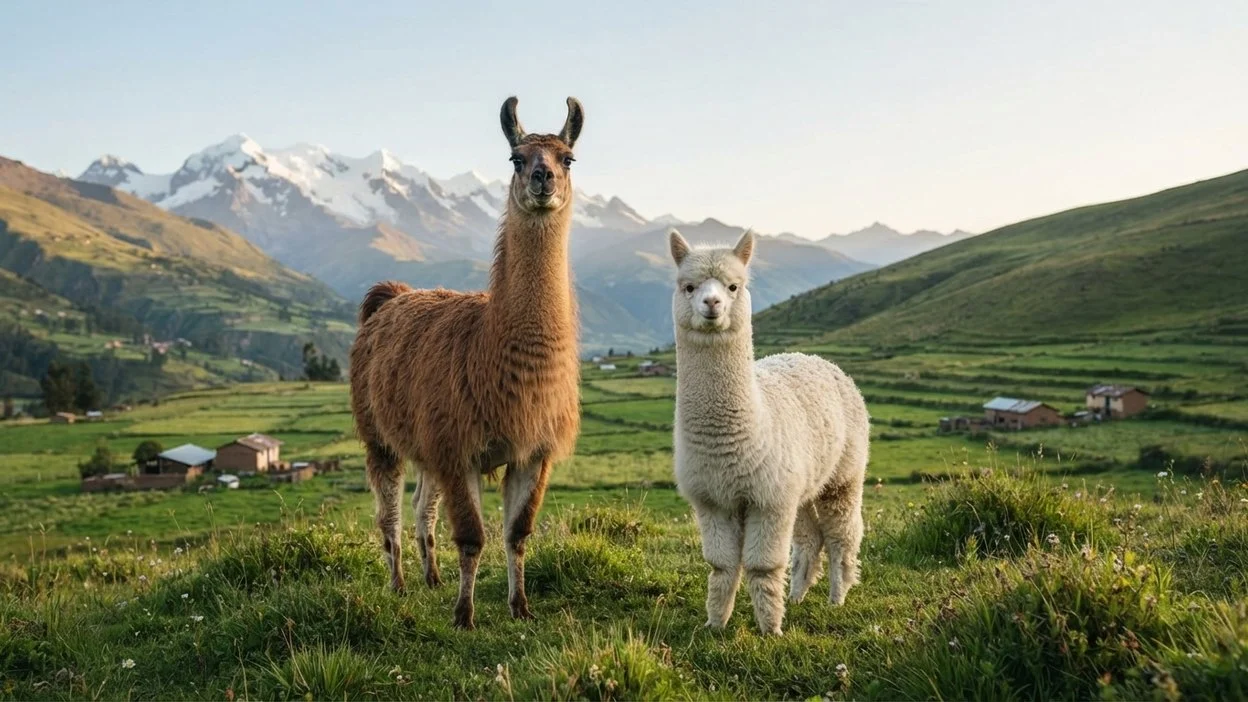
A llama is a large domesticated South American camelid. It is generally taller and heavier than an alpaca and has a longer, more pronounced face.
Llamas have relatively long, curved, banana-shaped ears. Their bodies are strong and well suited to carrying loads.
Historically, llamas have been important as pack animals in the Andes. They are also kept for fiber, meat, and companionship.
Key features of a llama
- Usually larger and taller than an alpaca
- Long, curved ears
- Longer face
- Stronger, more athletic build
- Coarser fiber than alpaca fiber
- Traditionally used as pack animals
- Can come in many coat colors and patterns
What Is an Alpaca?
An alpaca is a smaller domesticated South American camelid best known for its high-quality fiber.
Alpacas generally have shorter ears, a rounder face, and a more compact body than llamas. Their thick fleece can be extremely soft and is used to make clothing, blankets, yarn, and other textiles.
Alpacas are commonly associated with two recognized fiber types: Huacaya and Suri. Huacaya alpacas have a dense, fluffy fleece, while Suri alpacas have longer, silky locks.
Key features of an alpaca
- Smaller and shorter than a llama
- Shorter, straighter ears
- Rounder face
- More compact body
- Very soft, fine fiber
- Mainly raised for fiber
- Commonly classified as Huacaya or Suri
Llama vs Alpaca: Comparison Table
| Feature | Llama | Alpaca |
| Size | Larger and taller | Smaller and shorter |
| Typical build | Strong and athletic | Compact and rounded |
| Face | Longer | Shorter and rounder |
| Ears | Longer and curved | Shorter and straighter |
| Main traditional use | Carrying loads | Fiber production |
| Fiber | Generally coarser | Generally finer and softer |
| Common fiber types | No equivalent two-type classification | Huacaya and Suri |
| Temperament | Often confident and alert | Often gentle and social |
| Scientific species | Lama glama | Vicugna pacos |
| Native region | Andes of South America | Andes of South America |
When Should You Use Each?
Because llama and alpaca are names for different animals, you should choose the word based on the animal you are describing.
Use llama when you mean the larger South American camelid, especially when discussing its traditional role as a pack animal.
Use alpaca when you mean the smaller camelid known particularly for its soft fleece.
Use “llama” for:
- A large pack animal
- A camelid with long, curved ears
- A discussion of llama fiber
- A llama farm or sanctuary
- The species Lama glama
Use “alpaca” for:
- A smaller, woolly camelid
- Fine alpaca fiber
- Alpaca clothing
- Huacaya or Suri animals
- The species Vicugna pacos
Llama vs Alpaca: 10+ Examples
- The llama carried supplies across the mountain trail.
- The alpaca had a thick, soft fleece.
- That llama is much taller than the alpacas.
- She bought a warm scarf made from alpaca fiber.
- The farmer keeps llamas as livestock guardians.
- We saw several alpacas at the farm.
- The llama’s long ears made it easy to identify.
- The alpaca had a round face and fluffy coat.
- Llamas were traditionally used to transport goods in the Andes.
- Alpacas are widely valued for their fine fiber.
- The children learned how to tell a llama from an alpaca.
- The Suri alpaca had long, silky locks of fiber.
Common Mistakes
Mistake 1: Thinking llamas and alpacas are the same animal
They are closely related, but they are different species.
Correct: “A llama is generally larger than an alpaca.”
Mistake 2: Assuming every woolly camelid is an alpaca
Coat thickness alone is not enough to identify the animal. Size, ears, and facial shape can provide better clues.
Mistake 3: Thinking alpacas cannot be different colors
Alpacas can have a wide variety of natural coat colors.
Mistake 4: Using “wool” as if it means exactly the same thing for both animals
People commonly use “wool” informally for animal fiber, but technically, llama and alpaca fiber is often called fiber or fleece.
Mistake 5: Assuming llamas are only used for carrying loads
Llamas have other uses, including fiber production, livestock guarding, and companionship.
Memory Trick
Remember:
Llama = Large
Both words begin with L, so think “Llama = Larger.”
Alpaca = Adorable and smaller
This is not a scientific rule, but it is an easy memory aid for beginners.
You can also remember:
Long ears → Llama
Shorter ears → Alpaca
American vs British English
There is no major American-versus-British English difference in the words llama and alpaca. Both terms are used in American and British English to refer to the same animals.
The spelling is generally the same in both varieties:
- American English: llama, alpaca
- British English: llama, alpaca
Pronunciation can vary slightly by speaker or accent, but the meanings do not change.
Similar Words
Several words are related to llamas and alpacas, but they do not mean exactly the same thing.
- Camel — a different group of camelids, generally associated with Africa and Asia.
- Vicuna — a wild South American camelid closely related to the alpaca.
- Guanaco — a wild South American camelid closely related to the llama.
- Camelid — the broader animal family that includes camels, llamas, alpacas, vicunas, and guanacos.
- Fleece — the woolly coat or fiber harvested from an animal.
- Fiber — the material obtained from an animal’s coat and used in textiles.
Final Verdict
The simplest distinction is size and purpose. A llama is usually the larger animal, with longer curved ears and a stronger build. An alpaca is generally smaller, with shorter ears, a rounder face, and a particularly fine fleece.
If you see a large, long-eared camelid, it is more likely to be a llama. If you see a smaller, fluffy animal with a compact body and soft fleece, it is more likely to be an alpaca.
Frequently Asked Questions
1. Are llamas and alpacas the same animal?
No. Llamas and alpacas are different domesticated South American camelids. Llamas are generally larger, while alpacas are smaller and particularly valued for their fine fiber.
2. Which is bigger, a llama or an alpaca?
A llama is generally bigger. Llamas are taller and more heavily built, while alpacas have a smaller and more compact body.
3. Can llamas and alpacas breed with each other?
Yes. Llamas and alpacas can produce hybrids because they are closely related camelids. One commonly known hybrid is called a huarizo.
4. Are alpacas softer than llamas?
Generally, yes. Alpaca fiber is usually finer and softer than typical llama fiber, although fiber quality can vary between individual animals.
5. Do llamas spit?
Both llamas and alpacas can spit. This behavior is usually associated with defense, social conflict, or irritation rather than being a normal action toward people.
6. Are alpacas related to llamas?
Yes. Alpacas and llamas are closely related. They are both domesticated South American camelids and share common ancestry with wild camelids such as the vicuna and guanaco.
7. Which animal is used for wool?
Both can provide useful animal fiber, but alpacas are especially valued for their fine fiber. Llamas can also produce fiber, although its characteristics vary among animals.
8. How can you tell a llama from an alpaca?
Look at the animal’s size, ears, and face. Llamas are usually larger, have longer curved ears, and have longer faces. Alpacas are smaller, with shorter ears and rounder faces.
Remember This
Llama = larger, longer ears, stronger build, traditional pack animal.
Alpaca = smaller, shorter ears, rounder face, prized for fine fiber.
Conclusion
Llamas and alpacas may look similar at first, but several clear differences make them easier to identify. Llamas are generally larger and stronger, with longer curved ears and a longer face. Alpacas are smaller and more compact, with shorter ears and a rounder appearance.
Both animals are important domesticated camelids from South America, and both have a long connection with Andean communities. The easiest memory trick is simple: think “Llama = Larger” and remember that alpacas are especially famous for their soft, fine fiber.

Sloane Miller creates captivating fiction filled with suspense, emotion, and unforgettable moments. Her engaging storytelling reflects determination, originality, and imagination, leaving readers inspired long after every novel concludes.